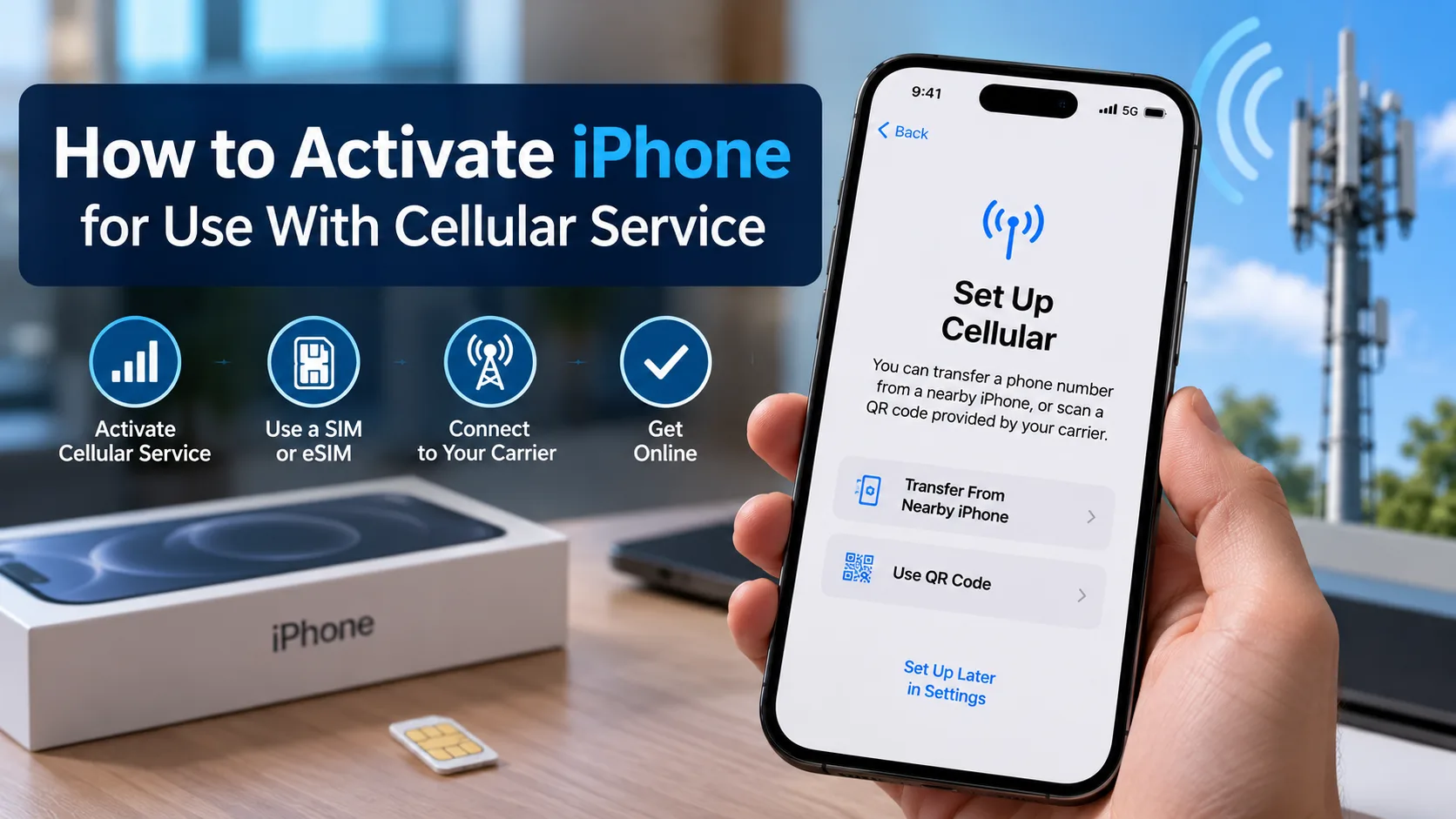


iPhones can lock you out in two very different ways. If you see “iPhone Locked To Owner,” that points to Activation Lock. Carrier Lock is something else. One protects your Apple account and data, the other limits which mobile network you can use. Both matter if you are buying a preowned device or trying to switch networks.
Key Takeaways
- “iPhone Locked to Owner” means the phone is tied to an Apple ID with Activation Lock, and it needs the original owner’s password to use.
- Carrier Lock keeps your iPhone on one network and blocks SIM cards from other carriers until payments or contract terms are complete.
- Activation Lock shows up during setup or under Find My settings; Carrier Lock status appears under Settings > General > About as “No SIM restrictions.”
- Only Apple can remove Activation Lock with the correct Apple ID or valid proof of purchase. Only your carrier can remove a carrier lock after you meet their rules.
- Check both locks before buying a preowned iPhone so you are not stuck with a phone you cannot activate or use on your carrier.
What Does “iPhone Locked to Owner” Mean?
“iPhone Locked to Owner” means the device is still linked to someone’s Apple ID through Activation Lock. During setup, the phone asks for that Apple ID and password. If you bought the device used and cannot get those details, setup stops right there.
What is iCloud Activation Lock?
Activation Lock is a security feature that ties an iPhone to a specific Apple ID. Turning on Find My iPhone turns this lock on automatically. After that, no one can set up, erase, or reactivate the phone without the right Apple ID password or, in some cases, the device passcode.
This helps block thieves and protects your data. The owner can remove the lock by signing in with their Apple ID on the device or at iCloud.com. Apple Support can also help, but they require solid proof of purchase.
“If your iPhone is ever lost, only you should hold the keys to unlock it.” You can still locate, lock, or erase the phone remotely, which keeps your information safer.
📖 Also Read: AT&T eSIM Unlock Done But “Unable To Activate”? Do This Next
How Does Find My iPhone Enable Activation Lock?
Find My iPhone is the switch that turns Activation Lock on. Once enabled, the device pairs with your Apple ID and stays that way. If someone tries to erase the phone or set it up again, they must enter that Apple ID password or the correct passcode.
This protects your account and location features. It also stops anyone from disabling Find My or signing out of iCloud without proper login details. In short, your Apple ID becomes the gatekeeper for setup and reset actions.
Why Is Activation Lock Important for Security?
Activation Lock protects your privacy and your purchase. A thief cannot make the phone useful without your Apple ID password. Even a factory reset will not help them complete setup.
That means your data is harder to reach, and your device is less attractive to steal. It keeps honest buyers safer too, since a locked device should raise a red flag before money changes hands.
What is a Carrier Lock?
A carrier lock ties your iPhone to one mobile network, like a gate that opens only for one pass. Until the lock is removed, other carriers’ SIM cards will not work.
What Does Carrier Lock Mean?
Carrier lock, sometimes called SIM lock, means the phone will work only with SIM cards from one carrier. This is common with devices bought on payment plans or with discounts. Carriers use it to make sure phones stay on their network until you finish the deal.
To check, go to Settings, tap General, then About. If you see “No SIM restrictions,” the iPhone is unlocked and ready for any compatible network.
If it ain’t unlocked, you’re not moving far, someone at the local phone store might say with a wink.
Removing the lock usually means you must pay off the phone first, then ask the carrier for an unlock. Proof of purchase may be required.
📖 Also Read: How To Unlock A Phone From A Deceased Account
How Does Carrier Lock Limit Cellular Network Use?
A carrier lock stops the device from using other networks’ SIM cards. Insert a SIM from a different provider, and the phone will not connect. For instance, a phone locked to AT&T will not work on T-Mobile or Verizon until it is unlocked.
Checking is simple. Open Settings, choose General, then About. If it says “No SIM restrictions,” you can switch carriers freely. If not, contact your current carrier and meet their unlock requirements first.
Why Are Devices Carrier Locked?
Carriers lock devices to protect their discounts and payment plans. A lower upfront price often comes with a commitment. The lock keeps the phone on that network until the bill is paid off or the contract ends.
After you meet the carrier’s rules, most providers will unlock the phone on request. That gives you freedom to change networks, especially helpful for travel or resale.
Key Differences Between iCloud Activation Lock and Carrier Lock
These two locks sound similar, but they solve different problems. Think of one as a door key for your account, and the other as a pass for a specific network.
Purpose and Functionality
Activation Lock guards your Apple account and data. It links the iPhone to your Apple ID, so nobody can set it up or erase it without the right login. That protects your privacy and your device ownership.
Carrier Lock controls mobile network use. It limits the SIM card to a single carrier until you meet payment or contract terms. It does not care who owns the phone, only which network it is allowed to use.
Activation Methods
Activation Lock turns on when you enable Find My iPhone. From then on, Apple ID login or device passcode is required for key actions like setup, erase, or disabling Find My.
Carrier Lock is set by the carrier, usually when the phone is sold on a plan. The lock blocks other carriers’ SIM cards until it is removed by the provider.
Removal Processes
To remove Activation Lock, you need the correct Apple ID and password, the device passcode, or valid proof of purchase for Apple Support. Apple is the only party that can clear this lock.
To remove Carrier Lock, you must meet the carrier’s rules, such as paying off the device, then request an unlock. Only the carrier can lift their network restriction.
📖 Also Read: Visible Wireless Unlock Requirements For ESIM: Don’t Miss Out!
How to Check for iCloud Activation Lock
Worried you might have an Activation Lock roadblock? A quick check now can save you from a dead end later.
How Can You Tell if Your iPhone is Locked to Owner?
If the phone shows “iPhone Locked to Owner” during setup and asks for an Apple ID, Activation Lock is on. That means the device is still linked to the previous owner’s account.
Trying a different Apple ID will not work. No passcode, SIM swap, or factory reset will bypass this lock. You need the original credentials or help from Apple with proof of purchase.
How to Verify Activation Lock in iPhone Settings
You can confirm Activation Lock by checking Find My and related account settings. Do this before buying or selling.
- Open Settings and tap your name at the top. This opens your Apple ID details.
- Tap Find My and check if Find My iPhone is on. If it is on, Activation Lock is active for that account.
- If you are setting up the phone and see a screen asking for the previous owner’s Apple ID, it is locked to that owner.
- If you have access to the linked Apple ID, sign in at iCloud.com, remove the device from the account, then set it up again.
- Still unsure? Contact Apple Support and ask them to review the activation status. They will request proof of purchase.
- If you do not have the required Apple ID, do not buy the device. You will not be able to activate it.
Checking now helps you avoid a phone you cannot use or resell.
How to Check for Carrier Lock
Carrier Lock checks take less than a minute. A quick visit to the About screen gives you the answer.
Where to Find Carrier Lock Status on Your iPhone
Go to Settings, tap General, then About. Scroll until you see Carrier Lock. If the line says “No SIM restrictions,” your iPhone is unlocked and ready for any compatible network.
If you see a message that indicates a restriction, the device will work only with the listed carrier’s SIM cards. To unlock it, contact that carrier after meeting their rules.
What Does “No SIM Restrictions” Mean?
“No SIM restrictions” means the device is carrier unlocked. You can pop in a SIM from AT&T, T-Mobile, Verizon, or a local provider abroad. The phone will connect to that network, no special steps needed.
This makes travel easier and boosts resale value. Buyers prefer unlocked phones because they can switch carriers without extra hassle.
Unlocking “iPhone Locked to Owner”
Stuck on the “iPhone Locked to Owner” screen? Use the correct Apple ID, or work with Apple Support if you have proof that you own the device.
How to Remove Activation Lock with Apple ID
The fastest path is to sign in with the right Apple ID. If you do not have it, try recovery options or contact Apple for help.
- Enter the Apple ID and password used to set up the iPhone. This confirms ownership.
- Or, visit iCloud.com, sign in, and remove the device from the account using Find My iPhone.
- If you forgot the password, start account recovery on Apple’s website and follow the steps.
- If you cannot access the account, gather proof of purchase and ask Apple Support to review the case.
- Keep two-factor authentication devices nearby if they are required for login.
- After removal, restart the iPhone and complete setup. The Activation Lock message should be gone.
- Avoid third-party unlocking sites or tools. They often fail and can put your data at risk.
How to Contact Apple Support with Proof of Purchase
If the normal sign-in path does not work, Apple Support can help confirm ownership. The more clear your documents, the smoother it goes.
- Gather your receipt or invoice. Make sure it shows the device serial number or IMEI along with your name.
- Find the iPhone’s serial number, IMEI, or MEID in Settings or on the original box.
- Contact Apple at 1-800-MY-APPLE, start a chat online, or visit an Apple Store.
- Say you need help removing Activation Lock and that you have your proof of purchase ready.
- Provide clear photos or scans of your documents. Blurry images slow things down.
- Answer questions about how you got the phone. This helps confirm ownership.
- Follow Apple’s instructions step by step. Skipping steps can delay the unlock.
- Watch your email and voicemail for updates so you can respond quickly to requests.
With valid paperwork and patience, most legit cases get resolved.
Unlocking Carrier-Locked iPhones
Thinking about switching carriers or selling your phone? If it is locked, request an unlock from your current provider first.
How to Request an Unlock from Your Carrier
Most carriers unlock for free once you meet their requirements. Here is the usual process.
- Check lock status in Settings > General > About. “No SIM restrictions” means you are already done.
- Contact your carrier by phone, chat, or in-store and request an unlock.
- Have your account number, phone number, and device IMEI ready to speed things up.
- Confirm that the device is paid off and the account is in good standing.
- Provide any extra documents they request, like a receipt or photo ID.
- Submit the unlock request as instructed. Some carriers use a form, others handle it on the call.
- Wait for approval. It can take a few hours, or up to seven business days.
- After approval, insert a SIM from another carrier and restart the iPhone to complete the unlock.
Once unlocked, your phone should accept compatible SIM cards without errors.
What Are the Requirements to Unlock Your iPhone?
Carriers have rules to protect their plans and prevent fraud. Missing one item can delay your unlock.
- The device must be paid off in full with no remaining balance.
- The account must be in good standing, with no overdue payments.
- Only the account holder or an authorized user can request an unlock.
- Some carriers require a minimum active period, such as 60 to 90 days.
- The phone cannot be reported lost, stolen, or tied to fraud.
- Proof of purchase may be requested, such as an invoice with your name and device details.
- If Settings shows “No SIM restrictions,” it is already unlocked and no request is needed.
- Traveling internationally may qualify you for an early unlock with some carriers.
- Carriers may require you to update iOS or reset network settings before the unlock finishes.
If anything is unclear, ask the carrier to confirm what is missing and how to fix it.
Conclusion
Activation Lock and Carrier Lock solve different problems, and mixing them up wastes time. Activation Lock ties the device to an Apple ID and protects your data. Carrier Lock ties the device to one network until you meet the carrier’s rules.
Before you buy a preowned device, check for both locks. The goal is simple. You want a phone you can activate with your account and use on your carrier, without workarounds or guesswork.
Know the difference, check the status, and use the right removal path. That way, you avoid surprises and enjoy a phone that works where and how you need it.
FAQs
1. What does “iPhone Locked To Owner” mean, and how is it different from a carrier lock?
When an iPhone is locked to its owner, it means the device needs the original user’s Apple ID and password before anyone else can use it. This happens if someone resets or erases the phone without signing out of their account first. A carrier lock, on the other hand, ties your phone to one mobile network provider. You can’t pop in another company’s SIM card and expect service until that lock gets removed.
2. Can I unlock my iPhone if it’s locked to an owner or a network provider?
If your phone says “Locked To Owner,” only the person with the right Apple ID details can unlock it; there are no shortcuts around this security wall. For a carrier-locked device, you usually need to finish paying off your contract or meet certain requirements set by your service provider before they’ll free up your phone for other networks.
3. Why do companies put these locks on phones anyway?
Apple uses activation locks as a theft deterrent; think of it like locking all doors when you leave home so nobody sneaks in behind you. Network providers add carrier locks because they want customers sticking around for their full payment plans instead of jumping ship early.
4. How do I check if my iPhone has either type of lock before buying secondhand?
Ask the seller to show proof that Find My Device is turned off and that no accounts remain signed in; this helps avoid getting stuck with an “Owner Lock.” For network restrictions, insert a SIM card from another company into the phone—if calls don’t go through or you see error messages about unsupported cards, then chances are high there’s still a carrier block hanging around like last season’s fashion mistake.