
Traveling across borders with a phone that won’t accept a different SIM feels like packing a wallet that refuses new currency. The good news—there are clear paths to open things up across most of Latin America. The details vary by country and carrier, but the patterns are consistent once you know where to look.
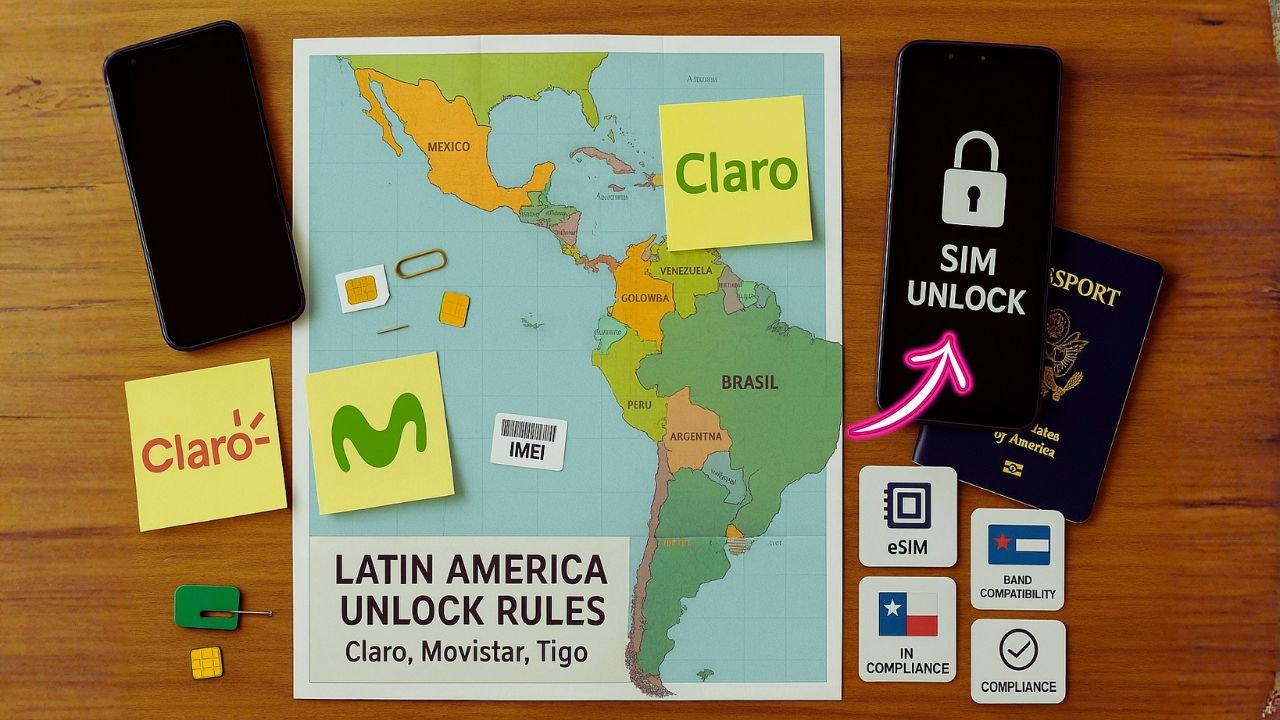
Here’s the thing: carriers like Claro, Movistar, and Tigo usually provide a code or push a server-side approval that frees your device to work with any compatible network. Some countries also run IMEI registries to fight theft; if your device isn’t on the “white list,” it may get blocked even after a successful carrier release. We’ll make both pieces simple.
You know what? A little preparation saves a lot of store visits. Let me explain.
Key takeaways
- Samsung regional lock is real; iPhones aren’t region-locked. Clear Samsung’s regional lock with an original-region SIM + voice calls; verify bands/eSIM for iPhone by target market and carrier feature support.
- Unlocking ≠ registration. An unlocked phone can still be blocked by RENTESEG/IMEI/CRC rules in Peru and Colombia, or by blacklists in Argentina. Check both the carrier lock and the country registry steps.
- Official paths exist. Movistar México and Movistar Argentina provide online code requests; Claro Perú and Claro DO have published workflows; Tigo Colombia documents in-store and form-based procedures for IMEI unblocks/registration.
- Chile and Brazil lead on “unlocked by default.” Chile requires unlocked devices; Brazil practice likewise favors unlocked sales and cautions on foreign-locked imports and homologation.
Why this matters (and how to use this guide)
Carrier locks and country rules are separate. Unlocking removes a phone’s restriction to one carrier. Registration/homologation is about whether the country allows the device (its IMEI/model) to operate on local networks. You might unlock perfectly… and still get blocked if your IMEI isn’t on the right list.
Use the sections below to:
- Understand common unlock paths with Claro, Movistar, Tigo (examples from Mexico, Argentina, Peru, Colombia, Dominican Republic).
- Check country rules that can block you even with an unlocked device (Chile, Colombia, Peru, Argentina, Brazil).
- Handle region-lock situations (especially Samsung) and iPhone band/eSIM nuances.
📖 Also Read: Japan Carrier Unlock Guide: SoftBank, au, Docomo Requirements + MNP/eSIM Porting Tips
Core unlock concepts (30-second primer)
- Carrier unlock: Lets your device accept other carriers’ SIM/eSIM. Most Latin American carriers will unlock for free once you meet eligibility (paid off/no fraud/account in good standing). Some countries require phones to be sold unlocked or unlocked on request at no cost. Chile has required unlocked sales/unlocking since 2012.
- IMEI registration/whitelists/blacklists: Governments or regulators maintain databases to combat theft and fraud. If your IMEI is not registered (Peru’s RENTESEG whitelist) or fails homologation (Colombia’s CRC), the device may be blocked even if unlocked. Argentina’s ENACOM coordinates blacklists for stolen/irregular IMEIs.
- Region-lock (Samsung) vs carrier lock: Samsung’s regional SIM lock can restrict first use outside the original sales region. The usual fix is to activate first with a local (original-region) SIM and make a few minutes of calls; then it behaves as normal. This is separate from carrier locking. iPhones are not region-locked, but models differ in supported bands and SIM tray/eSIM policies by market.
Unlocking with Claro (examples & official paths)
Peru (Claro Perú): Claro provides a public “Desbloquea tu celular” portal. You submit your IMEI and follow the on-screen steps to receive a network unlock code (for code-based devices). If the code fails, Claro directs you to call support or visit a store.
Argentina (Claro Argentina): Claro explains what a “celular liberado” is (SIM-lock removal) and states that since December 21, 2015, unlocking has no cost; devices sold by Claro are unlocked. If you need to unlock an older unit or one from another operator, you request the code from the original operator.
Dominican Republic (Claro DO): Claro’s support describes an on-device sequence (9838284#) after removing the SIM, then entering the unlock code supplied by Claro—useful for devices that still rely on MEP/NCK codes. (Some newer phones unlock remotely by server, but code entry remains common in parts of LATAM.)
Takeaway for Claro:
Have your IMEI ready (dial *#06#), request the unlock via official portal or care, and keep purchase proof handy if asked. Expect no charge where mandated (e.g., Argentina), and remember a blacklisted or irregularly registered IMEI won’t be usable even after unlocking in countries with strict registries.
📖 Also Read: Using a Locked U.S. Phone in Canada: Unlock Steps + VoLTE/5G Compatibility
Unlocking with Movistar
Mexico (Movistar México): Movistar runs an official unlock-code request page. Enter your email and IMEI, then track your request via a status system. When eligible, Movistar issues the code and instructions.
Argentina (Movistar Argentina): There’s an online unlock section: input your IMEI and receive the unlock code plus a short tutorial to complete the process on the phone.
Peru (Movistar Perú & RENTESeg): Movistar Peru also surfaces guidance about RENTESEG—Peru’s device registry. Even if your Movistar device is unlocked, its IMEI must appear on the country’s whitelist or it risks service blocks under Decreto Legislativo 1338. You can check IMEI status on OSIPTEL’s public portal.
Takeaway for Movistar:
Unlock steps are straightforward and code-based where applicable; in Peru, always verify RENTESeg status to avoid post-unlock surprises.
Unlocking with Tigo
Colombia (Tigo Colombia): Tigo’s Help Center outlines requirements for device services, including unlock-related attention in stores (bring the device, ID, proof of purchase; if you lack a receipt, they offer a declaration of ownership form). They also explain how to request IMEI unblock and how to fix an IMEI blocked for non-registration, with timelines (e.g., within 60 hours after meeting conditions).
Regional insight: Many Tigo markets follow similar principles: no fraud/blacklist, account in good standing, and device paid off. But in Colombia there’s an extra layer: IMEI registration/homologation with the CRC and operator registration obligations before a device can work normally.
📖 Also Read: UK Unlocking Rules in 2025: EE, O2, Three, Vodafone (With BYOD & eSIM Tips)
Country rules that affect your unlock (even after it’s “unlocked”)
Chile: devices must be sold unlocked; unlocking on request is free
Chile’s regulator (SUBTEL) established long ago that phones offered to the public must not be SIM-locked, and users can obtain unlocking at no cost—a consumer-friendly framework that has shaped market expectations across the region.
Peru: RENTESEG whitelist and IMEI checks
Peru uses RENTESEG (managed with OSIPTEL and operators). All IMEIs must be on the Lista Blanca; non-whitelisted devices can be blocked. You can check your IMEI online and there’s a separate registration portal for imported/assembled devices—important for phones purchased abroad.
Colombia: Homologation + IMEI registration
The CRC requires homologation (device model approval) and IMEI registration with your operator. If your device isn’t homologated or registered to your line, it risks suspension. Tigo’s guidance explicitly notes registration applies to IMEIs homologated by the CRC—and provides links to check status.
Argentina: ENACOM coordinates blacklisting (anti-theft)
Argentina’s ENACOM explains that blacklist/whitelist actions run through service providers. If a device/IMEI is in the blacklist (e.g., reported stolen), it won’t work until properly rehabilitated per regulator and operator rules.
Brazil: unlocked by policy and practice; ensure homologation & bands
Brazilian practice and court decisions pushed the market to sell unlocked, and Anatel warns that Brazilian carriers don’t have to unlock foreign-locked phones. Also, non-homologated devices and band mismatches can fail—so check Anatel certification and local LTE/5G bands.
Region-lock considerations (Samsung & iPhone)
Samsung’s regional SIM lock
Samsung historically applies a regional SIM policy to some models. If you buy a phone in Region A and first try to use it in Region B, you may see limited voice service or a “SIM not supported” style message. The typical remedy: insert a SIM from the original sales region and place several minutes of standard voice calls. This clears the regional lock; afterward, the device works globally (subject to carrier locks and bands). Some carriers or sellers will even perform the initial activation for you.
Pro tip: If you plan to import a Samsung into a LATAM country, ask the seller to pre-activate it with a local (original-region) SIM so the regional lock is cleared before it reaches you. Keep proof of this activation in case you need support.
iPhones and “region locks”
iPhones are not region-locked in the SIM-lock sense, but hardware variations matter. Some markets (e.g., U.S.) have eSIM-only models; some have different band support or mmWave availability. Apple’s support pages list carrier features by country—a good way to confirm VoLTE/Wi-Fi Calling/hotspot support with your target operator.
Number portability & switching in Latin America
Number portability is widely available across the region and helps reduce lock-in. Chile, Peru, Colombia, Mexico, and many others support mobile number portability at scale, with high annual port volumes. Argentina formalizes timelines and brief outage windows in consumer-facing material. The broader LATAM picture shows portability as a mature tool boosting competition.
What this means for you: once you unlock and ensure IMEI compliance, keeping your number while moving to Claro/Movistar/Tigo (or MVNOs on their networks) is usually straightforward—watch for SIM/eSIM activation windows, bring your NIP/port-out code where applicable, and settle any device debt before you move.
Practical, carrier-by-carrier playbook
Claro: quick checklist
- Confirm eligibility (device paid off, no fraud/loss report).
- Request unlock via official channels:
- If you’ll use the phone in Peru, verify RENTESeg whitelist status first.
Movistar: quick checklist
- Mexico: submit email + IMEI at Movistar’s unlock page; track request online.
- Argentina: use Desbloqueo Online with your IMEI to receive code + tutorial.
- Peru: ensure RENTESEG compliance (IMEI must be on Lista Blanca).
Tigo: quick checklist (Colombia)
- For lock/IMEI issues, Tigo provides in-store service—bring the device, ID, and proof of purchase (or complete a declaration of ownership if you lack a receipt).
- If your IMEI is blocked for non-registration or after a loss/theft report, Tigo outlines email/form procedures and scopes (e.g., up to 60 hours to unblock if requirements are met).
- Independently, confirm homologation/registration compliance via the CRC and operator records.
Buying or bringing phones across borders: what to check
- Bands & 4G/5G profiles: Make sure the model supports local LTE/5G bands (e.g., B2/B4/B5/B28 across many LATAM markets; 5G n28/n78 in some markets). Apple’s country pages and GSMArena-style spec sheets help. For Brazil, Anatel reminds that carriers don’t have to unlock a foreign-locked device and that non-homologated gear may not work.
- Samsung regional lock: Ask your seller to pre-activate with an original-region SIM and place a few minutes of calls before shipping.
- IMEI rules:
- Peru: check RENTESeg and register imported devices to the Lista Blanca.
- Colombia: ensure homologation and register your IMEI with your operator.
- Argentina: confirm the IMEI isn’t blacklisted; ENACOM points you to your operator for any block/unblock actions.
- eSIM vs physical SIM: U.S. iPhones (and some other markets) may be eSIM-only. Verify your LATAM carrier supports eSIM activation on your specific model. Apple’s carrier feature matrix is a good pre-check.
Troubleshooting after an unlock
- “No service” in Peru after swapping SIMs: check your IMEI on OSIPTEL’s portal; if you imported the device, it might not be on Lista Blanca yet.
- Blocked in Colombia despite unlock: verify CRC homologation and operator IMEI registration; ask your carrier to confirm your IMEI is tied to your line.
- Samsung won’t accept a foreign SIM even though it’s unlocked: likely regional lock. Insert an original-region SIM, place a few minutes of voice calls, then try again.
- iPhone works in one country but not another: check bands, eSIM availability, and carrier features (VoLTE/Wi-Fi calling) for the target country.
FAQ
Is unlocking legal across Latin America?
Yes, generally. Many markets either sell unlocked or require carriers to unlock when conditions are met. Chile made unlocked sales the norm years ago; Brazil also pushed unlocked sales. Always use official channels.
Do I need anything besides the IMEI to unlock?
Commonly you’ll need IMEI and proof you’re eligible (no theft report, device paid off). For store visits (e.g., Tigo Colombia), bring ID and proof of purchase, or complete a declaration.
Can a blacklisted phone be unlocked?
Carriers can refuse to unlock devices that are reported stolen/fraudulent. In Argentina, ENACOM notes only providers can perform blacklist/unblacklist operations. If a device is blacklisted, unlocking won’t restore service.
I unlocked my phone, but data/voice still fails. Why?
Check IMEI registration (Peru/Colombia), bands, and regional SIM lock (Samsung). iPhones aren’t region-locked but may lack certain bands or SIM trays by market.
Can I keep my number when switching between Claro/Movistar/Tigo?
In most countries, yes—number portability is broadly available and widely used. Expect short porting windows and minimal downtime.
Step-by-step example workflows
Unlocking a Movistar México phone for use in Peru
- On Movistar MX’s site, submit IMEI + email to receive the unlock.
- In Peru, check the phone’s RENTESEG status. If it’s not on Lista Blanca, follow the registration path before inserting a Peruvian SIM.
- Insert the Peruvian SIM (Movistar/Claro/Entel/Bitel), complete any APN prompts, and test VoLTE/Wi-Fi Calling per Apple’s carrier features page (for iPhone) or the Android device’s specs.
Bringing a Samsung from Europe to Colombia (Tigo/Claro/Movistar)
- Ask your seller to pre-activate the phone in its original region with a few minutes of voice calls to clear regional SIM lock.
- In Colombia, verify CRC homologation for the model and register the IMEI with your operator.
- If you see “not registered on network,” visit your carrier and show ID + proof of purchase; Tigo outlines store requirements and forms.
The Bottom Line
Phones in Latin America follow two systems at once: the carrier’s restriction and the country’s IMEI controls. Clear both, and your device becomes truly travel-ready. Use the carrier’s official request paths (Claro’s local support, Movistar’s portals, Tigo’s in-store validation) and, where required, register your IMEI so it lives on the right list. Keep Apple’s country pages bookmarked for feature support and eSIM planning, and remember the quirk of region policy on some Samsung models.
Honestly, that’s the whole playbook. Ready to free your phone for your next trip—or do you want a quick checklist tailored to your country and carrier?