
Headed to Toronto, Banff, or Montreal with a U.S. phone that’s still tied to a carrier? You can still make your trip work—calls, texts, data, and even 5G—if you prep a few things before you cross the border.
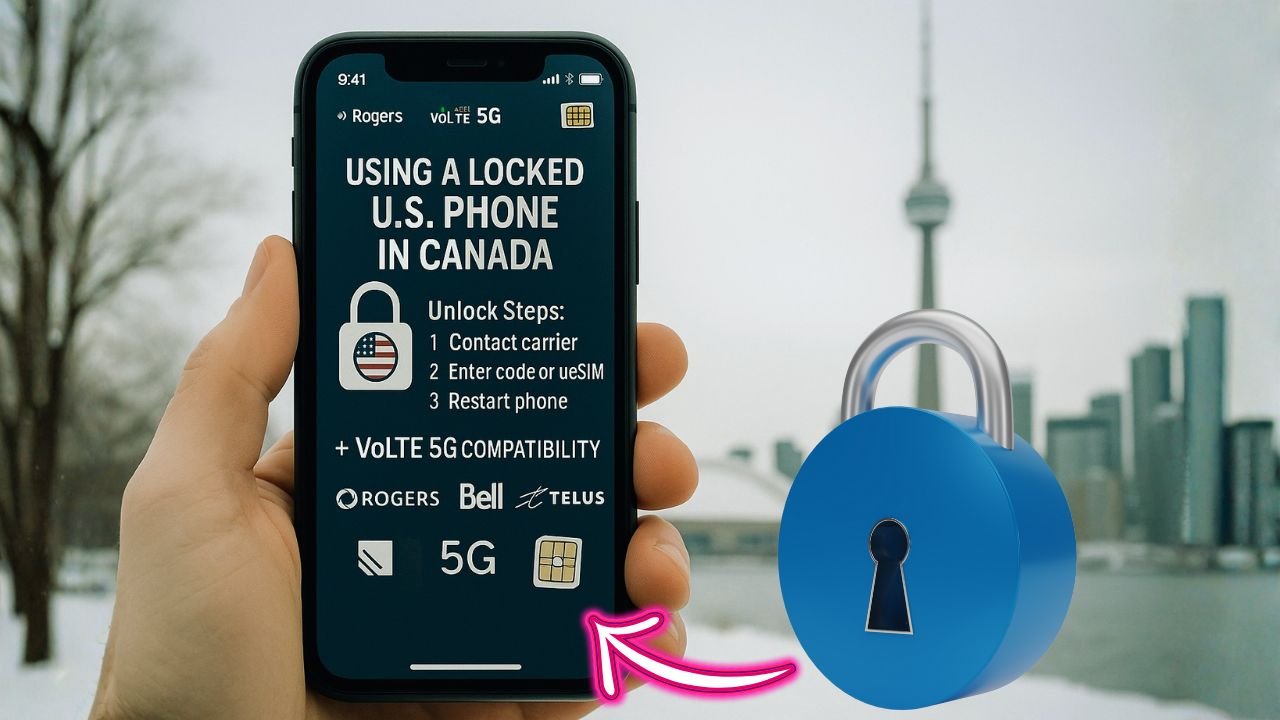
Here’s the simple game plan: free the device from its carrier tie, confirm that it supports Canadian voice calling over LTE (VoLTE), match bands for Rogers, Bell, or Telus, then pick the right eSIM or roaming setup. That’s it. No stress, no tech drama. And yes, I’ll show you how, step by step.
Key Takeaways
- VoLTE is non-negotiable for calls in Canada. With 3G gone, your phone needs voice over LTE. Make sure VoLTE is on, or your calls may fail even if data works.
- Band match = better coverage and speed. Phones that support LTE 2/4/5/7/66 (and 5G n71 or mid-band) play nicest with Rogers, Bell, and Telus. More overlap usually means fewer headaches.
- Roaming vs local eSIM depends on your trip. U.S. plans often include Canada, which is simple and keeps your number. If coverage or speeds lag—or you want a local number—add a Canadian eSIM and you’re set.
- Free the device for flexibility. If the phone is still tied to a U.S. carrier, request a carrier release before you fly. That way you can switch to a Canadian eSIM on the spot if roaming acts up.
Why Canada is different for U.S. phones
Here’s the thing: Canada’s carriers have been phasing out 3G, which means old-school voice calls fall back to LTE now. If your phone can’t handle Voice over LTE (VoLTE) with the partner network, calls may fail—even if data looks fine. That’s why people say “data works but calls don’t.” It’s not random; it’s VoLTE. The CRTC (Canada’s regulator) has flagged that voice will move to LTE as 3G sunsets, making VoLTE support essential.
What about 5G? Great to have, but not required. Data on LTE is usually plenty. If you do want 5G, you’ll get broad low-band 5G coverage (think 600 MHz) in many places, and faster mid-band in cities, depending on your phone’s support.
📖 Also Read: Keep your number while switching to T-Mobile, Verizon, or AT&T
The fast pre-travel checklist
Use this quick list a week before takeoff. It saves headaches.
- Free the device from its carrier tie (if needed). If your phone is still tied to AT&T, T-Mobile, or Verizon, ask for a network release so it can accept a Canadian SIM/eSIM. Even if you plan to roam, having the device free gives you options if coverage or pricing disappoints. (Steps below.)
- Confirm VoLTE support. Most iPhones (6s and newer) and modern Androids are fine, but double-check in your settings that VoLTE is enabled. If your carrier account forbids it while roaming, calls may struggle. Canada now expects voice over LTE as 3G winds down.
- Match network bands. Canada’s Big Three—Rogers, Bell, Telus—lean heavily on LTE bands 4/66, 2, 5, 7; and 5G on n71 (low band) plus mid-band where available. Your phone doesn’t need every band, but the more overlap, the better.
- Choose roaming vs local eSIM. U.S. unlimited plans often include Canada usage. If not—or if you want a Canadian number—grab a local eSIM from Rogers, Bell, Telus, or their budget brands. I’ll help you weigh both paths next.
How to request a carrier release (AT&T, T-Mobile, Verizon)
Let me explain the idea in plain language: a carrier-tied phone won’t accept a different carrier’s SIM/eSIM until the tie is removed on the back end. The process is online and free if you meet your carrier’s criteria (paid off, no fraud flags, etc.). Use these official pages or app flows:
- AT&T: Most AT&T Unlimited plans already include usage in Canada. If you still want the device freed for a local eSIM, submit the request through AT&T’s official device portal or chat support. AT&T also sells an International Day Pass for non-North-America countries; Canada is already included on Unlimited.
- T-Mobile: Many Magenta/Go5G plans include “Canada & Mexico” usage (Mobile Without Borders) with a set chunk of high-speed data. If you want to run a Canadian eSIM instead, request the device release via your account/app.
- Verizon: With most modern Unlimited plans, Canada usage is included or you can enable TravelPass ($6/day for CA/MX) if it isn’t. If you prefer using a Canadian eSIM, ask Verizon to free the device (many postpaid devices auto-release after a short period).
Why bother if roaming works? Flexibility. If your assigned roaming network has weak coverage where you’re staying, a quick local eSIM can fix it. It’s also handy if your plan throttles at a low threshold.
📖 Also Read: Bought from Apple, Financed by a Carrier: Can You Still Unlock?
Roaming on your U.S. plan vs using a Canadian plan
Roaming on your U.S. plan
Pros: keeps your number, simple setup, calls/texts/data often included on Unlimited plans. Cons: data may be capped at 5–15 GB high-speed before slowing; you can’t always choose the best local network; and rare plan quirks can block service until enabled.
Using a Canadian eSIM/SIM
Pros: pick the network (Rogers, Bell, or Telus) that actually covers your destination best; get local speeds and features; avoid U.S. roaming caps. Cons: a new number unless you activate a data-only eSIM; minor setup time.
Tip: If your roaming is flaky—for example, texts land but calls won’t—switching to a Canadian eSIM with VoLTE usually fixes it because you’ll be native on that network. The key is that calls ride over LTE now.
eSIM vs physical SIM in Canada
Most recent phones support eSIM, which is fast and convenient. You can land in Vancouver, hop on Wi-Fi, buy a plan online, scan a QR code, and you’re live. Carriers and reputable travel eSIM providers list Canada options that ride on major networks.
Physical SIM still works too—handy if your device limits the number of eSIM profiles. Either way, ensure VoLTE is toggled on after activation and restart the phone to refresh network features.
Match your phone to Rogers, Bell, or Telus
You don’t have to be a radio engineer. Just know the common bands:
- LTE: 4/66 (AWS), 2 (PCS), 5 (850 MHz), 7 (2600 MHz)
- 5G: n71 (600 MHz) for wide coverage; mid-band (like n77/n78) in many cities
If your phone supports these, you’re in good shape. Some devices miss 7 or 66 and still work—but speeds and building penetration can vary. When signal looks fine yet data crawls, it’s often a band mismatch.
Quick reference sources (if you want to geek out):
- Bell’s public frequency lists and community pages summarize LTE bands 2/4/5/7/12/13/17 and VoLTE availability.
- Telus and Rogers spectrum summaries (low-band 600 MHz and AWS variants) show where 5G and LTE operate.
📖 Also Read: Military Phone Unlock: How to Use Deployment Unlock Policy & Carrier Exceptions (AT&T, Verizon, T-Mobile, UScellular)
Step-by-step: Freeing the device for a Canadian SIM/eSIM
You know what? Let’s keep it ultra clear and friendly:
- Back up your phone (iCloud/Google). Just a precaution.
- Remove any installment holds with your U.S. carrier. Paid off? Great.
- Request the release in your carrier account (AT&T, T-Mobile, Verizon). If you’re already eligible, approvals are often quick.
- Reboot and insert/activate the Canadian SIM/eSIM. If asked for a “SIM network PIN,” follow your carrier’s instructions—it’s a one-time back-end code, not your lock screen PIN.
- Turn on VoLTE/Wi-Fi Calling in settings. Wi-Fi Calling saves you in basements and older buildings.
- Test calls and data. Place a short call, run a speed test, and send an iMessage/RCS and a plain SMS.
VoLTE is not optional anymore (and how to enable it)
Canada’s 3G sunset makes LTE voice the default path. On iPhone, go to Settings → Cellular → Cellular Data Options → Voice & Data → LTE and make sure it’s allowed; on Android, Settings → Mobile Network → VoLTE (wording varies by model). If there’s no toggle, your phone or plan may not allow VoLTE while roaming. That’s when a local Canadian plan solves it.
5G in Canada: what to expect
You’ll see low-band 5G (n71) for broad coverage and mid-band 5G in many cities for a speed bump. If your U.S. device supports these bands, you’ll ride them; if not, LTE is still solid for maps, rides, and streaming audio. Don’t chase status bars—chase stable VoLTE and the right plan.
Which Canadian network should you choose?
- Rogers: largest footprint, lots of low-band coverage, strong urban presence.
- Bell: broad LTE and 5G, shared infrastructure with Telus in many regions; plenty of AWS (4/66) capacity.
- Telus: competitive national footprint, excellent urban service, similar band mix to Bell due to RAN sharing in places.
If you’re heading to smaller towns or cottage country, look at coverage maps and choose the carrier that lights up your route. If your plan forces you onto one partner (e.g., your U.S. plan roams on X), and coverage stinks, adding a quick local eSIM from a different network is the easy fix.
Troubleshooting cheat sheet
No calls but data works
That screams VoLTE. Toggle it on; reboot; try Wi-Fi Calling; if roaming, consider a local Canadian plan so you’re native on the network.
SOS-only or no service
Manually choose the carrier under Network Selection and try the other big players (Rogers/Bell/Telus). Move near a window; low-band 5G/700–600 MHz reaches better indoors, but your phone must support it.
Slow data in busy areas
Could be congestion or a band mismatch. If your phone lacks bands 7 or 66 in a dense area, speeds suffer. Short-term fix: try another carrier profile or use Wi-Fi. Long-term fix: pick a device with broader band support.
Texts fail when switching SIMs/eSIMs
Re-register iMessage/FaceTime or RCS after activating the new line. Plain SMS should still send once the new profile is live.
Can’t activate an eSIM
Use a stable Wi-Fi network for QR activation. If a QR won’t scan, most carriers let you enter details manually in Add eSIM → Enter Details.
When roaming makes more sense
If your U.S. plan already includes Canada (many do), keeping your line active is painless. You’ll text your friends on the same number, your banking apps won’t freak out, and voicemail stays the same. Watch for fair-use rules (too much use in Canada can reduce benefits), and keep an eye on high-speed data caps—once you hit the cap, speeds may drop.
When a Canadian eSIM is smarter
You want a local number for reservations or job-hunting, you need consistent VoLTE calling in fringe areas, or your U.S. plan throttles too early. In those cases, a local eSIM pays for itself in peace of mind. After your trip, you can disable it and keep your U.S. line as primary again.
A simple way to test before you go
Two small moves:
- Band check: Look up your exact model on a compatibility database and confirm LTE 2/4/5/7/12/13/17/66 and 5G n71 if possible. (You don’t need all of them—but the more the merrier.)
- VoLTE test: Make a phone call with LTE showing in the status bar (not dropping to 3G). If it stays on LTE during the call, good sign. If it flips to 3G at home, that’s fine—Canada will expect LTE voice, so ensure the toggle exists and works after arrival.
Real-world travel setups that work
- The breezy traveler: Keeps their AT&T/T-Mobile/Verizon plan active, uses the included Canada bucket. Enables Wi-Fi Calling in hotels; done.
- The coverage hunter: Adds a short-term Bell/Telus/Rogers eSIM for the exact region they’re visiting, leaves the U.S. number for iMessage/WhatsApp only.
- The budget fixer: Uses a data-only Canadian eSIM for maps and rides; calls go through FaceTime/WhatsApp to avoid per-minute charges.
FAQs
Do I need 5G in Canada?
No, LTE is more than fine for most travelers. 5G is a nice bonus in cities. Focus on LTE Bands 4/66 and 12/17 first; add 5G n66/n71/n77 if you want max speeds.
Will my calls fail if my phone doesn’t support VoLTE with that carrier?
Possibly. With 3G retiring, voice relies on VoLTE or VoNR. If your phone or plan doesn’t provision VoLTE, you could have data but no calls. Wi-Fi Calling can be a temporary workaround.
Can I keep my U.S. number for banks and 2FA while using a Canadian data plan?
Yes—use dual-SIM. Keep your U.S. line active for texts and calls, and set the Canadian eSIM for data.
Which carrier is best for road trips?
Coverage is excellent on all three near cities. Rural performance varies; locals on your route will know. If your phone misses low-band coverage, Rogers often feels forgiving; Bell/Telus share RAN in many regions and are strong too.
Is my phone “whitelisted” for VoLTE in Canada?
There isn’t a single public master list per brand, and policies evolve. Most mainstream U.S. models work. If you have an obscure import, test with a prepaid SIM, and confirm VoLTE toggles on. Rogers’ VoLTE FAQ shows VoLTE availability across its LTE footprint.
The Bottom Line
Honestly, the formula is simple: make sure your phone does voice over LTE, match a few common bands, and decide whether you’ll roam or run a local eSIM. That’s the entire trip in three moves. If your calls still hiccup, switch to a Canadian eSIM and you’re golden—no drama, no wasted time. Safe travels. And one question before you pack: where in Canada are you headed? I can point you to the best network for that spot.