
Unlocking an iPhone from a carrier simply removes the network lock so you can use any SIM or eSIM. First, check if it’s already unlocked: go to Settings > General > About and look for Carrier Lock (“No SIM restrictions” means you’re done).
If it’s locked, make sure the phone is paid off, the IMEI is clean (not lost/stolen), and the account is in good standing, then submit an official unlock request to your carrier (portal, app, or support). After they approve, Apple updates your device on its servers finish by inserting a different SIM or adding a new eSIM, then restart or Reset Network Settings and install any Carrier Settings update. Test calls, texts, data, and 5G.
If denied (financing, fraud flag, or MDM), resolve the issue and reapply and avoid “unlock code” scams: modern iPhones unlock only through the carrier/Apple server process.
Key Takeaways
- Check your status in seconds. On your iPhone, go to Settings → General → About → Carrier Lock. If it shows “No SIM restrictions,” your phone is already unlocked and ready for any compatible SIM/eSIM.
- Only the original carrier can approve the unlock. An AT&T-locked iPhone must be unlocked by AT&T (same idea for T-Mobile, Verizon, etc.). iPhones don’t use user-entered “unlock codes”—the carrier authorizes it and Apple flips the status on its activation servers.
- Meet basic eligibility first. Make sure the device is paid off, the IMEI is clean (not lost/stolen), and any minimum active time is satisfied. Many carriers/authorized retailers auto-unlock after about 60 days unless there’s a fraud or loss flag.
- Finish and verify on the phone. After approval, insert a different SIM or add an eSIM, accept any Carrier Settings Update, and restart if needed. You’re done when Carrier Lock = No SIM restrictions and calls, texts, and data (LTE/5G) all work.
What “Unlocking Your iPhone from Carrier” Actually Means
Unlocking removes the network lock set by your carrier so the phone can register on any compatible carrier, at home or abroad. On iPhones this isn’t a code you type—your carrier flags your IMEI as unlocked, Apple updates its activation servers, and the change sticks through updates and resets. It doesn’t erase iCloud/Activation Lock, passcodes, or MDM, and it doesn’t add new radio bands—your phone still needs to support the target network’s bands and features (VoLTE/5G).
Network Lock vs. Screen/Activation Lock (they’re different)
A network lock only controls which carriers your iPhone can use. A screen lock (passcode/Face ID) protects your data, and Activation Lock (Find My/iCloud) ties the phone to an Apple ID. Carrier unlocking won’t remove a passcode, won’t bypass Activation Lock, and won’t clear MDM from employer/school devices. You must address those separately with the owner/admin.
Permanent “whitelist” unlock vs. temporary international unlock
A permanent (whitelist) unlock updates Apple’s servers so your IMEI is “unlocked” for good. It survives factory resets, iOS updates, and SIM swaps. Some carriers may offer a temporary travel unlock (time-limited permission to use foreign SIMs). When the window ends, the device can re-lock to the original carrier. If you plan to sell or switch carriers, aim for the permanent unlock.
Physical SIM vs. eSIM vs. Dual SIM: how unlocking applies to each
On iPhone, unlocking is device-level. Once unlocked, both the physical SIM tray and any eSIM profiles can be from any supported carrier. With Dual SIM/Dual eSIM, you can run two carriers at once (e.g., local data eSIM + home voice line). After unlocking, add or swap SIM/eSIMs, then update Carrier Settings and test calls, texts, data, Wi-Fi Calling, and 5G.
📖 Also Read: 5 Reasons an Unlocked Phone Makes Switching Carriers Easy
Quick Checks: Is Your iPhone Already Unlocked?
Open Settings → General → About and find Carrier Lock. If it says “No SIM restrictions,” your iPhone is fully unlocked and will accept any compatible SIM or eSIM. If you see wording like “SIM locked” or a carrier name, it’s still locked (or not yet updated on Apple’s servers). Note: very old iOS versions may not show this line—use the SIM-swap test below.
The SIM-swap test with any different-carrier SIM/eSIM
Power off, insert a different carrier’s physical SIM, then power on and try a call/data. For eSIM, go to Settings → Cellular → Add eSIM and add a line from another carrier/app.
- Works immediately: you’re unlocked.
- “SIM Not Supported” / activation fails: still carrier-locked (or an MDM/Activation Lock issue).
- No service but no error: could be coverage or band support—try another known-working SIM or move to a good-signal area.
Activation Policy/Carrier Bundle check (what it means at setup)
On setup (or after a reset), your iPhone contacts Apple to fetch an Activation Policy and Carrier Settings.
- Unlocked policy: any SIM/eSIM will activate; you may see a Carrier Settings Update prompt.
- Locked policy: non-matching SIMs trigger “SIM Not Supported.”
You can’t directly “view” the policy in iOS, but these behaviors (and the Carrier Lock line) reveal it.
Common IMEI checkers: what they can/can’t tell you (and red flags)
Carrier and third-party IMEI checkers can confirm basics like blacklist status, model, and network compatibility, but many cannot reliably confirm unlock status for iPhones. Apple no longer offers a public unlock-status lookup. Use carrier eligibility portals when available, but treat third-party “unlock status” results as advisory, not final.
Red flags: sites asking for your Apple ID/password, promising “instant unlock codes” (iPhones don’t use user-entered codes), or charging just to “check” unlock status without clear sources.
📖 Also Read: Why Buy an Unlocked Phone vs Carrier Locked (The Complete Guide)
Requirements You Must Meet Before the Carrier Will Unlock
Carrier unlocking is mostly a database update tied to your iPhone’s IMEI. For the carrier to approve it, four boxes usually need to be checked: you (or the original owner) must own the device outright, the account must be clean, minimum service-time rules must be met, and the phone can’t be flagged or managed in ways that block unlocking.
Ownership: paid off vs. financed/Installment plan
Carriers rarely unlock phones that are still on an installment plan or lease. If the device is financed, you’ll typically need to pay it off (and wait for the account systems to reflect a $0 balance) before requesting an unlock. Bought the phone outright? You’re generally eligible once any short “new line” lock period passes. If you purchased second-hand, your eligibility still depends on the original account’s payoff status—carriers see the IMEI, not your receipt. When in doubt, ask the seller for payoff proof or have them submit the unlock before you buy.
Account status: fraud blocks, past-due bills, blacklisted vs. clean IMEI
Your line and account must be in good standing—no past-due balances, chargebacks, or suspicious activity. The IMEI must be clean (not reported lost/stolen and not on any fraud/blacklist database). Fraud flags and blacklists are hard stops; carriers won’t unlock those devices. Mismatches (e.g., replaced hardware with a different IMEI than the one on the account) can also stall requests until records are corrected.
Service time minimums: postpaid vs. prepaid basics
Most carriers enforce a short tenure requirement before unlocking. On postpaid, that window is usually a few weeks to a couple of months from activation (and after any financing payoff). Prepaid/MVNO plans often require longer active service—commonly several months—to deter quick flips. These windows vary by carrier and brand, so always check the current policy for your exact plan type.
Corporate/MDM and Lost Mode devices: why carriers/Apple won’t unlock
If the iPhone is company-owned or MDM-managed, only the organization’s admin can request changes; carriers and Apple will not override enterprise controls. Similarly, a device in Lost Mode or tied to Activation Lock (Find My) will not be unlocked until the rightful owner clears those states. Unlocking doesn’t remove passcodes, Activation Lock, or MDM—it only changes network eligibility.
Bottom line: To breeze through approval, ensure the phone is fully paid, the account is clean, any minimum active-time rule is met, and the device isn’t blacklisted or MDM-controlled. Once those are true, your carrier can authorize Apple’s servers to flip the switch.
📖 Also Read: Verizon Unlock Policy Explained for 2025: When and How It Unlocks
Official Unlock Methods (Best Practice)
Requesting from Your Carrier (typical flow)
The legitimate iPhone unlock is a carrier-authorized change on Apple’s activation servers—there’s no code to type. The flow is simple: verify eligibility (paid off, clean IMEI, account in good standing) → submit the unlock request through your carrier (portal/app/support) → wait for Apple’s server update tied to your IMEI → complete final steps on the device. Those steps are usually just: connect to Wi-Fi or cellular, insert a different carrier’s SIM or add a new eSIM (Settings → Cellular → Add eSIM), accept any Carrier Settings Update, and then reboot or Reset Network Settings if needed. When activation finishes without errors and Settings → General → About → Carrier Lock shows No SIM restrictions, you’re done.
Unlock via Online Portals/Apps vs. phone/chat support
Online portals/apps are fastest for straightforward cases and keep everything tracked by a case number you can reference. You’ll need the IMEI, account PIN/passcode, and (if financed) proof of payoff. Phone/chat support is best when records don’t match (IMEI swaps, warranty replacements), there’s a past-due balance that just cleared, or you’re on a prepaid/MVNO brand with special rules. Tip: have the original account holder submit the request, keep the line active until approval, and don’t factory reset unless support specifically asks.
“Apple can’t unlock your phone” myth—why Apple relies on carrier authorization
Apple doesn’t decide whether a device is locked or unlocked; it hosts the activation policy the carrier sets. Only the carrier (or the brand that sold/financed the phone) can flip your IMEI from “locked” to “unlocked” on Apple’s servers. Apple Stores and Apple Support can help with things like Activation Lock or hardware issues, but they can’t override a carrier’s network lock without that carrier’s approval.
Timelines, confirmation texts/emails, and how to know it’s done
Most approvals complete within hours to a few days, but edge cases (recent payoff, fraud review, account merges) can take longer. Carriers typically send a text or email confirming approval with simple finishing steps (insert new SIM/add eSIM and restart). You’ll know it’s truly finished when:
- Settings → General → About → Carrier Lock shows No SIM restrictions, and
- A different-carrier SIM/eSIM activates without “SIM Not Supported.”
If you still see errors after an approval notice, toggle Airplane Mode, reboot, accept Carrier Settings updates, or do Reset Network Settings; if that fails, contact support with your case number for a refresh on their side.
Carrier Policy Snapshots (verify before you act)
Below are quick, current-as-of Aug 20, 2025 summaries plus a what-to-prepare checklist for each carrier/brand. Policies change—always confirm on the official page before submitting your request.
AT&T (postpaid, prepaid, installment payoff basics)
Policy snapshot: AT&T generally requires that the device be 60+ days from purchase, paid in full, not lost/stolen, and the account current. AT&T Prepaid typically needs six months of paid service. AT&T notes many Apple devices on active AT&T accounts unlock automatically once eligible.
What to prepare: IMEI, proof the installment is $0, AT&T passcode, and your contact email/number. If prepaid, have proof of 6 months of active paid service.
Verizon (60-day lock, fraud exceptions)
Policy snapshot: Verizon locks devices for 60 days after purchase (or activation if bought at an authorized retailer). After that, unlock is automatic unless the phone is flagged lost/stolen/fraud. Verizon Prepaid requires 60 days of paid active service and “ordinary usage.” Updated May 22, 2025.
What to prepare: IMEI, account PIN, any proof of purchase if records don’t match, and be ready to insert a different SIM/eSIM to complete activation after you get the approval notice.
T-Mobile (account tenure, device history)
Policy snapshot: For postpaid, the line must be active 40 days, device not lost/stolen, and any financing must be paid. For prepaid, it’s typically 365 days since activation or $100 in refills (and >14 days since purchase). Once eligible, T-Mobile usually auto-unlocks within two business days if the device supports remote unlock.
What to prepare: IMEI, account PIN, payoff confirmation if financed, and proof of purchase if requested. Keep the line active until the unlock completes.
U.S. Cellular & regionals (general patterns)
Policy snapshot (UScellular): iPhone postpaid: locked 120 days (or until a 36-month RIC is completed/paid, with at least 120 days active). Prepaid: iPhone 120 days (Android often 180 days). They auto-unlock when practical if the account is in good standing; standard lost/stolen/fraud blocks apply.
What to prepare: IMEI, proof of payoff (if on an installment contract), and account details showing good standing and active ≥120 days.
MVNOs (Straight Talk, Tracfone, Metro, Boost, Cricket)
Straight Talk / Tracfone (Verizon Value brands): As of Apr 1, 2025, Verizon Value’s unified policy generally unlocks after 60 days of paid active service (fraud/loss exceptions apply). Use the official Verizon Value unlock portal to check eligibility/submit requests.
Metro by T-Mobile: Requires 365 days from activation (military exceptions). Unlock is free if criteria are met; some models use the on-device unlock app.
Boost Mobile (DISH): Typically unlocks 1 year after initial activation for prepaid devices, provided any device balance is paid and the account isn’t suspended.
Cricket (AT&T): Generally requires 6 months of active service; iPhones can be unlocked online once eligible, Androids often via the Cricket Device Unlock app (for newer models). Military exceptions exist.
What to prepare (MVNOs): IMEI, brand account info/PIN, proof of paid active service for the required window, plus payoff and clean-IMEI status. Expect an auto-unlock on many brands once the timer and usage criteria are satisfied.
Disclaimer: Some policies include nuanced exceptions (e.g., deployed military) and backend “ordinary usage” checks. Always re-check the carrier’s current page right before you request an unlock. If your request is denied, ask support to specify which criterion failed so you can fix it and resubmit.
Step-by-Step: How to Unlock Your iPhone (Core Tutorial)
Step 1 — Confirm the phone status (Settings + SIM test)
Start by checking if the phone is already unlocked. Go to Settings → General → About and look for Carrier Lock. If it reads No SIM restrictions, you’re done. If it shows SIM locked or a carrier name, do a quick SIM test. Power off, insert a SIM from a different carrier, power back on, and try a call or data. For an eSIM check, go to Settings → Cellular → Add eSIM and try adding a plan from another carrier. If you see “SIM Not Supported” or activation fails, the device is still locked or restricted by MDM/Activation Lock, which you must resolve separately.
Step 2 — Check eligibility + gather info (IMEI, account #, payoff proof)
Carriers unlock only when basic rules are met. Make sure the phone is paid off, the account is in good standing, and the IMEI is clean (not lost/stolen). Find your IMEI with *#06# or Settings → General → About. Collect your account number, account PIN/passcode, and proof of payoff if you recently finished installments. If you bought the phone second-hand, ask the original owner to confirm payoff or submit the request on their account; carriers make decisions by IMEI history, not your receipt.
Step 3 — Submit official unlock request (portal or support)
Use your carrier’s online portal/app when possible—these are fastest and give you a case number. Enter the IMEI, confirm eligibility, and submit. If records don’t match (warranty swap, IMEI change, billing just cleared), use phone or chat support so an agent can refresh your line or attach proof. Keep the line active until approval. There’s no code to type on iPhones: the carrier approves the IMEI and signals Apple’s servers to switch your activation policy from locked to unlocked.
Step 4 — Complete the Apple activation step
Once you receive the approval text/email, finish the unlock on the device. Be on Wi-Fi or cellular and follow the right path for your setup.
For physical SIM users:
Power off, insert a different-carrier SIM, then power on. If prompted, accept any Carrier Settings Update. If calls or data don’t start, toggle Airplane Mode off/on, reboot, or go to Settings → General → Transfer or Reset iPhone → Reset → Reset Network Settings (this won’t erase your photos/apps, but you’ll re-enter Wi-Fi passwords). Avoid a full factory reset unless support instructs it.
For eSIM users (Add eSIM, erase/add plan if needed):
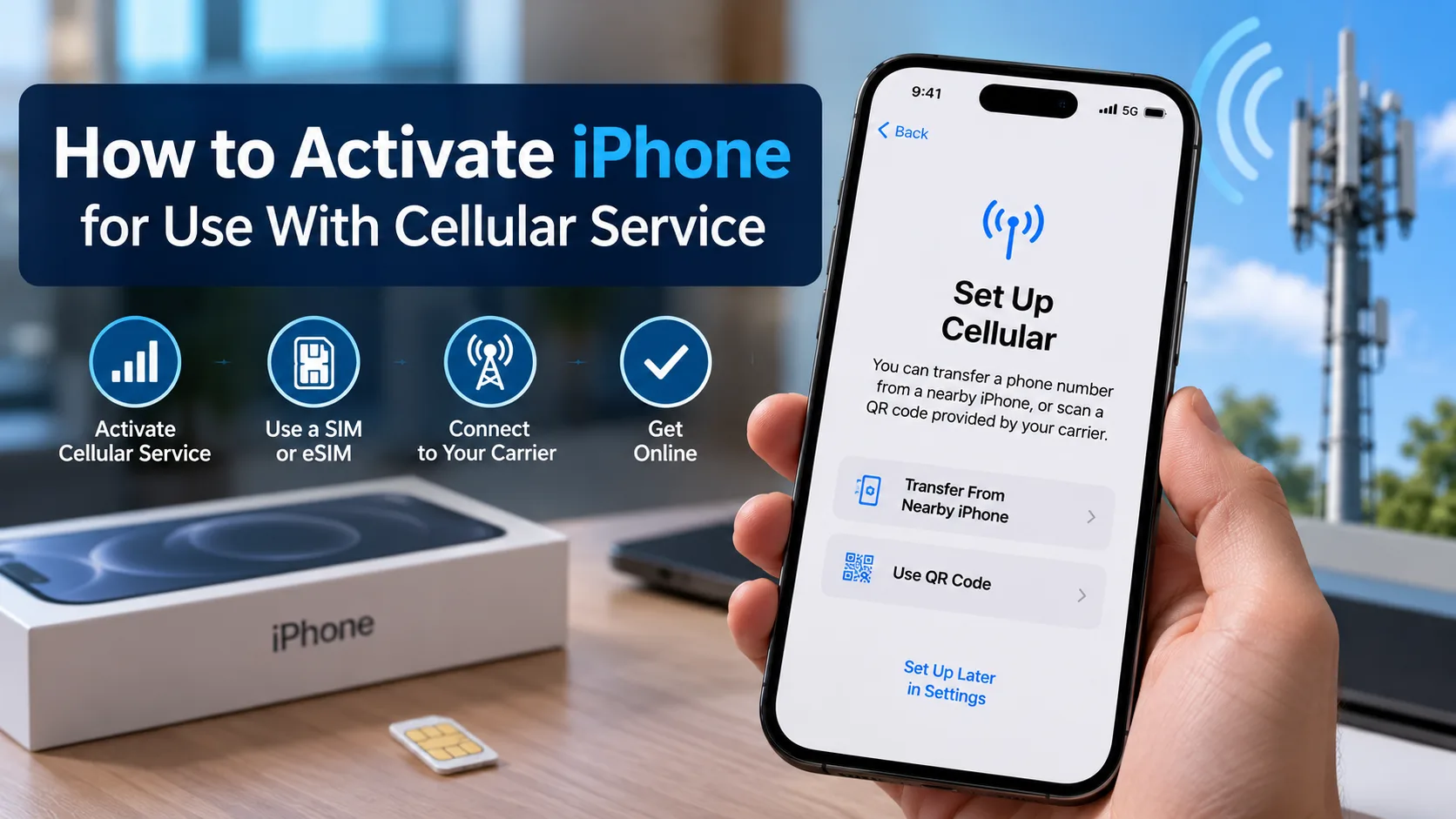
Go to Settings → Cellular → Add eSIM. Scan the QR from your new carrier, use their app, or pick “Transfer from Nearby iPhone” if supported. If your old carrier profile remains and blocks activation, remove it: Settings → Cellular → [Old Plan] → Delete eSIM, then add the new one. After activation, accept any Carrier Settings Update and confirm that the new line shows signal and the correct network name.
Step 5 — Verify and test (calls, SMS, data, LTE/5G, Wi-Fi Calling)
Make sure everything works on the new carrier. Place a test call, send a text (and an MMS/photo if supported), run a quick speed test to confirm LTE/5G data, and check VoLTE/HD Voice if your carrier uses it. Turn Wi-Fi Calling on in Settings → Cellular → Wi-Fi Calling if your plan includes it. If you have Dual SIM/Dual eSIM, set which line handles cellular data, voice, and iMessage/FaceTime under Settings → Cellular and Messages/FaceTime. If data works but calls fail, re-apply the carrier’s APN/Cellular Data Network settings (some MVNOs require manual entries), install any pending Carrier Settings Update, and reboot. Still stuck? Share your case number with carrier support and ask for an unlock refresh on the IMEI.
Bottom line: confirm locked status, meet the carrier’s rules, submit the request, trigger Apple’s activation step, then test. Once Carrier Lock = No SIM restrictions and a different-carrier SIM/eSIM works, your iPhone is permanently unlocked.
eSIM-Specific Tips After Unlock
Adding a local eSIM when traveling (QR code vs. in-app purchase)
Once your iPhone is unlocked, you can add a local plan in minutes. Most travel eSIMs give you either a QR code or an in-app purchase. With a QR, go to Settings → Cellular → Add eSIM → Use QR Code, scan, and follow prompts (stay on Wi-Fi). With in-app purchase, install a reputable carrier/travel eSIM app, choose a plan, and it will auto-provision the eSIM—no QR needed. Before you fly, download the app and buy the plan so activation is ready on arrival. Turn Data Roaming on for the travel line, and keep your home line for calls/iMessage if you like. Save any activation code or SM-DP+ address the provider sends; you may need it to re-download if activation times out.
Managing multiple lines; choosing default line for data/voice
Unlocked iPhones support Dual SIM/Dual eSIM, so you can run a home line and a travel/data line together. After adding the eSIM, label them (e.g., “Home” and “Japan Data”) via Settings → Cellular → [Line] → Cellular Plan Label. In Settings → Cellular:
- Default Voice Line: Pick which line places calls/SMS by default.
- Cellular Data: Choose which line handles data. Toggle Allow Cellular Data Switching if you want the phone to fall back to the other line for data during a call.
- iMessage/FaceTime: In Settings → Messages/FaceTime, set which number/email is used for send/receive.
If your travel plan is “data-only,” leave voice and Wi-Fi Calling on your home line, but set Cellular Data to the travel line to avoid roaming charges. When you return, switch Cellular Data back to your home line and toggle the travel eSIM off instead of deleting it (you can reuse remaining data later if the provider allows).
Removing carrier profiles and refreshing network settings
If you’re done with a plan—or it’s causing activation conflicts—remove it safely: Settings → Cellular → [Plan] → Delete eSIM. Only delete a line you’re sure you won’t need; some providers don’t allow re-downloads without a new purchase. If you hit odd issues (no data, calls failing, or wrong carrier name), try:
- Toggle Airplane Mode off/on.
- Reboot the iPhone.
- Install any Carrier Settings Update (you’ll see a prompt).
- Reset Network Settings: Settings → General → Transfer or Reset iPhone → Reset → Reset Network Settings (this keeps your photos/apps but clears Wi-Fi/Bluetooth/APN caches).
If the travel eSIM won’t provision, delete it, re-add via QR/app, or ask the provider for a fresh activation code. For MVNOs, confirm APN fields under Cellular Data Network match the carrier’s instructions.
After the Unlock: Make Everything Work Properly
Reset Network Settings & update Carrier Settings
After approval, your iPhone still needs a clean handshake with the new network. First, connect to Wi-Fi and insert the new SIM or add the new eSIM. If you see a Carrier Settings Update banner, tap Update—this installs the latest network profile for things like VoLTE, 5G, and Visual Voicemail. If data/voice feels flaky, do a quick refresh: Settings → Airplane Mode on/off, then restart. Still odd? Run Settings → General → Transfer or Reset iPhone → Reset → Reset Network Settings. This doesn’t erase photos/apps, but it clears stale APNs, Wi-Fi, and Bluetooth caches so the phone can re-provision cleanly.
APN/Cellular Data options for MVNOs
Many MVNOs (e.g., Cricket, Metro, Mint, Visible, Boost) auto-push APNs through carrier settings. If data or MMS won’t work, you may need to confirm or enter APN values. Go to Settings → Cellular → [Your Line] → Cellular Data Network and compare each field (Cellular Data/APN, MMS, Personal Hotspot) with the MVNO’s setup page. If the menu is missing or greyed out, the APN is managed by the profile—ask the carrier to push updated settings or re-provision your eSIM. For travel eSIMs, turn Data Roaming on and ensure the APN matches the provider’s SM-DP+ profile notes.
Visual Voicemail, Wi-Fi Calling, 5G/VoLTE band support
After a carrier change, features may need a nudge. Open Phone → Voicemail to initialize Visual Voicemail; if it errors, toggle Cellular Data off/on and confirm the feature is active on your plan. Enable Wi-Fi Calling at Settings → Cellular → Wi-Fi Calling, then power-cycle once. For 5G/VoLTE, check Settings → Cellular → Cellular Data Options → Voice & Data and set 5G Auto/On (or LTE/VoLTE on older models). Remember: unlocking doesn’t add radio bands—performance depends on your iPhone model and the target carrier’s bands. If calls sound worse after switching, ensure VoLTE/HD Voice is enabled and that your plan supports it.
Fixing “No Service” or “SIM Not Supported” errors
No Service right after unlocking usually means provisioning isn’t complete or settings are stale. Confirm coverage, reseat the SIM (or delete/re-add the eSIM), accept any Carrier Settings Update, then Reset Network Settings. Also verify the line assignment: Settings → Cellular and make sure your new line is enabled and selected for Cellular Data and/or Default Voice as intended. For MVNOs, recheck APN entries and Data Roaming.
“SIM Not Supported” means Apple’s activation policy hasn’t flipped yet for your IMEI. Connect to Wi-Fi, insert the non-original SIM, and try activation again. If it persists after an approval email/text, contact the carrier with your case number and ask for an unlock refresh/re-push on the IMEI; sometimes a recent payoff or an IMEI swap (warranty replacement) needs manual syncing. As a last resort, update iOS, back up, and perform Erase All Content and Settings, then set up with the new SIM/eSIM—this forces a fresh pull from Apple’s activation servers. If the device is blacklisted, in Lost Mode, or MDM-managed, the unlock won’t complete until those blocks are cleared.
If Your Unlock Request Was Denied
Common denial reasons (finance owed, fraud flag, active contract)
Most denials fall into a few buckets. Financing or balance due: the phone is still on an installment plan, lease, or there’s a past-due bill. Fraud/loss/theft flags: the IMEI is blacklisted or under investigation—carriers will not unlock these. Active contract/tenure not met: your line hasn’t been active long enough (postpaid weeks; prepaid often months). Record mismatch: the IMEI on your device doesn’t match what the carrier has (common after warranty replacements). MDM/Activation Lock: company-owned or “Find My” locked devices can’t be carrier-unlocked until the owner/admin removes those locks. Not originally sold by the carrier: some brands only unlock phones that were sold by or used on their network long enough to meet policy.
How to resolve and re-submit (payoff, documentation, IMEI mismatch fixes)
Work the denial one cause at a time. If you owe money, pay off the device and any past-due balance, then wait 24–72 hours for systems to update. Ask support to refresh your line and confirm a $0 device balance before resubmitting. If tenure is the issue, keep the line active until you hit the required window (postpaid or prepaid/MVNO), then try again. For IMEI mismatches (warranty swap, repair), provide proof of the replacement and ask the agent to attach the new IMEI to your line, then submit a new unlock request. If you bought it second-hand, ask the original owner to request the unlock (or provide payoff proof). For MDM/Activation Lock, only the organization or Apple ID owner can remove those; once cleared, reapply. Always get a case number and, after approval, ask the carrier to re-push the unlock to Apple’s servers if your iPhone still shows “SIM Not Supported.”
Escalation paths (carrier executive support, regulator complaint where applicable)
If frontline support stalls, escalate politely. Ask for Tier-2/technical support or Executive Relations and reference your case number, denial reason, and the fix you completed (e.g., payoff posted on <date>). Keep documents ready: payoff receipt, proof of purchase, IMEI photos from Settings and the SIM tray box, and any prior correspondence. If you believe the carrier is ignoring its stated policy, file a complaint with your national regulator (e.g., FCC in the U.S., Ofcom in the U.K., CRTC in Canada)—they often prompt faster reviews. If an authorized retailer sold you a phone that was promised as “unlocked,” use their return/complaint channel with your evidence.
When an unlock is not possible (blacklist/MDM/lost or stolen)
Some cases are hard stops. Blacklisted (lost/stolen/fraud) devices will not be unlocked; only the party that reported the device can remove the flag. MDM-managed or corporate-owned iPhones require the organization’s admin to release controls; carriers and Apple won’t override them. Activation Lock (Find My) must be cleared by the Apple ID holder. And if a phone remains unpaid/under active financing and the owner refuses to settle, carriers won’t unlock it. In these situations, your options are practical, not technical: seek a refund/return from the seller, ask the original owner to complete the unlock, or use the phone with the original carrier until it qualifies. Avoid any service promising to “bypass” carrier locks or iCloud—those are risky, often illegal, and can permanently block the device.
Third-Party Unlock Services: Pros, Cons, and Warnings
When it might make sense (out-of-country, legacy models, MVNO edge cases)
Third-party services can be useful when you’re outside the carrier’s market and can’t access support, when you have a legacy model no longer sold by the carrier, or when you’re on an MVNO whose policy makes official unlocks slow or awkward. Some services are simply intermediaries that submit the same carrier request on your behalf (or via partners) and charge for convenience. If the phone is financed, blacklisted, or under MDM/Activation Lock, a third party can’t legitimately fix that—only the owner/carrier can.
Risk checklist: scams, refund policies, privacy, IMEI misuse
- Scam signals: promises like “unlock any iPhone in minutes,” “works even if blacklisted/financed,” or “factory code unlock” for iPhone.
- Refund traps: vague “admin fee non-refundable,” partial refunds, or “verification fees” if they fail. Read the policy line by line.
- Payment red flags: crypto-only or gift cards. Prefer credit card/PayPal for dispute rights.
- Privacy: they need your IMEI, not your Apple ID, passcode, or personal ID scan. Never share Apple credentials.
- IMEI misuse: shady actors may submit fraudulent claims that can get a device blacklisted later. Stick to providers with a paper trail and real business details.
- Support opacity: no business address, no named owners, only WhatsApp/Telegram contact, or brand-new domains are risk multipliers.
How to vet a provider; what realistic timelines look like
Check independent reviews (not just testimonials on their site), the age of the domain/business, clear contact info, and a written refund policy that covers “unable to unlock” outcomes. Ask what method they use—legitimate services will say the result is a carrier/Apple server whitelist change, not software tricks. Typical timelines for clean, eligible devices are 24 hours to a few business days; older carriers/regions can take up to 7–10 days. Prices should be plausible—ultra-cheap is suspect, ultra-expensive without transparency is too. Start with a low-risk test (e.g., an older model) before trusting them with your daily driver. Keep screenshots of your Carrier Lock status before/after and insist on a case/reference number if they claim to have filed anything with a carrier.
Why “software” or “code” unlocks aren’t a thing on modern iPhones
Modern iPhones don’t accept user-entered “unlock codes.” The lock state lives on Apple’s activation servers and is flipped only when the carrier authorizes it. “Software/jailbreak unlocks,” “RSIM/Gevey” shims, or profile hacks are temporary, unreliable, and risky—they can break after updates, disable services (VoLTE, 5G, iMessage/FaceTime activation), or violate laws/terms. The only durable, legitimate result is a permanent whitelist unlock reflected as Settings → General → About → Carrier Lock = No SIM restrictions and the ability to activate a different-carrier SIM/eSIM without errors.
Bottom line: Use third-party services only as a convenience layer when official routes are impractical. Protect yourself with sane payment methods, strict privacy, and verifiable outcomes—and walk away from anyone selling “codes,” asking for Apple logins, or promising to unlock financed/blacklisted devices.
Buying a Used iPhone? Unlock & Clean-IMEI Checklist
Meet at a store or verify on the spot: SIM test + Settings check
Whenever possible, meet at a carrier or Apple Store so you can test in front of the seller. Power on the iPhone, connect to Wi-Fi, and go to Settings → General → About → Carrier Lock. If it says No SIM restrictions, it’s unlocked. Next, do a quick SIM/eSIM swap test: insert a different-carrier physical SIM or add an eSIM via Settings → Cellular → Add eSIM. Make a call, send a text, and load a web page to confirm voice/SMS/data all work. If you see “SIM Not Supported” or can’t activate an eSIM from another carrier, treat the phone as locked until proven otherwise.
Check for iCloud Activation Lock/MDM and Lost Mode
An unlocked network is useless if the device is tied to someone else’s Apple ID or managed by an organization. In Settings, see if an Apple ID is signed in; ask the seller to sign out and turn Find My off (this requires their Apple ID password). To be extra safe, perform Erase All Content and Settings together; during setup, the phone should not ask for the previous owner’s Apple ID—if it does, walk away. Also check Settings → General → VPN & Device Management for any MDM profile (or a banner saying “This iPhone is managed by…”). A device in Lost Mode will show a custom lock message—do not buy it.
Verify IMEI status and payment/upgrade locks
Dial *#06# or open Settings → General → About to get the IMEI. Compare it to the SIM tray/box label (if available) and put the IMEI on the bill of sale. Ask the seller for proof of purchase and, if finance was involved, proof of payoff. Use the carrier’s official BYOD/eligibility checker or support chat to confirm the IMEI is clean (not lost/stolen) and not under financing. Third-party “IMEI check” sites can help, but they aren’t definitive for unlock status—trust the carrier’s answer. If the device is still financed or recently paid off, insist the seller completes the unlock before money changes hands.
Band support for your target carrier(s) and country
Unlocking doesn’t add radio bands. In Settings → General → About, tap Model Number to reveal the A-model (e.g., A####). Check your carrier’s BYOD compatibility page to confirm LTE/5G support for your region. If you plan to travel, verify the model supports the destination carriers, too. For best results, bring a second-carrier SIM/eSIM to test on the spot—real-world signal and features (VoLTE, 5G, Wi-Fi Calling) are the proof.
International Travel: Unlocking for Local Plans
Why unlocking beats roaming; eSIM marketplaces and local carriers
Once unlocked, your iPhone can use local eSIMs that are often cheaper, faster, and better covered than roaming. You can keep your home number active for calls/iMessage while using a local data plan, avoid surprise bills, and switch providers in minutes. You can buy from reputable eSIM marketplaces or directly from local carriers, comparing data size, validity, hotspot rules, and supported networks.
Set up: download eSIM, select data line, turn on data roaming for the travel line
Before you fly (or on arrival with Wi-Fi), install the provider app or scan the QR activation. Go to Settings → Cellular → Add eSIM and follow prompts. Label lines (e.g., Home and Japan Data). In Settings → Cellular:
- Set Cellular Data to your travel eSIM.
- Keep Default Voice Line on Home if you want your usual number for calls/SMS.
- Turn Data Roaming on for the travel line.
In Messages/FaceTime, choose which number/email to use. Accept any Carrier Settings Update and do a quick test: load a page, place a short call (if voice is included), and check maps.
Cost control tips and hotspot use
Use Low Data Mode (Settings → Cellular → Cellular Data Options) and disable Wi-Fi Assist. Turn off Background App Refresh on cellular for heavy apps (photos, cloud drive, social video). Download offline maps/playlists on Wi-Fi. If your plan includes hotspot, enable it and connect laptops/tablets as needed—just monitor usage in Settings → Cellular → Cellular Data. When heading home, switch Cellular Data back to your Home line and toggle the travel eSIM off (don’t delete it unless you’re done—some plans allow re-use within validity).
Troubleshooting Matrix
“SIM Not Supported” after carrier says it’s unlocked → actions
- Force an activation refresh: Connect to strong Wi-Fi, insert the non-original SIM/eSIM, and reboot. Accept any Carrier Settings Update.
- Reset Network Settings: Settings → General → Transfer or Reset iPhone → Reset → Reset Network Settings (clears Wi-Fi/APN caches; no data loss).
- Update iOS: Make sure you’re on the latest iOS, then retry activation.
- Check the IMEI on the case: If the device had a warranty swap/repair, the carrier may have approved the old IMEI. Call/chat and ask for an unlock re-push to the current IMEI.
- Remove stale eSIMs: If switching from eSIM, delete the old carrier profile, reboot, then add the new SIM/eSIM.
- Last resort: Back up → Erase All Content and Settings → set up with the new SIM/eSIM on Wi-Fi (forces a fresh pull from Apple’s servers).
- Hard stops: If the phone is blacklisted, in Lost Mode, MDM-managed, or unpaid/financed, activation will fail until that status is cleared.
Data works but calls drop/HD Voice missing → settings to check
- Voice & Data mode: Settings → Cellular → Cellular Data Options → Voice & Data → choose 5G Auto/On (or LTE/VoLTE on older models).
- VoLTE/HD Voice: Ensure it’s enabled (some carriers expose a toggle; others push it via provisioning). Ask support to refresh HD Voice/IMS features.
- Network Selection: Keep Automatic on unless your carrier advises otherwise.
- Allow Cellular Data Switching: If using Dual SIM, try off to keep voice and data on one line during calls.
- Coverage/band fit: Move outside/another area and test—poor band support can cause drops.
- Carrier reprovision: Ask the carrier to remove & re-add features (VoLTE/5G/Wi-Fi Calling) on your line and push a profile refresh.
- Refresh stack: Reboot → Reset Network Settings → re-test calls.
Visual Voicemail/Wi-Fi Calling won’t activate → carrier features refresh
- Visual Voicemail (VVM): Open Phone → Voicemail; if setup fails, toggle Cellular Data, reboot, and retry. Confirm VVM is enabled on your plan; ask carrier to reprovision voicemail and send a feature reset. If prompted for a PIN you don’t know, have them reset voicemail password.
- Wi-Fi Calling: Settings → Cellular → Wi-Fi Calling → On, complete E911 address, then reboot. Try a different Wi-Fi (some routers block it). If it still won’t enable, have the carrier remove/re-add Wi-Fi Calling on your line and push a carrier update.
- Dual SIM note: Ensure the Default Voice Line is the one with these features.
- General refreshes: Accept Carrier Settings Update, Reset Network Settings, and confirm Date & Time = Set Automatically.
eSIM won’t download → Wi-Fi, region, profile restore steps
- Stable Wi-Fi, no captive portals: Use home/hotel Wi-Fi (not airplane/public portals). Turn off VPN/Private Relay, then Settings → Cellular → Add eSIM.
- Use the right method: Scan the QR, enter the SM-DP+ server + Activation Code, or install via the carrier app—exactly as the provider instructs.
- EID/IMEI accuracy: Some carriers bind the eSIM to your EID/IMEI. Confirm the numbers (Settings → General → About) match what they provisioned. Ask them to cancel & reprovision if not.
- Clear old profiles / slot limits: Delete unused eSIMs (Settings → Cellular → [Plan] → Delete eSIM), reboot, then retry. Newer iPhones store many eSIMs, but a full slot can still block downloads.
- Region restrictions: Some eSIMs only activate within the carrier’s country/footprint. If you’re abroad, choose a travel eSIM or wait until you arrive in the supported region.
- iOS & feature refresh: Update iOS, accept Carrier Settings Update, and perform Reset Network Settings.
- Still stuck: Request a fresh activation code from the provider or try a different Wi-Fi network. If it stalls at “Activating…,” contact support and ask them to re-push the eSIM to your EID.
Pro tip: When troubleshooting, change one thing at a time (update → reboot → carrier refresh). Keep your case number, note timestamps, and capture screenshots of error messages to speed up support escalations.
FAQs
Can a carrier-locked iPhone be unlocked?
Yes—if it meets the carrier’s rules (paid off, clean IMEI, required active time). The carrier flips your IMEI to “unlocked” on Apple’s servers, making it permanent and surviving resets. Devices that are blacklisted, in Lost Mode, or MDM-managed generally can’t be unlocked until those blocks are cleared.
Can you unlock an iPhone yourself?
You can’t flip the lock yourself; there’s no code to enter. What you can do is request the unlock from the carrier, then complete the on-device steps (insert a different SIM/add eSIM, accept Carrier Settings, and reboot).
Can you ask a carrier to unlock your phone?
Absolutely. Use the carrier’s portal/app or contact support with your IMEI, account PIN, and (if financed) payoff proof. If eligible, they approve it and Apple updates the activation policy; you finish on the phone.
Can SIM lock be removed on iPhone?
Yes—by the carrier. iPhones don’t use user-entered “unlock codes”; the lock status lives on Apple’s activation servers. Once updated, your iPhone will accept any compatible SIM/eSIM.
Can you get rid of a carrier lock?
Yes, via a permanent carrier/Apple server unlock. Avoid “software/jailbreak” tricks or SIM shims—they’re unreliable, can break services like VoLTE/5G, and don’t make the device truly unlocked.
How much does it cost to unlock a SIM-locked iPhone?
The official carrier unlock is usually free once you meet eligibility. Third-party services (used when official routes are impractical) typically charge a fee—prices vary—so vet carefully and pay with a method that offers buyer protection.