
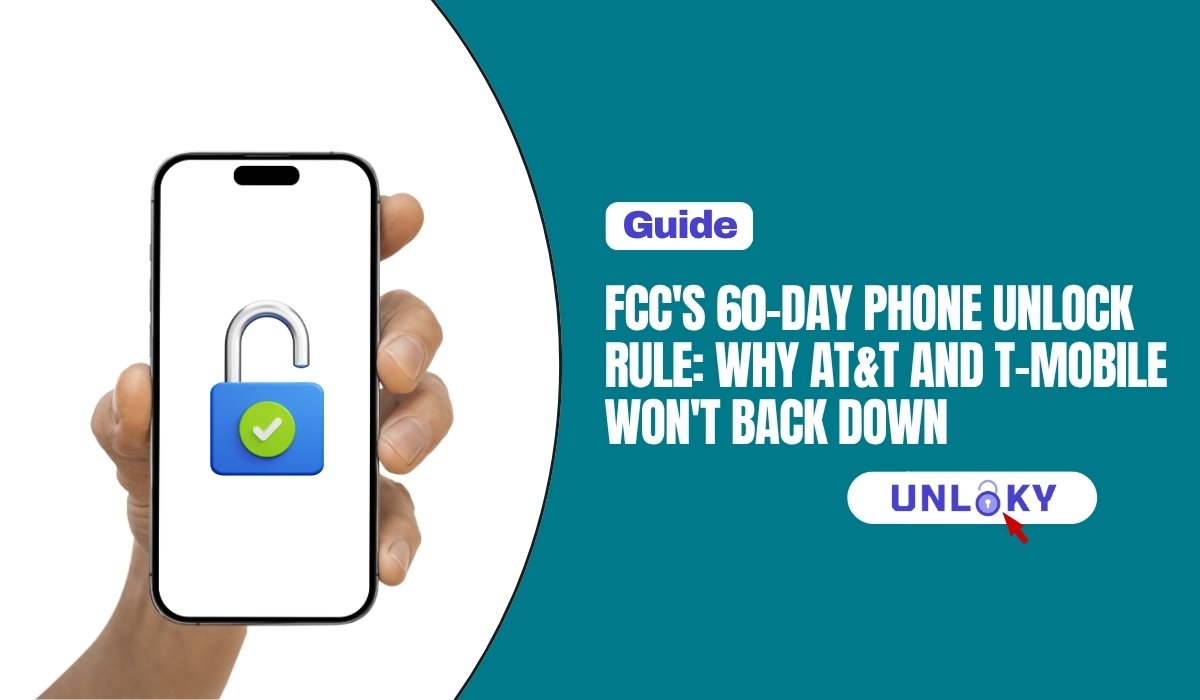
The FCC wants every carrier to unlock your phone 60 days after you turn it on. Two years later, that plan still isn’t a rule — and the one carrier that did have a 60-day clock just got released from it.
TL;DR — The Honest Quick Answer
- Days after activation the FCC proposed as the unlock deadline
- Final unlocking rules adopted since the docket opened in 2024
- Cut in prepaid phone subsidies T-Mobile told the FCC to expect
- Days lawmakers and cable groups are now asking for instead
What the FCC actually proposed
In July 2024, the FCC voted 5–0 to open a rulemaking with a simple idea at the center of it. Every mobile provider would have to unlock a handset 60 days after a customer activates it, unless the provider found within that window that the phone was bought through fraud. The docket number is WT 24-186, and it is still open today.
The reasoning was about switching. The Commission said it was looking at unlocking policies as a way to improve consumer choice and flexibility and strengthen competition across the wireless market. Right now a locked phone is a wall. You can find a cheaper plan, but you can’t take your phone to it, so you stay put.
One detail matters a lot and gets lost in most coverage: the proposal would apply whether or not the phone is paid off. That single sentence is the reason the carriers fought it so hard.
Why AT&T and T-Mobile pushed back
The comment period brought in a wall of paper. AT&T, Verizon and T-Mobile filed more than 160 pages of opposition between them, with AT&T alone writing 76 pages and T-Mobile 33.
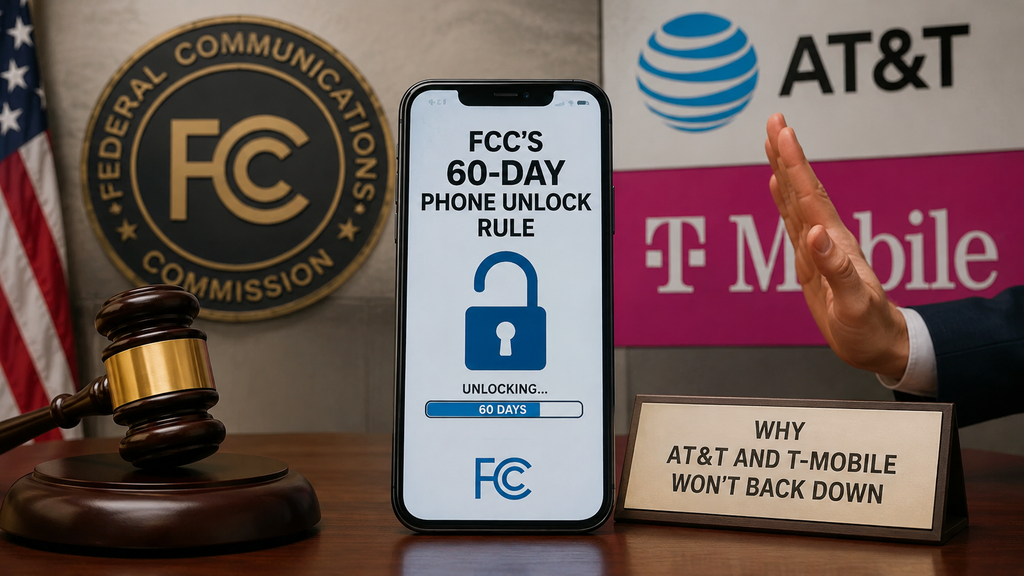
Their core argument is that a lock is not a punishment — it’s the collateral on a loan. Carriers buy an $800 phone, hand it to you for free or for $5 a month, then earn that money back over a year or two of service. Take away the lock, they say, and the loan has no security behind it.
AT&T, T-Mobile, CTIA
- T-Mobile told the FCC its prepaid customers would see subsidies cut by 40% to 70% on devices like the Moto G, Galaxy A15 and iPhone 12, and that providers would be left offering cheaper, weaker phones.
- AT&T said the rule would create upward pressure on handset prices and discourage flexible financing terms.
- Both argued the Commission has no authority to impose handset unlocking requirements at all, and that 60 days is not long enough to detect fraud.
- Carriers say a large share of losses come from people impersonating customers to walk out with devices — and on prepaid they often know almost nothing about the buyer.
State AGs, cable, consumer groups
- Fifteen state attorneys general, led by Massachusetts, urged the FCC to adopt the rule, saying inconsistent carrier timelines make buying a phone confusing and expensive.
- NCTA argues unlocking saves billions across the mobile market by expanding choice, competition and affordability.
- Smaller competitors point out that Verizon kept offering discounted devices for years while under a 60-day rule, so contracts — not locks — can secure the debt.
- Senators backing action cite figures showing American families spend over $2,000 more a year than necessary on mobile service, partly because of lock-in.
Both sides filed in FCC docket WT 24-186. Neither has won yet.
The twist: Verizon got out of its 60-day rule
Here’s the part that surprised almost everyone who had been following this.
Verizon had been under a 60-day unlock requirement since 2007, attached as a condition to spectrum it bought in the 700 MHz band. It was the only national carrier with that obligation. In May 2025 it asked the FCC to lift it — and on January 12, 2026, the FCC said yes.
The waiver means Verizon now only has to follow the wireless industry’s voluntary CTIA code, which calls for unlocking prepaid devices a year after activation and postpaid devices once a contract, financing plan or termination fee is settled. Chairman Brendan Carr framed it as an anti-theft measure, saying the old rule pushed criminal networks toward one carrier’s handsets.
The effect on real customers was fast and not subtle. Verizon postpaid devices now unlock only after they’re paid off, with no fixed time requirement — and if you pay off the balance online, in the My Verizon app, or with a Verizon gift card, unlocking is delayed by an extra 35 days.
the FCC’s stated goal in both actions was the same word — uniform. In 2024 that meant pulling everyone down to 60 days. In 2026 it meant letting Verizon rise back up to the industry norm. Same goal, opposite outcome for consumers.
Where the fight stands in August 2026
The docket never closed, and the pressure to finish it is now coming from an unexpected side of the aisle.
FCC votes 5–0 to propose a uniform 60-day unlocking requirement for all providers.
AT&T, T-Mobile and Verizon file heavy opposition. Fifteen state attorneys general file in support.
Verizon petitions the FCC to waive the 60-day rule that applies only to it.
The waiver is granted. Verizon tightens its policy within weeks. The rulemaking is left unresolved.
Senators Lummis, Kennedy and Schmitt write to Chairman Carr asking the FCC to finalize a 180-day automatic unlocking rule for all carriers.
A coalition including SpaceX, NTCA, ACA Connects and the Rural Wireless Association files jointly, urging automatic unlocking within 180 days of activation.
Four Republican lawmakers send letters pressing Carr to resolve the open rulemaking and set a firm deadline after which phones must work on other networks. NCTA has argued for 180 days rather than 60, sharing the carriers’ fraud concerns to a point.
So the realistic outcome has shifted. Almost nobody outside consumer groups is still pushing for 60 days. The live question is whether the FCC lands on 180 days, leaves the CTIA code as the de facto standard, or quietly closes the docket without acting.
What your carrier actually does today
Ignore the headlines for a second. This is the clock you’re really on if you bought your phone from a carrier.
| Provider | Postpaid | Prepaid | Catch to watch for |
|---|---|---|---|
| AT&T | 60 days of active service and paid in full | About 6 months | Account must be current and the device not reported lost or stolen |
| T-Mobile | 40 days on the requesting line and paid in full | 365 days, or $100+ in refills | Limit of two unlocks per line in any 12 months |
| Verizon | Paid in full — no fixed waiting period | Tightened in 2026; devices no longer auto-unlock at 60 days | 35-day delay if you pay the balance online, in-app, or with a Verizon gift card |
| Mint / Ultra Mobile | 60 days after activation | A merger commitment T-Mobile agreed to — shorter than its own prepaid rule | |
Policies as published by the carriers in mid-2026. Carriers change these without much notice, so confirm before you plan a switch.
Notice what the table shows: T-Mobile’s own postpaid clock is already 40 days — shorter than the FCC’s proposal. The fight was never really about the number of days. It was about the words and paid in full.
What this means for you right now
No rule is coming this month, and probably not this year. That leaves you with the old-fashioned options, which still work fine.
Almost every denial comes down to one of two things: not enough days on the network, or a financing balance that isn’t zero. Confirm both before you request anything.
This is specific to Verizon, and it’s the single most expensive detail in this article. Paying the balance online can add 35 days to your wait.
If you travel, use a local SIM abroad, or plan to switch within a year, buying the phone from Apple, Samsung or Google skips the whole question. You pay more up front and trade away the subsidy — that’s the real deal being made.
Unlocking your own phone has been legal since 2014. What isn’t guaranteed is the timing — that’s set by each carrier’s policy. We break the law and each carrier’s fine print down in our guide to U.S. phone unlock laws.
Ask the carrier for the specific eligibility rule you failed. If they can’t name one, that’s when a formal complaint becomes worth your time.
Your carrier can tell you in one call whether your device is eligible today and, if not, exactly which requirement you haven’t met yet. These are the official lines — there’s no fee to unlock an eligible phone.
- 800-331-0500
- 800-937-8997
- 800-922-0204
- 1-888-225-5322
No. It is a proposal in an open FCC rulemaking, docket WT 24-186, adopted for public comment in July 2024. The Commission has not voted on final rules, and no carrier is required to follow a 60-day timeline because of it.
There’s no deadline. An open rulemaking can sit for years, and this one has now sat for two. Lawmakers wrote to Chairman Carr in July 2026 specifically asking him to resolve it and set a firm unlocking deadline — which tells you it hadn’t moved.
Because it splits the difference on fraud. Even NCTA, which supports an unlocking requirement, pushed for 180 days rather than 60 out of concern about handset fraud. Carriers have consistently said 60 days is too short to detect a fraudulent purchase. A longer window takes away their strongest objection while still setting a hard limit.
Yes, and it’s the biggest practical change of the last two years. Verizon used to unlock nearly everything automatically at 60 days. After the January 2026 waiver, devices stay locked until they’re paid off, and paying off through the app or website adds a 35-day delay on top.
Probably not automatically. Carriers asked that any requirement apply only going forward, and that free and installment-plan devices be excluded entirely. Rules like this usually land on devices sold after the effective date, with a transition period. Don’t buy a phone today expecting a future rule to rescue it.
Be careful here. Some third-party services genuinely process carrier requests. Others simply submit the same free request you could submit yourself, charge you for it, and fail if you’re not eligible. If your device isn’t paid off, no legitimate service can override that. Start with your carrier — it costs nothing.
Not always. Unlocking removes the carrier’s software lock, but the phone still needs the right bands and the new carrier’s approval of the device. Most recent iPhones and flagship Android phones handle all three U.S. networks fine. Older or carrier-exclusive models sometimes lose 5G coverage or specific features after a switch.
Ask them to name the exact eligibility requirement you failed and get it in writing through chat or email. Most refusals turn out to be a balance on a different line, a device flagged in a past claim, or an account not in good standing. If nothing explains it, you can file a complaint with the FCC’s Consumer Complaint Center at 1-888-225-5322.