
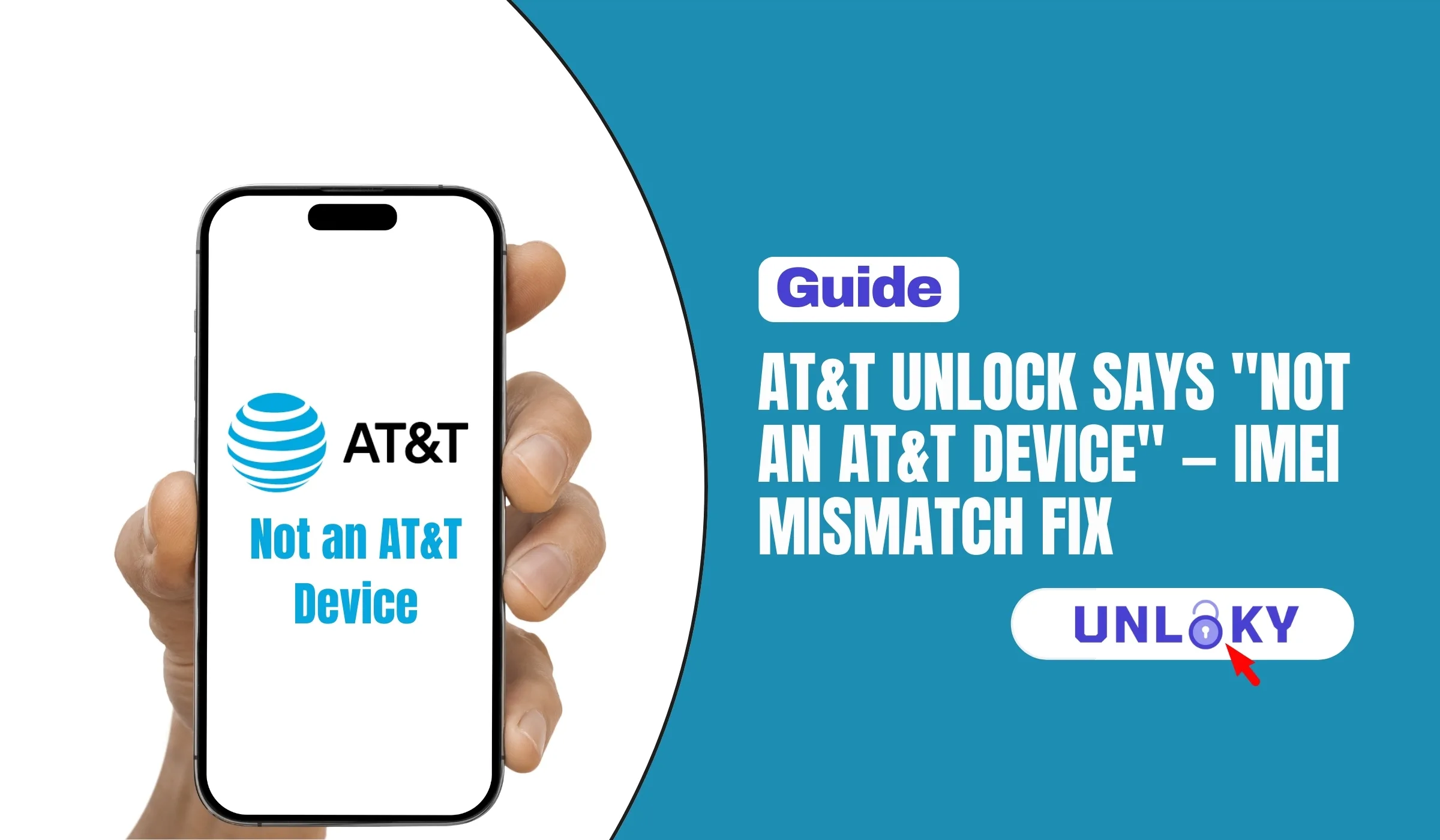
The “not an AT&T device” error means AT&T’s system doesn’t recognize your phone’s IMEI number in their database. This commonly happens with BYOD (Bring Your Own Device) phones, refurbished or second-hand devices, and phones that had their IMEI swapped during an Apple or carrier replacement. To fix it, first double-check your IMEI by dialing *#06#. Then try using the Non-AT&T Device portal at att.com/deviceunlock/nonattunlock. If that fails, contact AT&T support directly at 611 or 1-800-331-0500 and ask them to manually register your IMEI in their system.
You’ve done everything right. Paid off your phone. Met all the unlock requirements. Gone to the AT&T device unlock page, typed in your IMEI, and then… the portal spits out an error message: “Looks like the IMEI number you entered doesn’t match an AT&T device.”
Frustrating? Absolutely. But you’re not alone. This is one of the most common issues people run into when trying to unlock a phone through AT&T. The good news is that in most cases, there’s a clear reason behind it — and a workable fix.
Let’s walk through what’s going on, why your phone is getting rejected, and exactly what you can do about it.
What Does “Not an AT&T Device” Actually Mean?
When you submit an unlock request on AT&T’s device unlock portal, the system checks your 15-digit IMEI number against its internal database. If AT&T can’t find your IMEI in that database, it throws out the “not an AT&T device” error — even if the phone is absolutely locked to AT&T.
The thing is, AT&T’s database isn’t perfect. It doesn’t always have records for every device that’s ever been used on their network. And certain situations — like buying a refurbished phone, getting a replacement from Apple, or using a BYOD device — can create gaps in their records.
So the error doesn’t necessarily mean your phone isn’t an AT&T device. It just means AT&T’s system can’t match it to their records right now.
Why Does the IMEI Mismatch Happen?
There are several common reasons why AT&T’s unlock portal doesn’t recognize your phone. Understanding which one applies to you will help you pick the right fix.
This is the number one reason people hit this error. If you bought a used iPhone or Android device from eBay, Swappa, Facebook Marketplace, or even a local store, the original owner’s account info is what AT&T has on file. When a device changes hands — especially through unofficial channels — AT&T’s records don’t automatically update. The IMEI stays tied to the original account, or in some cases, it drops out of their system entirely.
If your original phone was replaced through Apple (either at an Apple Store or through AppleCare), the replacement device comes with a brand new IMEI number. Apple ships these replacements directly, and the new IMEI doesn’t always get reported back to AT&T’s database. So when you try to unlock the replacement phone, AT&T has no idea it exists in their system. Users on Apple’s community forums have reported this exact scenario multiple times.
If you brought your own unlocked phone to AT&T’s network — meaning you didn’t buy it from AT&T — the unlock portal may not recognize it at all. AT&T’s system primarily tracks devices that were sold through their own stores, authorized retailers, or installment plans. A BYOD device was never in their sales database to begin with, which is why you get the mismatch error.
Phones bought from retailers like Best Buy, Walmart, or Costco sometimes take a few days — or even weeks — to register in AT&T’s IMEI database. Some users have reported that devices purchased during holiday sales (like Black Friday) didn’t show up in AT&T’s system for up to 14 days. In rarer cases, the registration simply never happens on AT&T’s end.
This sounds basic, but it happens more than you’d think. IMEI numbers are 15 digits long, and a single wrong digit will produce the “not found” error. Some phones display both an IMEI and an IMEI2 (for dual-SIM models), and entering the wrong one can cause issues. Always dial *#06# on your phone’s keypad to confirm the correct IMEI.
IMEI Mismatch Causes at a Glance
| Cause | Why It Happens | Fix Difficulty |
|---|---|---|
| Refurbished / Used Phone | IMEI tied to original owner’s account or dropped from database | Medium |
| Apple Replacement Device | New IMEI never reported to AT&T after hardware swap | Hard |
| BYOD Phone | Device was never sold through AT&T — not in their sales database | Easy |
| Third-Party Retailer Purchase | IMEI registration delayed or missing from AT&T’s system | Medium |
| Wrong IMEI Entered | Typo or used IMEI2 instead of primary IMEI | Easy |
How to Fix the “Not an AT&T Device” Error
Now for the part you actually came here for. Here’s what to do, step by step, depending on your situation.
Step 1: Verify Your IMEI Number
Before anything else, make sure you’re entering the right IMEI. Open your phone’s dialer and type *#06#. This will display your device’s IMEI number on screen. Write it down carefully and double-check each digit against what you’re entering in AT&T’s portal. If your phone has two IMEI numbers, use the first one (IMEI1).
Step 2: Try the Non-AT&T Device Unlock Portal
AT&T actually has a separate unlock page specifically for devices that aren’t showing up as AT&T phones. Go to att.com/deviceunlock/nonattunlock and submit your request there as a “Non-AT&T Mobility Customer.” This portal is designed for people who don’t have an active AT&T account or whose device isn’t registered in AT&T’s main system. Many people have had success using this route when the regular portal rejected them.
Step 3: Insert an AT&T SIM Card (If Possible)
Here’s a trick that’s worked for quite a few people in online forums. If you can get your hands on an active AT&T SIM card — even borrowing one from a friend temporarily — pop it into your phone and let it sit for 24-48 hours. This can sometimes force AT&T’s system to recognize the device’s IMEI and add it to their database. After that waiting period, try the unlock request again.
Step 4: Call AT&T Customer Support
If the online portal keeps rejecting you, it’s time to call. Dial 611 from an AT&T phone or 1-800-331-0500 from any phone. Ask to speak with the device unlock department. Explain the situation clearly — tell them your IMEI, that the portal says it’s not an AT&T device, and whether the phone is refurbished, a replacement, or a BYOD device. Customer support agents can sometimes manually look up and register your IMEI in their system where the automated portal cannot.
If the first rep can’t help, ask to be escalated to Tier 2 support. Higher-level agents have access to more tools and can sometimes push through unlock requests that the standard system rejects. Be polite but persistent — and have your proof of purchase ready if you bought the phone second-hand.
Step 5: Contact Apple (For Replacement iPhones)
If your iPhone was replaced through Apple and AT&T can’t find the new IMEI, call AppleCare at 1-800-275-2273. Ask to speak with Tier 2 support and explain that your replacement device’s IMEI isn’t in AT&T’s database. Apple’s senior advisors can sometimes update or re-send the IMEI information to AT&T on your behalf. Having the original device’s serial number or the AppleCare case number will make this process much smoother.
Step 6: Wait and Try Again (Third-Party Retailer Purchases)
If you just bought a phone from Best Buy, Walmart, or another third-party retailer, the IMEI might not be in AT&T’s system yet. Give it at least 14 days from your purchase date before trying the unlock portal. Some retailers take longer to report device registrations to AT&T. If it’s been more than two weeks and you’re still getting the error, contact both the retailer and AT&T to sort things out.
AT&T’s Device Unlock Requirements (2026)
- Device purchased at least 60 days ago. AT&T won’t unlock a phone that’s been active for less than 60 days on their network.
- Device is fully paid off. Any remaining instalment balance must be zero. You can check your balance through your AT&T account online.
- Not reported lost, stolen, or involved in fraud. If the device has been flagged, AT&T will refuse to unlock it — no exceptions.
- Account in good standing. Your AT&T bill cannot be past due. All payments need to be current before they’ll process an unlock.
- For prepaid devices: The phone must have at least six months of active, paid AT&T Prepaid service before it qualifies for unlocking.
If you bought a second-hand phone that still has an unpaid installment balance from the original owner, AT&T will not unlock it. There’s no workaround for this — the device must be paid off first. Always check a used phone’s IMEI status before buying.
How to Check If Your Phone Is Already Unlocked
Before spending time fighting the unlock portal, there’s a chance your phone might already be unlocked. Here’s how to check:
On iPhone: Go to Settings → General → About and scroll down to Carrier Lock. If it says “No SIM restrictions,” your phone is already unlocked. If it says “SIM locked,” it’s still locked to a carrier.
On Samsung (before September 2025): Open Settings → About Phone → Software Information. Look at the “Service provider software version” line. If it ends in “ATT/ATT,” the phone is still locked to AT&T. If it contains “ATT” but ends in something else, it’s already been unlocked.
On Samsung (after September 2025): Go to Settings → Connections → More Connection Settings and look for Network Lock Status.
The SIM test: Pop a SIM card from a different carrier (T-Mobile, Verizon, etc.) into your phone. If you can make a call, your phone is unlocked. If you get a “SIM not supported” or “SIM not valid” message, it’s still locked.
Interestingly, some people have gotten the “not an AT&T device” error for phones that were already unlocked. If AT&T’s system doesn’t recognize the IMEI because the phone was never in their database (like a BYOD phone), it sometimes means the device was never carrier locked by AT&T in the first place. It’s worth testing with another carrier’s SIM before spending hours on troubleshooting.
Does AT&T Automatically Unlock Phones?
Yes — in many cases, AT&T will auto-unlock eligible devices without you having to do anything. If you have an Apple, Samsung, or Google device on an active AT&T Wireless plan and it meets all the unlock requirements, the phone should unlock on its own. You can verify this by checking your AT&T account overview, where it will show “Device unlocked” under your wireless number if the automatic unlock was successful.
However, auto-unlock doesn’t kick in for every device. Older phones, prepaid devices, and phones purchased from third-party sellers often require a manual unlock request. That’s where the portal — and its potential errors — come into play.
Yes, AT&T phones can be carrier unlocked. Once your device is paid off, has been active for at least 60 days, isn’t reported as lost or stolen, and your account is in good standing, you can request an unlock through AT&T’s device unlock portal at att.com/deviceunlock. Eligible Apple, Samsung, and Google devices may even unlock automatically once they meet all the requirements.
AT&T can deny an unlock request for several reasons: the device still has an outstanding installment balance, it’s been active for fewer than 60 days, the account has a past-due balance, the phone has been reported lost or stolen, or the IMEI doesn’t match a device in their system. For prepaid phones, you need at least six months of paid service before they’ll approve it.
Not every unlocked phone works on AT&T. Your phone needs to support AT&T’s LTE bands (bands 2, 4, 5, 12, 14, 17, 29, 30, and 66) and be on AT&T’s device whitelist. International or budget unlocked phones often lack the right band support or aren’t whitelisted, which means they won’t work properly — or at all — on AT&T’s network. Most recent iPhones and Samsung flagships work fine.
AT&T’s unlock process works by removing the carrier lock on your device so it can accept SIM cards from other carriers. You submit your phone’s IMEI through AT&T’s online portal, and if it meets all requirements, AT&T sends an unlock authorization to your device. For iPhones, the unlock happens over the air — just connect to Wi-Fi and the lock is released. For older Android phones, AT&T may send an unlock code that you enter manually.
AT&T does not charge any fee to unlock your phone. The unlock process is completely free as long as your device meets all the eligibility requirements. Be cautious of third-party services that charge money to unlock AT&T phones — in many cases, you can do it yourself for free through AT&T’s official portal or by calling their customer support.