
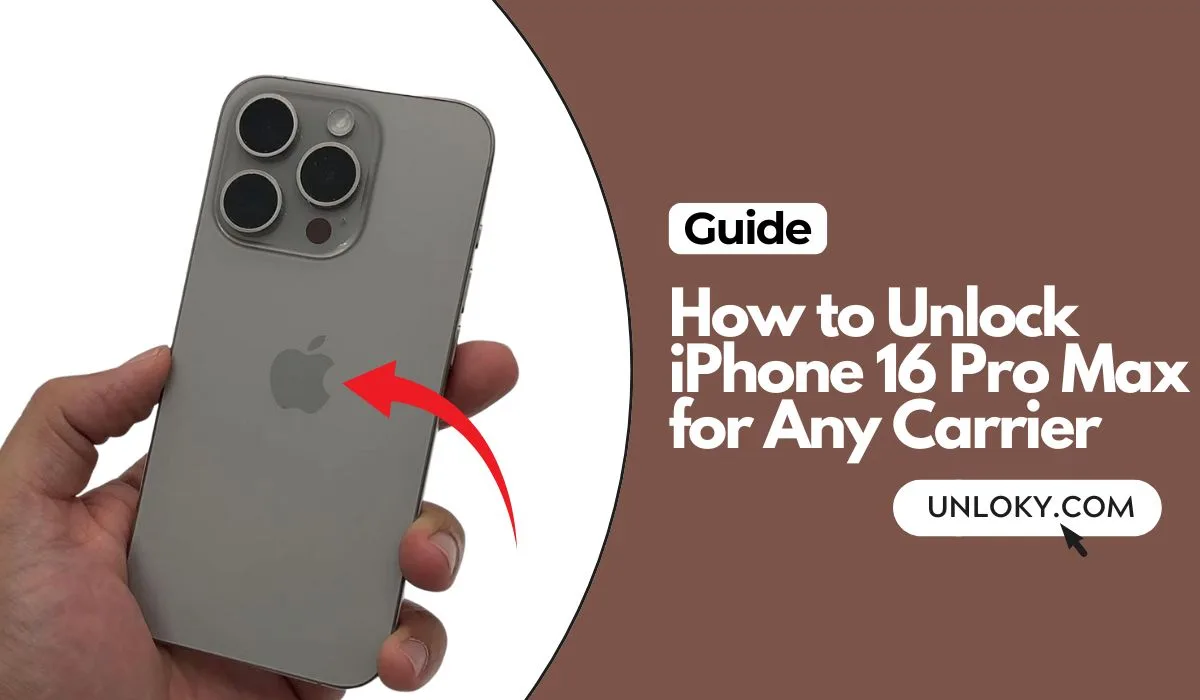
Unlocking your iPhone 16 Pro Max lets you choose the plan and price that fit you—whether that’s a big-three carrier, an MVNO with a cheaper monthly bill, or a local eSIM while you travel. The good news: the process is straightforward once you know who locked the phone and what each carrier requires. This guide walks you through everything—how to check lock status, the rules for each U.S. carrier, how eSIM changes the flow on iPhone 16 Pro Max, what to do if something goes wrong, and how to switch plans without losing service.
Key Takeaways
- Only your carrier can unlock it. Apple doesn’t unlock iPhones—once you meet your carrier’s rules (time-on-network, paid off, not lost/stolen), they flip it server-side and your phone shows “No SIM restrictions.”
- Timing varies by carrier. Expect eligibility windows (e.g., ~60 days on many networks) plus good-standing and payoff requirements; if it doesn’t unlock automatically, ask support to re-submit the IMEI.
- U.S. iPhone 16 Pro Max is eSIM-only. After it’s unlocked, you can add eSIMs from compatible carriers at home or abroad and run up to two active lines.
- Skip third-party “IMEI unlock” sites. Use the official carrier process—warranty isn’t voided by a legitimate carrier unlock, and always check the IMEI/blacklist status before buying used.
Can The iPhone 16 Pro Max Be Unlocked?
Yes—but it depends what you mean by “unlock.” If it’s carrier-locked, the iPhone 16 Pro Max can be unlocked only by the original carrier once you meet its rules (e.g., time on network, paid-off device); after approval the phone will show “No SIM restrictions.”
Avoid paid “IMEI unlock” sites—Apple doesn’t unlock iPhones and third parties can’t legitimately change that status. If you’re talking about a forgotten passcode or Activation Lock, the only safe path is to erase the device and sign in with the correct Apple ID (proof of ownership required); there’s no bypass.
📖 Also Read: How to Unlock iPhone 14 Pro Max for Any Carrier
First, make sure your iPhone 16 Pro Max is actually locked
Check in Settings
On your iPhone, go to Settings > General > About and look for Carrier Lock. If you see “No SIM restrictions”, your phone is already unlocked and ready for any compatible carrier or eSIM.
Know the eSIM reality on iPhone 16 Pro Max
Models purchased in the United States are eSIM-only (no physical SIM tray). Outside the U.S., some regions still include a nano-SIM tray—so your exact setup depends on where the phone was sold.
Quick SIM/eSIM sanity check
If you’re in the U.S., plan to activate via eSIM with your carrier or an eSIM app. If you’ll use the phone abroad, confirm that local carriers in your destination support eSIM (most do). Apple maintains a live list of carriers that support eSIM activation.
Ground rules that apply to every iPhone unlock
Only the carrier can unlock an iPhone. Apple doesn’t do the unlocking; carriers submit the unlock to Apple’s activation servers when you’re eligible. You request it from your current carrier.
Your account and device must be in good standing. Phones marked lost/stolen or linked to unpaid financing usually won’t be unlocked until resolved. (You can check stolen status using the industry’s free CTIA Stolen Phone Checker before you buy a used device.)
For U.S. models since iPhone 14: expect eSIM activation steps after the carrier processes your unlock; you won’t be popping in a physical SIM if you bought the phone in the U.S.
Step-by-step: The simplest path to an unlock
Step 1 — Find your IMEI
Dial *#06# or check Settings > General > About to copy the IMEI. You’ll need it for most unlock forms and to run any blacklist checks for peace of mind.
Step 2 — Verify it’s clean
Before you spend time on requests, use the CTIA Stolen Phone Checker to ensure the IMEI isn’t reported lost or stolen. A blacklisted device won’t work on many networks, even if unlocked.
Step 3 — Identify the original carrier
If you bought it from Apple outright, it’s typically unlocked (exceptions exist for certain AT&T financing options at Apple). If you bought through a carrier or a retailer activation, the phone will follow that carrier’s policy. Apple’s buy pages note that iPhones purchased directly from Apple are sold unlocked, aside from a few carrier financing exceptions.
Step 4 — Request the unlock (or wait for it to auto-complete)
Each carrier has its own timeline and rules. Once the carrier unlocks it on Apple’s servers, you’ll finish with a quick eSIM activation or by inserting a compatible physical SIM (outside the U.S. where trays exist).
Step 5 — Confirm “No SIM restrictions”
After you get the “unlocked” confirmation, restart the phone, connect to Wi-Fi, then return to Settings > General > About and verify Carrier Lock: No SIM restrictions. If it still shows locked, see troubleshooting near the end.
📖 Also Read: How to Unlock iPhone 13 Pro Max for Any Carrier
U.S. carrier unlock policies (2025 snapshot)
Carrier rules can change, so treat this as a clear starting point and always double-check your carrier’s current policy page before you submit a request. The summaries below reflect what those pages say right now.
Verizon (postpaid & prepaid)
Verizon locks new phones for the first 60 days. After that window, the phone normally unlocks on its own—as long as it hasn’t been reported lost, stolen, or bought fraudulently. This timing applies to both postpaid and prepaid accounts (for prepaid, it’s 60 days after paid activation and normal use). If your device doesn’t unlock on day 61, contact Verizon support and ask them to review the IMEI against their policy.
AT&T (including AT&T Prepaid)
On postpaid, iPhones are typically eligible after 60+ days—and only when the device is fully paid off, the account is in good standing, and the phone isn’t flagged for fraud. You submit your request through AT&T’s Device Unlock portal and can track the status there as well.
For AT&T Prepaid, expect a longer wait: most devices must show six months of paid service before AT&T will approve an unlock, provided the device isn’t lost/stolen and isn’t tied to another AT&T account.
T-Mobile (postpaid/Go5G, etc.)
T-Mobile will unlock eligible iPhones once certain boxes are checked: the device must be active on T-Mobile for at least 40 days, fully paid off if financed, and the account balance must be clear. iPhone unlocks are done remotely; if it doesn’t flip over automatically after you qualify, message support and ask them to push the unlock.
UScellular (transitioning to T-Mobile as of Aug 1, 2025)
Historically, UScellular phones followed a longer window. Postpaid iPhones are locked for 120 days (prepaid iPhones: also 120 days), after which UScellular auto-unlocks if the account is in good standing. Android timing can differ (e.g., 180 days for some prepaid Android phones). UScellular won’t unlock devices reported lost/stolen and can’t unlock phones sold by other carriers.
As of August 1, 2025, T-Mobile closed its acquisition of UScellular’s wireless operations. Legacy UScellular customers can still manage service as the networks integrate, but expect policy pages and processes to evolve over time. If you’re moving a UScellular handset to another network, the original carrier’s rules still apply get it unlocked by UScellular first.
Metro by T-Mobile (prepaid)
Most Metro devices must stay active for 365 days before Metro will unlock them (with the usual requirements that the phone isn’t lost/stolen and was purchased from Metro). Once you hit the one-year mark, follow Metro’s unlock instructions to finish up.
Cricket Wireless (AT&T network)
Cricket generally requires six months of paid service before it will unlock a device. There are military exceptions if you’re being deployed. Many Cricket Android phones are unlocked through the myCricket app; iPhones are handled server-side once you’re eligible.
Xfinity Mobile (Verizon network)
Xfinity Mobile’s standard is 60 days from activation, with the account in good standing and the device not flagged lost or stolen. If you meet the criteria and it hasn’t flipped, reach out via chat or phone and ask for a manual review.
Spectrum Mobile (Verizon network)
Spectrum Mobile unlocks after 60 days of active service on a paid-off device with an account in good standing. You’ll usually contact Spectrum support to complete the unlock if it doesn’t happen automatically.
Tracfone family (Total by Verizon, Straight Talk, Simple Mobile, etc.)
For TracFone brands activated on the Verizon network on or after Nov 23, 2021, phones typically auto-unlock after 60 days of paid active service. If your device was activated earlier or on another underlying network, different rules may apply, but newer Verizon-based activations follow the 60-day auto-unlock model.
📖 Also Read: How to Unlock iPhone 12 Pro Max for Any Carrier
How unlocking works behind the scenes
When a carrier approves your request, they flip a switch on Apple’s side. Your iPhone then reaches out to Apple’s activation servers (usually over Wi-Fi) and updates its lock status. On eSIM-only iPhones (like U.S. iPhone 16 Pro Max), you then activate a new eSIM from your new carrier (QR code, carrier app, or automatic activation). Apple’s support article spells out that you must contact the carrier first; Apple doesn’t override locks.
Switching carriers after the unlock (eSIM tips that save time)
Use carrier-supported eSIM activation. Most U.S. carriers and many global carriers support eSIM Carrier Activation or Quick Transfer, so setup is often as simple as scanning a QR code or tapping a prompt.
Traveling? Install a local or travel eSIM. An unlocked iPhone 14 and later purchased in the U.S. can activate with hundreds of carriers across 100+ markets that support eSIM. Keep your home line active on one eSIM and add a local data eSIM for cheaper roaming.
Two lines at once. iPhone models that support eSIM can store multiple eSIMs and use two active lines simultaneously (great for work+personal or travel). U.S. 16 Pro Max can run two active eSIMs at the same time.
Common scenarios (and the smartest move in each)
“I bought the iPhone 16 Pro Max from Apple, paid in full.”
It’s almost always already unlocked. Confirm in Settings > General > About. If you financed via a specific AT&T plan at Apple, that unit may be locked per AT&T’s rules—use the AT&T portal to unlock when eligible.
“I financed with my carrier and just paid it off.”
Some carriers unlock automatically on their timeline (e.g., Verizon 60 days). Others require a manual request via their portal or chat (e.g., AT&T). After approval, connect to Wi-Fi and check the Carrier Lock line again.
“I want to move to a cheaper MVNO.”
Unlock first, then pick an MVNO that runs on your preferred network (Verizon, AT&T, or T-Mobile). Your U.S. iPhone 16 Pro Max will activate via eSIM. MVNOs often offer QR-code activation in their app. (The exact MVNO policies vary—check each provider’s site.)
“This is a used phone and I’m not sure it’s clean.”
Run the CTIA Stolen Phone Checker before you invest time or money. If it’s blacklisted, it may never work on many carriers—even after an unlock.
What to avoid (so you don’t brick your plans)
Paid “IMEI unlock” sites that promise instant unlocks. Apple’s servers change status only when the original carrier authorizes it. Apple’s guidance is explicit: contact your carrier to unlock. Third-party “codes” do not apply to iPhones the way they do on some Android models.
Skipping the blacklist check on a used device. A clean unlock doesn’t override a lost/stolen block. Check first.
Troubleshooting after the carrier says “unlocked”
Refresh activation
Connect to Wi-Fi, restart the iPhone, and wait 1–2 minutes on the Home Screen. Then check Carrier Lock again.
Re-provision the line
If you’re switching carriers, install the new eSIM (QR code / app). For international eSIMs, follow the provider’s app steps; Apple’s support has a concise eSIM guide if activation stalls.
Update carrier settings
Go to Settings > General > About and accept any Carrier Settings Update prompt. This can fix “No Service” after an unlock.
Reset Network Settings
If calls/data still fail after an unlock, try Settings > General > Transfer or Reset iPhone > Reset > Reset Network Settings (you’ll re-enter Wi-Fi passwords).
Still locked?
Contact your previous carrier and ask them to re-submit the unlock to Apple’s servers. If they insist it’s unlocked but your device disagrees, escalate to a supervisor and have them verify the IMEI they unlocked matches your device. Apple’s doc reiterates that the carrier must complete the unlock on their end.
Carrier-by-carrier quick actions (links & specifics to check)
Verizon: Wait 60 days from purchase/activation; auto-unlock if the device isn’t flagged. If not unlocked on day 61, chat or call and reference the unlock policy.
AT&T: Use the Device Unlock portal once you hit the 60-day mark (postpaid) and the device is fully paid off; AT&T Prepaid often needs 6 months.
T-Mobile: Confirm you meet time-on-network and payoff rules (commonly 40 days on many plans); ask support to push the iPhone unlock if it doesn’t auto-complete.
UScellular: Historically 120 days; some devices sold unlocked. With T-Mobile’s acquisition (Aug 1, 2025), watch for updates. For BYOD to UScellular/T-Mobile, the original carrier must unlock first.
Metro by T-Mobile: 365 days of service before unlock. Use Metro’s instructions when eligible.
Cricket: 6 months (military exceptions exist). Use myCricket app for Android; iPhones are processed server-side.
Xfinity Mobile: 60 days active; account in good standing.
Spectrum Mobile: 60 days active; contact support to complete.
Tracfone family: Many Verizon-based devices auto-unlock after 60 days of paid service; check the official TracFone Unlocking Policy portal and your brand’s rules.
International use: the fast way to add local data on your unlocked iPhone 16 Pro Max
Install a local or travel eSIM for data in your destination. Keep your home eSIM for calls/texts, and route mobile data through the local plan. Apple’s guidance confirms wide eSIM support worldwide and explains how to set it up.
Dual-line control is easy. In Settings > Cellular, you can label lines (e.g., “Home” and “Travel”), pick which line handles Data, and choose which line to use for iMessage/FaceTime. Two active eSIMs are supported on models without a SIM tray.
FAQ (quick answers)
Does unlocking void my warranty?
No. Carrier unlocking is a server-side permission change. It doesn’t modify hardware or iOS.
Can I unlock faster by paying the balance early?
Paying off the device usually removes the financing block, but you still must meet the carrier’s time requirement (e.g., 60 days on Verizon, 40 days on many T-Mobile plans). Then the carrier can process the unlock.
Is a U.S. iPhone 16 Pro Max eSIM-only a problem abroad?
No—in most places you’ll activate a local eSIM using a QR code or carrier app. Apple maintains a list of carriers that support eSIM on iPhone.
Will my phone work on any network once unlocked?
It will work on any compatible network. Unlocking removes the carrier lock; it doesn’t add radio bands that your hardware doesn’t support. (The 16 Pro Max supports very broad bands, but check the exact model number and country bands if you’re moving regions.)