
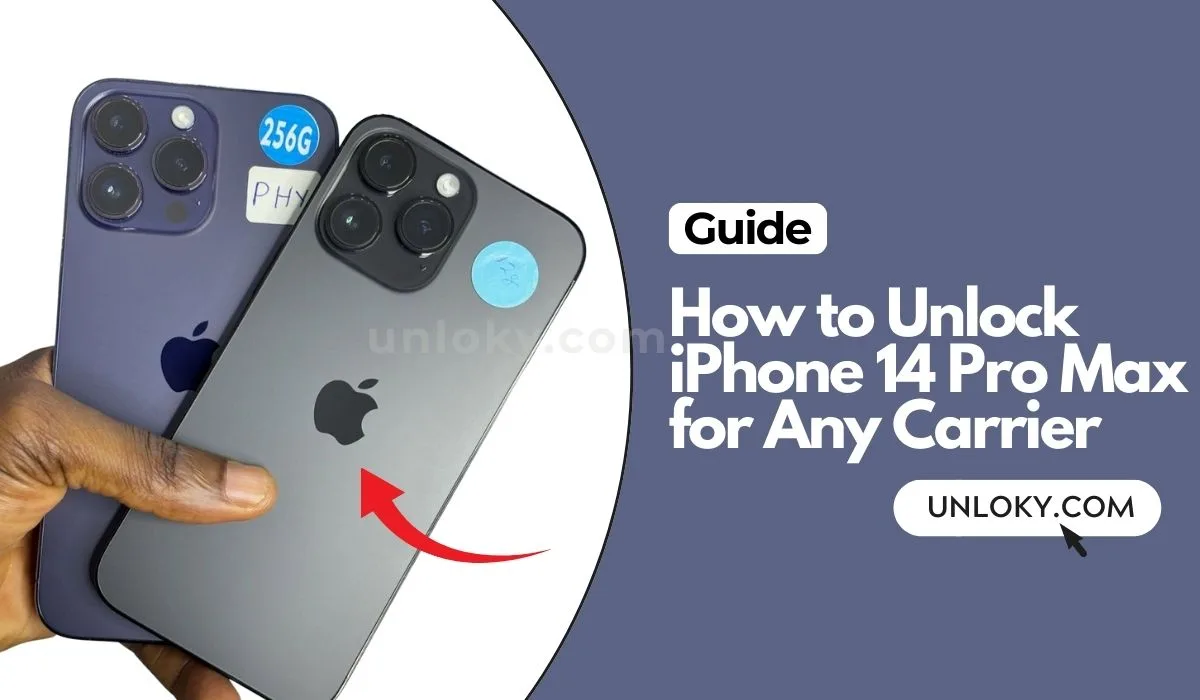
Unlocking your iPhone 14 Pro Max gives you freedom. You can switch to a cheaper plan, pop in a local eSIM while traveling, or sell the phone at a better price. The good news: on iPhone, carrier unlocking is clean and simple—there’s no secret code to type. Your carrier lifts a server-side lock, and your phone activates on any compatible network.
This guide walks you through how to check your lock status, understand eSIM on the iPhone 14 Pro Max, meet each carrier’s rules, request the unlock the right way, and set up service with a new carrier afterward. Everything is written in plain language with easy, repeatable steps.
Key Takeaways
- Check lock status: Settings → General → About → Carrier Lock; “No SIM restrictions” means unlocked.
If it says “SIM locked,” proceed with your current carrier. - Only the original carrier can unlock an iPhone. Meet their rules (paid off, time active, good standing) and submit the request.
- U.S. iPhone 14 Pro Max is eSIM-only. After unlock, add your new plan via Settings → Cellular → Add eSIM or the carrier’s app.
- iPhone unlocks are server-side—there’s no code to type. If you see “SIM Not Supported,” restart and ask the carrier to refresh the unlock.
- Skip third-party “instant IMEI unlock” sites. Official carrier unlocks are permanent, legal, and keep your warranty intact.
What “carrier-locked” means on iPhone
A carrier lock is a restriction set by the carrier that sold or financed your phone. When the lock is active, your iPhone will only activate with that carrier. Once your account is eligible and the carrier removes the lock, your iPhone can activate with other carriers that support your model.
You can check your status on the phone itself. Go to Settings → General → About, then look for Carrier Lock (sometimes shown as Network Provider Lock). If you see “No SIM restrictions,” your iPhone is already unlocked.
iPhone 14 Pro Max and eSIM: a quick heads-up
In the United States, every iPhone 14 model (including 14 Pro Max) is eSIM-only—there’s no physical SIM tray. If you bought your iPhone 14 Pro Max in the U.S., you’ll add or move service using eSIM instead of a plastic SIM card.
Outside the U.S., many iPhone 14 Pro Max units include a physical SIM tray and eSIM, so you can use either. The unlocking process is still controlled by the carrier.
📖 Also Read: How to Unlock iPhone 13 Pro Max for Any Carrier
Before you try to unlock: quick readiness checklist
Unlocks are easy when you meet your carrier’s rules. Most carriers look for a few basic things:
- Paid off or in good standing. If you financed the phone, pay it off or bring your account current.
- Wait period completed. Carriers require a minimum time active on their network (details below).
- Not reported lost or stolen. Devices flagged for fraud or theft are not unlockable.
- Right account info ready. You may need your phone number, account password/PIN, and IMEI (dial *#06# to view it).
If you bought the phone SIM-free directly from Apple and paid in full, it’s usually sold unlocked by default. Still, always confirm in Settings → General → About → Carrier Lock as above.
The official way to unlock an iPhone
On iPhone, there is no unlock code entry. Your current carrier updates Apple’s activation servers. After they approve the unlock, you just connect to Wi-Fi and reactivate the phone (or insert/add the new carrier’s eSIM). Apple’s guidance is clear: contact your carrier to unlock; if your iPhone shows “No SIM restrictions,” it’s already unlocked.
Tip: Third-party “IMEI unlock” websites often just forward your request to the carrier (or worse). For a clean, permanent unlock, always use the official carrier route.
Carrier-by-carrier rules and how to meet them
Below are the U.S. carrier policies most readers deal with. If you use an MVNO (a smaller provider that runs on a big network like Verizon or T-Mobile), check its own policy, because MVNO rules can be different from the parent network.
Verizon (Postpaid)
Rule in one line: Verizon locks phones for 60 days after activation, then auto-unlocks them if the device hasn’t been flagged for fraud or theft.
What to do
- Use your iPhone on Verizon for at least 60 days of paid service.
- After day 60, the unlock is automatic—no form needed.
- If you still see a lock after day 61, contact Verizon support and ask them to refresh the unlock.
Good to know
Hotlines and in-store reps can push a manual unlock if the auto process misses your line.
AT&T (Postpaid and Prepaid)
Rule in one line: AT&T unlocks eligible devices on request via its online portal. Some Apple devices on postpaid auto-unlock when eligible; AT&T Prepaid usually needs six months of service.
What to do
- Visit AT&T’s Device Unlock portal and submit your request with your IMEI.
- If you’re postpaid and fully eligible, Apple devices may unlock automatically; otherwise, you’ll get an email with status or next steps.
- Prepaid lines typically qualify after six months of active service.
Good to know
If you bought the phone from Apple (paid in full) and used it on AT&T, you can still unlock through the portal after eligibility is met.
T-Mobile (Postpaid and Prepaid)
Rule in one line: T-Mobile unlocks when you meet eligibility; for postpaid, the device must be active on T-Mobile for at least 40 days. When eligible, T-Mobile automatically unlocks within two business days if your phone supports remote unlock. Prepaid has a 365-day rule (or $100 in refills if less than 365 days, plus other conditions).
What to do
- Make sure your iPhone has been on T-Mobile for at least 40 days (postpaid) and is fully paid.
- If you’re eligible, T-Mobile triggers an automatic, remote unlock; for iPhone, you may need to contact support to submit the request.
- If you’re prepaid, check the 365-day rule or the refill alternative on T-Mobile’s policy page.
Good to know
If your line was canceled, the account balance must be zero before unlock. Military deployment exceptions exist; contact support.
Metro by T-Mobile (Prepaid)
Rule in one line: Metro auto-unlocks eligible devices after 365 days from activation; some models need a manual step if remote unlock isn’t supported.
What to do
Use the device for a full year on Metro, then watch for the unlock to trigger. If nothing changes, contact Metro support for manual help.
📖 Also Read: How to Unlock iPhone 12 Pro Max for Any Carrier
TracFone brands (TracFone, Straight Talk, Total by Verizon, Simple Mobile, etc.)
Many TracFone-family brands share a common unlock policy. In general, the device must be active for a period and not reported lost or stolen; once eligible, the brand will provide the unlock. Always check the exact brand’s policy page.
Step-by-step: request and complete your unlock the right way
You only need to do this once per device.
- Confirm your status in Settings → General → About. If it says “No SIM restrictions,” you’re done—your phone is unlocked.
- Meet policy requirements for your current carrier (time active, paid off, account in good standing). See the sections above for the rule that applies to you.
- Request the unlock if your carrier requires a request (AT&T portal; T-Mobile support for iPhone). Verizon unlocks automatically after day 60.
- Activate with your new carrier. On iPhone 14 Pro Max in the U.S., you’ll add service with eSIM. See the next section for easy eSIM setup.
After you’re unlocked: set up a new line with eSIM
On iPhone 14 Pro Max purchased in the U.S., you will use eSIM to add or move service.
Ways to add eSIM
- Scan a QR code from your new carrier.
- Use the carrier’s app to download eSIM.
- Transfer an eSIM from your old iPhone during setup or later in Settings.
Apple notes that you can activate an unlocked iPhone 14 series device from the U.S. with hundreds of carriers across 100+ markets that support eSIM. Always confirm your destination carrier supports eSIM before you travel.
To start: turn on Wi-Fi, go to Settings → Cellular → Add eSIM (or Mobile Service → Add eSIM), then follow your carrier’s instructions. If your carrier pushes an eSIM automatically, a banner will guide you through the install.
Tip: The iPhone 14 Pro Max can store multiple eSIMs and keep two active lines at once. It’s handy for one line for daily calls and another for data or travel.
📖 Also Read: Activate a Verizon Unlocked Phone & APN Settings
Quick troubleshooting if the new line won’t work
Even after a successful unlock, you might hit a snag. Here’s how to solve the common ones fast.
“SIM Not Supported” or “Invalid SIM”
- This message usually means the carrier lock is still active or your new carrier doesn’t support activation for this model in your region. Re-check Settings → General → About → Carrier Lock and contact your original carrier to confirm the unlock is complete. Also ask the new carrier to confirm they support iPhone 14 Pro Max eSIM for your plan.
No signal or data after adding eSIM
- Turn Airplane Mode on and off, or restart the phone.
- Update Carrier Settings if prompted.
- Toggle Settings → Cellular → Cellular Data to the correct line.
- If needed, Reset Network Settings (this removes saved Wi-Fi networks).
eSIM won’t download
- Make sure you have a stable Wi-Fi connection.
- Verify the QR code or activation code hasn’t expired.
- Try the carrier’s app instead of QR, or ask support to re-issue the eSIM.
Used or second-hand iPhone 14 Pro Max? Read this first
Buying used can save money, but double-check two things before you pay:
- Carrier Lock: On the device, check Carrier Lock → “No SIM restrictions.” If you cannot access Settings, ask the seller to provide a short screen recording that shows it.
- Clean history: Phones reported as lost or stolen won’t unlock and may not activate even if they look fine. Ask for the original proof of purchase and verify the IMEI with the carrier.
If the phone was financed and the seller still owes money, carriers may refuse to unlock it until the balance is cleared. Always get a written note that the device is paid off and not tied to a delinquent account.
Putting it all together: a simple action plan
- Check lock status on your iPhone 14 Pro Max. If it says “No SIM restrictions,” stop—you’re already unlocked.
- Match your carrier’s rule (60 days for Verizon; request via portal for AT&T; 40-day minimum for T-Mobile postpaid; 365 days for Metro; brand-specific rules for TracFone family).
- Submit the unlock or wait for auto-unlock. Keep your account current and your phone on the network until it clears.
- Add your new eSIM in Settings → Cellular → Add eSIM, scan the QR or install from the carrier app, and pick which line carries data and iMessage.
Do this once, and your iPhone 14 Pro Max will stay unlocked for life.
FAQs
Does unlocking remove my Apple ID or Activation Lock?
No. Carrier unlocking is separate from Apple’s Activation Lock (Find My). Make sure the seller signs out of Apple ID and turns off Find My before you buy a used device.
Will unlocking affect my warranty or future iOS updates?
No. Official carrier unlocks are permanent and supported by Apple’s activation servers. Your phone continues to get iOS updates normally.
Can I unlock a phone still on installments?
Usually not. Carriers require the device to be paid off or the account to be in good standing; see your carrier’s exact terms.
How long does it take?
- Verizon: automatic at day 60 after activation.
- T-Mobile: automatic within two business days once eligible.
- AT&T: submit in the portal; many Apple devices auto-unlock when eligible, but you may still receive a status email.
I travel a lot—can I use a local eSIM for data?
Yes. If your iPhone is unlocked, you can add local eSIM plans in supported countries and switch data lines in Settings. Apple reports support from hundreds of carriers across 100+ markets; always confirm availability with the provider.
Conclusion
Unlocking the iPhone 14 Pro Max isn’t mysterious. Confirm your status in Settings, meet the simple carrier rules, and finish with an eSIM add from your new provider. Once done, you can chase better prices, better coverage, and easier travel—without buying a new phone.