
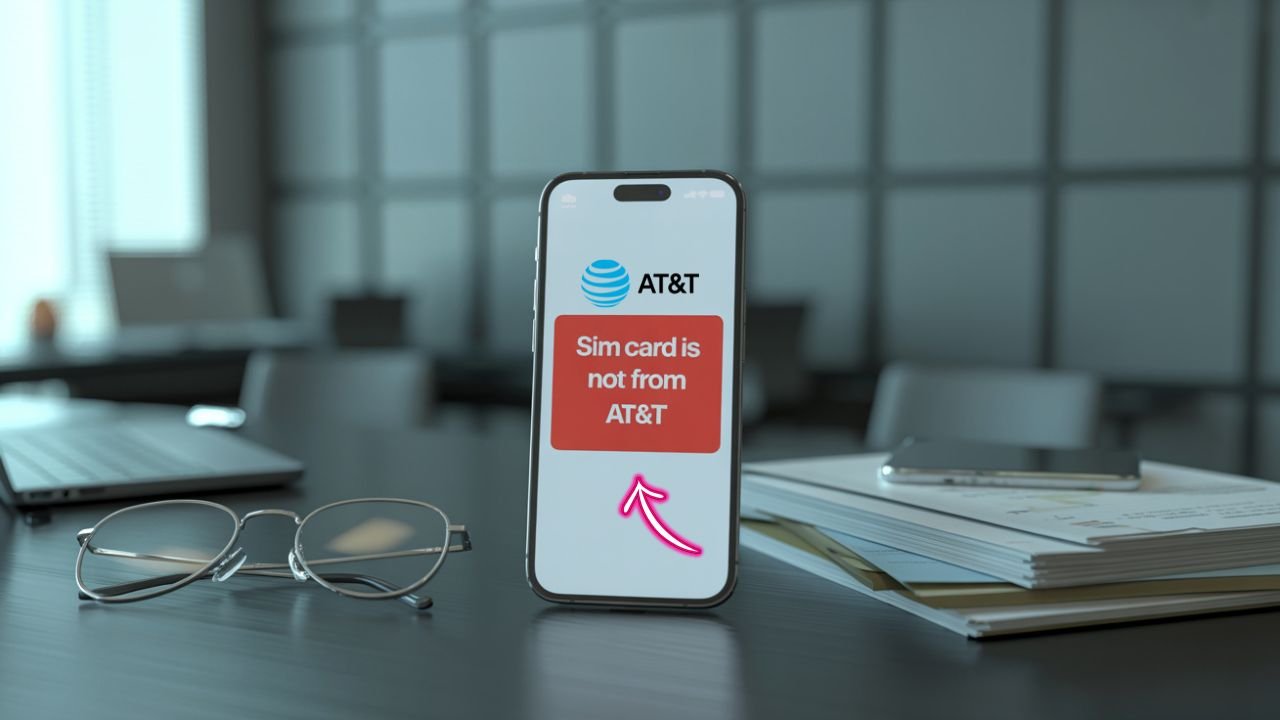
If your phone shows “SIM card is not from AT&T,” it usually means the device is still locked to AT&T’s network and you inserted a SIM from another carrier or MVNO. Sometimes it also pops up after switching to eSIM, moving abroad, changing plans, or restoring your phone. The good news is you can fix it—often in minutes—once you know why it appears and which steps apply to your phone.
In this guide, you’ll learn what the message really means, how to check if your phone is carrier-locked, and the exact steps to remove the error on iPhone and Android. We’ll also cover eSIM quirks, APN confusion, IMEI issues, and what to do if you bought a used phone that still shows the lock message.
Key Takeaways
- “SIM card is not from AT&T” almost always points to an AT&T carrier lock blocking a different carrier’s SIM/eSIM.
- Check lock status first (iPhone: “No SIM restrictions”; Android: try another carrier SIM).
- If locked, use AT&T’s official unlock process. iPhone unlocks via Apple’s server; Android often needs a code.
- If unlocked but still failing, it’s likely a setup issue: eSIM provisioning, dual-SIM line selection, or APN for data/MMS.
- Always check IMEI status when buying used to avoid blacklisted or financed devices that won’t activate.
What This Error Actually Means
Phones sold through carriers are usually “locked” to that carrier for a period of time or until certain conditions are met. When a device is locked and you insert a different carrier’s SIM (or try to activate a different carrier’s eSIM), the phone blocks network use and displays a message like:
- “SIM Not Supported”
- “SIM card is not from AT&T”
- “Invalid SIM”
- “Network unlock required”
If you’re seeing one of these, your phone is almost certainly carrier-locked, or the new SIM/eSIM hasn’t been provisioned correctly. Less commonly, the device’s IMEI has a problem (e.g., reported lost/stolen or has unpaid balance) which also prevents activation.
📖 Also Read: How to Fix “SIM Card Is Not From T-Mobile” (iPhone & Android)
Quick Checklist Before You Dive In
Use this short checklist to save time:
- Confirm the SIM’s carrier. Is the new SIM from an AT&T brand (AT&T, Cricket, some AT&T MVNOs) or a different network like T-Mobile/Verizon? The message appears most often when it’s not AT&T.
- Test an AT&T SIM. If you pop in a working AT&T SIM and the phone works fine, the device is still locked to AT&T.
- Check Carrier Lock status (iPhone). Settings → General → About → Carrier Lock. If it says SIM locked (or shows a restriction), the phone is locked. If it says No SIM restrictions, your issue is likely setup or eSIM, not a lock.
- Check IMEI status. Make sure the phone isn’t blacklisted. (Search “CTIA stolen phone checker” or “IMEI blacklist check.”)
- Update software, reboot, reseat SIM. Simple, but this often clears activation glitches.
If the device is locked and you want to use another carrier, you’ll need to unlock it (free once you meet the eligibility rules) or use it with AT&T service instead.
Common Reasons You See “SIM Card Is Not From AT&T”
- Device still locked to AT&T. You’re inserting a non-AT&T SIM/eSIM while the device remains locked.
- eSIM mis-provisioned. The eSIM QR or activation didn’t finish, or you have multiple eSIMs causing conflicts.
- APN confusion. Data settings (APN) don’t match the new carrier. (This won’t trigger the lock message itself, but it can look similar if you only notice “no service.”)
- IMEI block or financing hold. If the phone is flagged or not fully paid off, activation may fail.
- Region/carrier mismatch. Some models are hard-locked to a specific carrier variant.
- Used phone still locked. Marketplace devices sometimes arrive locked even if the listing claims “unlocked.”
How to Fix It on iPhone
Step 1: Verify Carrier Lock
- Go to Settings → General → About.
- Find Carrier Lock (or Network Provider Lock).
- No SIM restrictions: Your iPhone is unlocked. Skip to eSIM/SIM setup below.
- SIM locked or similar: Your iPhone is locked to AT&T. You must unlock before another carrier’s SIM will work.
Step 2: Try a Clean Activation (Unlocked iPhone)
If your iPhone is unlocked and still complains:
- Update iOS: Settings → General → Software Update.
- Remove and reseat the SIM (if using a physical SIM). Inspect for dust or damage.
- Toggle Airplane Mode for 30 seconds, then off.
- Reset Network Settings: Settings → General → Transfer or Reset iPhone → Reset → Reset Network Settings. (You’ll re-enter Wi-Fi passwords.)
- Carrier Settings Update: If prompted, tap Update.
- APN/Data Settings: For some MVNOs, go to Settings → Cellular → Cellular Data Network and input the carrier’s APN if required.
If you use eSIM:
- Remove old eSIM profiles you no longer need: Settings → Cellular → eSIMs (varies by iOS).
- Add eSIM again via QR code or Carrier Activation/Transfer.
- Reboot after adding.
Step 3: Request an Official Unlock (Locked iPhone)
If the iPhone shows SIM locked:
- Confirm you meet AT&T’s unlock rules. Generally you need a device that’s not flagged, is fully paid off, and has met the minimum active time. (Rules vary by plan/device; check AT&T’s official unlock portal for your IMEI.)
- Find the IMEI: Dial *#06# or check Settings → General → About.
- Submit an unlock request through AT&T’s official online portal (search “AT&T device unlock portal”).
- Wait for approval and follow the instructions AT&T sends.
- After approval, insert your new carrier’s SIM or activate its eSIM.
- Activate the unlock with iTunes/Finder if needed:
- Power off the iPhone, insert the new SIM, power on.
- If you get “SIM Not Supported,” connect to a computer with iTunes/Finder and complete activation while connected to the internet.
If you’re told the IMEI has issues (lost/stolen/financing), you’ll need to resolve those with the seller or AT&T before the unlock works.
Step 4: Advanced Resets (Only If Needed)
If everything should work but the iPhone still refuses the SIM:
- Full iCloud backup → Erase All Content and Settings → Restore.
- DFU restore via computer (last resort). This wipes and reinstalls firmware. Only do this if you’re comfortable and you have a complete backup.
📖 Also Read: How to Fix “SIM card is not from Verizon Wireless”
How to Fix It on Android
Android brands and menus differ, but these steps cover Samsung, Google Pixel, Motorola, OnePlus, and others on AT&T-compatible models.
Step 1: Check If the Phone Is Locked
- Insert a known-working AT&T SIM.
- If it works: phone is locked to AT&T.
- If it still doesn’t work: look for other issues (IMEI, hardware, firmware).
- Some phones show lock status under Settings → About Phone → Status or Network Unlock menus. If you see “Network Locked” or “SIM Network PIN,” the device is locked.
Step 2: Basic Fixes for Unlocked Phones
If you believe the phone is unlocked but you still get errors:
- Update Android: Settings → System → Software update (or Settings → Software update on Samsung).
- Power off → remove SIM → power on → power off → reinsert SIM → power on.
- Reset Network Settings (varies by brand):
- Samsung: Settings → General management → Reset → Reset network settings
- Pixel/others: Settings → System → Reset options → Reset Wi-Fi, mobile & Bluetooth
- Check APN (for data/MMS): Settings → Mobile Networks → Access Point Names. Add your carrier’s APN if missing.
(Note: APN doesn’t remove a lock, but it fixes “no data” after activation.)
Step 3: Official Unlock Paths for Android
If the device is locked to AT&T, you have two typical paths:
- AT&T Unlock Code (many Android models)
- Gather IMEI (*#06#), confirm eligibility with AT&T.
- Submit the unlock request at the official portal.
- When approved, AT&T provides either an unlock code or pushes a server-side unlock.
- If you receive a Network Unlock Code (NUC):
- Power off, insert the non-AT&T SIM.
- Power on; you’ll see “SIM network unlock PIN” prompt.
- Enter the code exactly once (you usually get limited attempts).
- Reboot if prompted and test calls/data.
- Server-Side/Remote Unlock (some models)
- AT&T processes an unlock in the background; your phone shows a message like “Network unlock successful.”
- Reboot and insert your new SIM.
If AT&T denies the request due to financing or IMEI status, you’ll need to resolve that first (e.g., pay off remaining balance, ask the seller to clear it, or return the device).
Step 4: eSIM on Android
More Android phones now support eSIM (Pixel, Samsung Galaxy S/Flip/Fold, Motorola, etc.). To fix activation issues:
- Remove old eSIMs you don’t need.
- Add the new carrier’s eSIM: scan their QR or use the carrier app.
- Set Preferred SIM for calls/data under Settings → Connections → SIM Manager (Samsung) or Settings → Network & Internet → SIMs (Pixel).
- Reboot and test.
📖 Also Read: How to Unlock a Total Wireless Phone (iPhone, Android)
Special Cases That Confuse People
1) AT&T MVNO vs. Non-AT&T Networks
If your phone is AT&T-locked and you put in a SIM from an AT&T MVNO (like some plans on H2O, RedPocket, PureTalk, etc.), it may still work because those services run on the AT&T network. If you insert a SIM from T-Mobile or Verizon (or their MVNOs), the lock error will appear until you unlock.
2) “SIM Not Supported” on iPhone After Unlock Approval
Occasionally, iPhones need a fresh activation to “learn” they’re unlocked:
- Connect to Wi-Fi and insert the new SIM.
- If it still fails, connect to a computer with iTunes/Finder and complete activation there.
- Make sure you’ve signed out of SIM restrictions or MDM profiles if it’s a corporate phone.
3) Dual-SIM Conflicts
With dual-SIM iPhones and Androids, having multiple eSIMs plus a physical SIM can confuse default lines.
- Temporarily disable all lines except the one you’re activating, then turn others back on.
- Set Default Line for calls and Cellular Data to the new carrier.
4) Blacklist/IMEI Problems
If an IMEI is reported lost/stolen or has unpaid balances, many carriers will refuse activation—even with an unlock.
- Run an IMEI blacklist check with a reputable checker.
- If it’s blacklisted, contact the seller or original owner to resolve it, or return the phone if you can.
5) International Travel
Using a local SIM abroad in a locked phone won’t work. You must unlock first or use AT&T’s roaming. eSIM local plans are great, but only on unlocked devices.
Step-by-Step: Fast Unlock Game Plan
If you just want the shortest path to fix the error, follow this flow:
- Test with AT&T SIM
- Works → phone is locked to AT&T.
- Doesn’t work → check IMEI and hardware.
- If locked and you want a different carrier
- Gather IMEI (*#06#) and go to AT&T’s official unlock portal.
- Submit request → wait for approval → follow the unlock instructions (code for Android, activation for iPhone).
- After approval, insert the new SIM or activate the eSIM and reboot.
- If unlocked but still not working
- Update software, reseat SIM, reset network settings.
- Remove unused eSIMs; re-add new eSIM correctly.
- Add APN for data/MMS.
- Connect to iTunes/Finder (iPhone) for a clean activation.
- If IMEI is blocked or financing holds exist
- Resolve with seller/AT&T. Unlocks won’t go through until the IMEI is clean.
eSIM Troubleshooting Tips (Both iPhone & Android)
- Delete and re-add the eSIM if activation stalled.
- Use strong Wi-Fi during activation; poor connectivity can break the process.
- Keep only one active line during setup. After it works, turn your other lines back on.
- Check carrier apps: Some providers require their app to push activation.
- Rename your lines to avoid confusion (e.g., “AT&T eSIM,” “Travel eSIM”).
How to Tell If Your Phone Is Truly Unlocked
- iPhone: “Carrier Lock: No SIM restrictions” in Settings → General → About.
- Android: Insert SIMs from two different carriers and confirm both work; or look for a Network Unlocked status in device info. Some Androids show Network Lock → “Off.”
If your phone is unlocked and you still see “SIM card is not from AT&T,” you’re likely dealing with an eSIM setup issue, a line selection problem (dual-SIM), a carrier provisioning delay, or an APN/data configuration issue—not a lock.
Buying/Selling: Avoiding the Lock Surprise
- Always check IMEI before buying a used phone.
- Ask the seller for proof of factory unlock or carrier unlock approval.
- For iPhone, ask for a screenshot of No SIM restrictions.
- For Android, verify with a non-AT&T SIM on the spot if possible.
- Beware of “financed but unlocked” claims; phones can be relocked or blocked later if payments stop.
FAQs
Why does my iPhone say “SIM Not Supported” after I requested an unlock?
It may take time for Apple’s servers to update. Insert the new SIM with Wi-Fi enabled, or connect to iTunes/Finder to complete activation. If it persists, contact AT&T with your IMEI and approval email.
Do I need an unlock code for iPhone?
No. iPhones unlock via Apple’s servers after AT&T approves the IMEI. There is no manual code entry for iPhone.
Do Android phones always need a code?
Not always. Many do, but some models unlock via an over-the-air server push. AT&T’s instructions will specify your method once approved.
Will APN settings remove the lock?
No. APN affects data/MMS after activation. A lock is removed only by an official carrier unlock (or by using AT&T service if you stay on that network).
What if the seller won’t help and the phone is blocked?
Your options are limited. If you bought through a marketplace with buyer protection, open a dispute. Otherwise, you may be stuck with a device that won’t activate on many networks.
Can a software update lock my phone again?
No. Legitimate carrier unlocks are permanent. Software updates won’t relock an officially unlocked phone.
Troubleshooting Scripts You Can Follow
Script A: iPhone with a Non-AT&T SIM
- Settings → General → About → Carrier Lock
- If locked → request unlock from AT&T.
- If unlocked → continue.
- Update iOS → reboot.
- Remove other eSIMs → Add eSIM from your new carrier again (or insert physical SIM).
- If “SIM Not Supported,” connect to iTunes/Finder and complete activation.
- Reset Network Settings if you still have no service or only SOS.
- Add APN for the new carrier if mobile data/MMS fails.
Script B: Android with a Non-AT&T SIM
- Insert a known AT&T SIM.
- Works → phone is AT&T-locked → request official unlock.
- After unlock approval:
- If you got a code, insert the non-AT&T SIM and enter the code when prompted.
- If it’s server-side, you should see confirmation of Network Unlock → reboot.
- Update Android, reset network settings, and set the correct APN for data/MMS.
- For eSIM, delete old profiles, add the new eSIM, set as preferred line, reboot.
When to Contact Support
- Your IMEI shows as unlocked, but activation still fails after all steps.
- You entered the correct Android unlock code and it’s rejected.
- eSIM activation errors keep looping or show “Activation server temporarily unavailable.”
- You suspect the phone is blacklisted or incorrectly flagged.
Be ready with:
- IMEI
- Model number and iOS/Android version
- Carrier you’re switching to
- Screenshots of the error and lock status
Troubleshooting Without Jargon (For Beginners)
Think of your phone like a door with a key. AT&T gave you the phone with a lock that only their key opens. If you put a different key (another carrier’s SIM) into the lock, the door won’t open until AT&T removes the lock. Once the lock is removed (official unlock), any key that fits (any carrier’s SIM that’s compatible) will open the door. If the lock is already gone but the door still won’t open, then the problem isn’t the lock—it’s something like the door handle (settings) or a sticky latch (eSIM/APN). Clean up those parts, and it opens right away.