

Buying an unlocked phone at Walmart sounds easy—until you see pages of choices, carrier logos, “prepaid” stickers, and third-party sellers mixed together. This guide breaks everything down in plain language. You’ll learn whether Walmart really sells unlocked phones, what “unlocked to any carrier” means, how to check compatibility before you buy, and which unlocked phone styles deliver the best value in 2025. We’ll also cover when it makes sense to buy unlocked (and when it doesn’t), with easy step-by-step checks you can do in minutes.
Quick Answer
Yes—Walmart still sells true unlocked phones online and in many stores. Look for listings that say “Carrier: Unlocked” or “SIM-free.” Unlocked phones can work on any compatible carrier (AT&T, T-Mobile, Verizon, MVNOs), but always run the IMEI through your carrier’s BYOD checker first. For most people, the best value is an upper-midrange model; power users should pick a current flagship, and tight budgets should target recent models with 4–6GB RAM and 128GB storage. Buying unlocked is a good idea if you want plan flexibility, travel eSIMs, cleaner software, and better resale; downsides are full upfront price and the chance a few features (certain 5G bands, visual voicemail, Wi-Fi Calling on some imports) may vary. To use one, insert your SIM or add an eSIM, activate with your carrier, then test calls/text/data and enable Wi-Fi Calling.
First Things First—What “Unlocked” Actually Means
An unlocked phone is a device that isn’t restricted by software to one carrier. When a phone is locked, it can only be used on the original network (until it’s officially unlocked). When a phone is unlocked, you can insert a compatible SIM or eSIM from another carrier, switch plans, and travel more freely. In short: unlocked = freedom, as long as the hardware and radio bands match your carrier’s network. The U.S. communications regulator explains it this way: unlocking lets you move your phone to another compatible network.
Does Walmart Still Sell Unlocked Phones?
Yes. Walmart sells a wide range of unlocked phones online and in many stores. On Walmart.com you’ll find a dedicated “Unlocked Phones” category with Apple, Samsung, Google, Motorola, and more. You’ll also see periodic deal pages that surface unlocked options. Selection changes often, but the unlocked category is very much alive.
You may also see “Unlocked Android Phones” broken out as a subcategory. That page usually lists current-year and previous-year models, from budget to premium. If you shop in store, local inventory will vary, but staff can usually point you to the unlocked section or confirm whether a box says “Unlocked.”
📖 Also Read: Clearance Unlocked Cell Phones: The Smart Shopper’s 2025 Guide
Are Walmart Phones Unlocked to Any Carrier?
It depends on which phone you pick:
- Walmart sells three broad types of phones:
- Unlocked (what you’re looking for),
- Carrier-locked postpaid phones (e.g., AT&T, Verizon, T-Mobile), and
- Prepaid phones (often locked to a prepaid brand like Walmart Family Mobile).
When a product page says “Carrier: Unlocked,” that device is sold SIM-free and isn’t tied to one network. If it says a carrier name or “Walmart Family Mobile,” it’s not unlocked.
- “Unlocked to any carrier” still requires compatibility.
Unlocked doesn’t guarantee your phone will work on every network feature (like 5G bands, VoLTE, or Wi-Fi calling). Always run the phone’s IMEI through your carrier’s BYOD (Bring Your Own Device) checker before you buy. AT&T, T-Mobile, and Verizon each offer a quick IMEI tool you can use in minutes.
Bottom line: Walmart does sell fully unlocked phones, but you must confirm it says “Unlocked,” and you should always run an IMEI compatibility check with your target carrier before paying.
Why Buy Unlocked at Walmart? (Pros, Cons, and Use Cases)
The Upside
Buying unlocked gives you real control:
- Freedom to switch. If you find a better plan, you can move—often by just swapping a SIM or scanning an eSIM QR code. The FCC’s guidance frames unlocking around this freedom to move between compatible networks.
- Travel made easy. When you land in another country, you can pop in a local SIM or install an eSIM data plan and avoid high roaming charges.
- No carrier bloat. Unlocked models typically have fewer preloaded apps.
- Better resale value. Unlocked phones are easier to sell because more people can use them.
The Trade-Offs
- Upfront cost. Unlocked phones are usually full price, while carriers may offer bill credits or bundles that lower the sticker shock—though those deals often come with time commitments.
- Limited in-store carrier support. Carriers naturally focus on devices they sold. You’ll still get device warranty support, but carrier reps may direct you back to your phone maker for device-specific help.
- Band and feature quirks. Even if IMEI checks pass, niche features (like certain 5G bands, visual voicemail on a small MVNO, or HD voice on a legacy plan) can vary by model.
When unlocked shines: you want the best plan at any time, you travel, you’re on a budget carrier, or you prefer clean software and fast updates.
📖 Also Read: Top Free Phone Unlock Apps for Android – Do They Really Work?
Best Unlocked Phone Styles to Buy at Walmart (and How to Choose)
Walmart’s lineup changes often, so think in tiers rather than chasing one exact model. Here’s a way to pick the “best unlocked phone to buy” based on your needs:
Flagship for Power Users and Creators
If you edit video, shoot lots of 4K, or want long OS support, look at current flagship families (e.g., Samsung Galaxy S-series, iPhone Pro). Walmart’s unlocked pages regularly feature current-gen and last-gen flagships; deal pages sometimes highlight big, short-term markdowns on premium models.
Why it’s “best” for you: top cameras, fastest chipsets, longest update support, best 5G performance, and the most robust accessory ecosystems.
Upper-Midrange for 90% of People
Upper-midrange phones give you a flagship-like experience for less: smooth displays, solid cameras, strong battery life, and long update promises. For example, Samsung’s midrange line saw excellent 2025 value coverage in the tech press, calling out deep discounts and years of updates—exactly the kind of device Walmart tends to carry unlocked.
Why it’s “best” for you: almost-flagship experience, way lower price, still gets years of updates.
Budget Under $250 (Everyday Use)
If you just need reliable calling, messaging, social apps, WhatsApp, and maps, Walmart’s “Unlocked Android” section usually has multiple budget models from Motorola, Samsung, and others. Prioritize:
- at least 4–6GB RAM,
- 128GB storage (or microSD support if offered),
- clear update commitment,
- carrier-band compatibility in the IMEI check.
Why it’s “best” for you: keeps costs low while covering the basics plus light photography and streaming.
iPhone Fans
If you prefer iOS, look for unlocked iPhone listings—new, previous-gen, or certified renewed. iPhones typically get 5–6+ years of software updates, strong resale value, and widespread accessory support. Walmart’s unlocked category and deals pages often include SIM-free iPhones alongside Android picks.
Why it’s “best” for you: long updates, tight app ecosystem, strong performance and camera quality even in older models.
How to Verify Compatibility Before You Buy (Takes 2–3 Minutes)
Even unlocked phones must match your carrier’s network. Here’s the safest path:
- Find the IMEI. On most phones, dial
*#06#or check Settings → About Phone to view the IMEI. Carriers explain this right in their BYOD pages. - Run the IMEI on your carrier’s site.
- AT&T BYOD: check compatibility and plan options.
- T-Mobile BYOD: quick IMEI checker (prepaid or postpaid).
- Verizon BYOD: IMEI checker for consumer and prepaid.
- Look for “Fully compatible.” If the tool flags issues (for example, missing VoLTE or specific 5G bands), consider a different model.
- Double-check eSIM support if you prefer eSIM-only activation.
Tip: If you plan to use an MVNO (like US Mobile, Visible, Cricket, Metro), run the IMEI on their site too. Most MVNOs use the same networks, but device whitelists and features can differ slightly.
Walmart Family Mobile vs. Unlocked—Know the Difference
Walmart Family Mobile (the store’s prepaid brand) sells phones and plans designed for that service. Those devices and kits are not the same as an unlocked, carrier-agnostic phone. Family Mobile even states that bringing your own phone requires an unlocked, compatible device—proof that “unlocked” is a specific thing separate from “prepaid.” If a listing says “Locked to Walmart Family Mobile,” that’s not the unlocked you want.
📖 Also Read: How to Unlock Your Phone for Use in Canada, the UK, and Europe
Is It a Good Idea to Buy an Unlocked Phone?
For many shoppers, yes—especially if you:
- Hunt for better monthly deals or switch carriers to chase promotions.
- Travel internationally and want cheap local data via SIM or eSIM.
- Value clean software and faster updates (often common on unlocked variants).
- Want strong resale value and flexibility later.
It’s not ideal if you want a heavy carrier subsidy that lowers the upfront cost, or if you prefer to keep service and support under one roof with a single bill. Still, the general consumer benefit of unlocking—being free to move to compatible networks—is widely recognized by the FCC and industry.
What to Watch for on Walmart Product Pages (So You Don’t Get the Wrong Phone)
- Exact “Carrier” field. It should read “Unlocked.” If it lists a carrier (Verizon, AT&T, T-Mobile, Walmart Family Mobile), it isn’t unlocked.
- Seller info. Walmart hosts first-party listings and marketplace sellers. Check seller ratings and fulfillment details.
- “Activation required” notes. If a listing mentions activation with a specific service, it’s not the unlocked device you want.
- Model year and bands. For best 5G coverage and futureproofing, newer is safer—especially if you live in a rural area that leans on specific bands.
- Return policy and warranty. Return windows for phones can be shorter than general items; read the fine print on the page and keep your receipt/confirmation email.
A Quick Reality Check on U.S. Unlocking Rules (Why This Matters)
The FCC has been weighing tighter, simpler rules to make unlocking more consistent across carriers—specifically discussing a 60-day unlock timeline. Industry debate continues (including feedback from major carriers), but the direction is clear: easier movement between networks helps consumers. Knowing this context helps you decide whether to buy unlocked now or wait for a carrier device to auto-unlock later.
Setup Guide—Bringing Your Walmart Unlocked Phone to a Carrier in Minutes
Step 1: Prep the Phone
Unbox the phone, charge it to at least 50%, and connect to Wi-Fi. While you’re on Wi-Fi, install any pending system and security updates—this avoids activation glitches later. If you’re moving from another device, back up your old phone (iCloud/Google) so you can restore apps and contacts after activation.
Have these numbers handy:
- IMEI (dial
*#06#or check Settings → About Phone) - EID (for eSIM models; shown in the same About screen)
If you’re porting your old number, also gather:
- Your current carrier account number
- Your port/transfer PIN (sometimes called “Number Transfer PIN”)
- The billing ZIP on your account
Quick sanity check: if you haven’t already, run the IMEI on your new carrier’s “Bring Your Own Device” (BYOD) checker. It takes 60 seconds and confirms network compatibility before you start.
Step 2: Choose SIM or eSIM
Most unlocked phones today support both. Pick what fits your plan and how fast you want to get going.
Physical SIM (simple and universal)
- Pop out the SIM tray with the included pin.
- Place the SIM with the metal contacts facing down, reinsert the tray, and power on.
eSIM (fastest and great for travel)
- Ask your carrier for an eSIM QR code or use their app to “Add eSIM.”
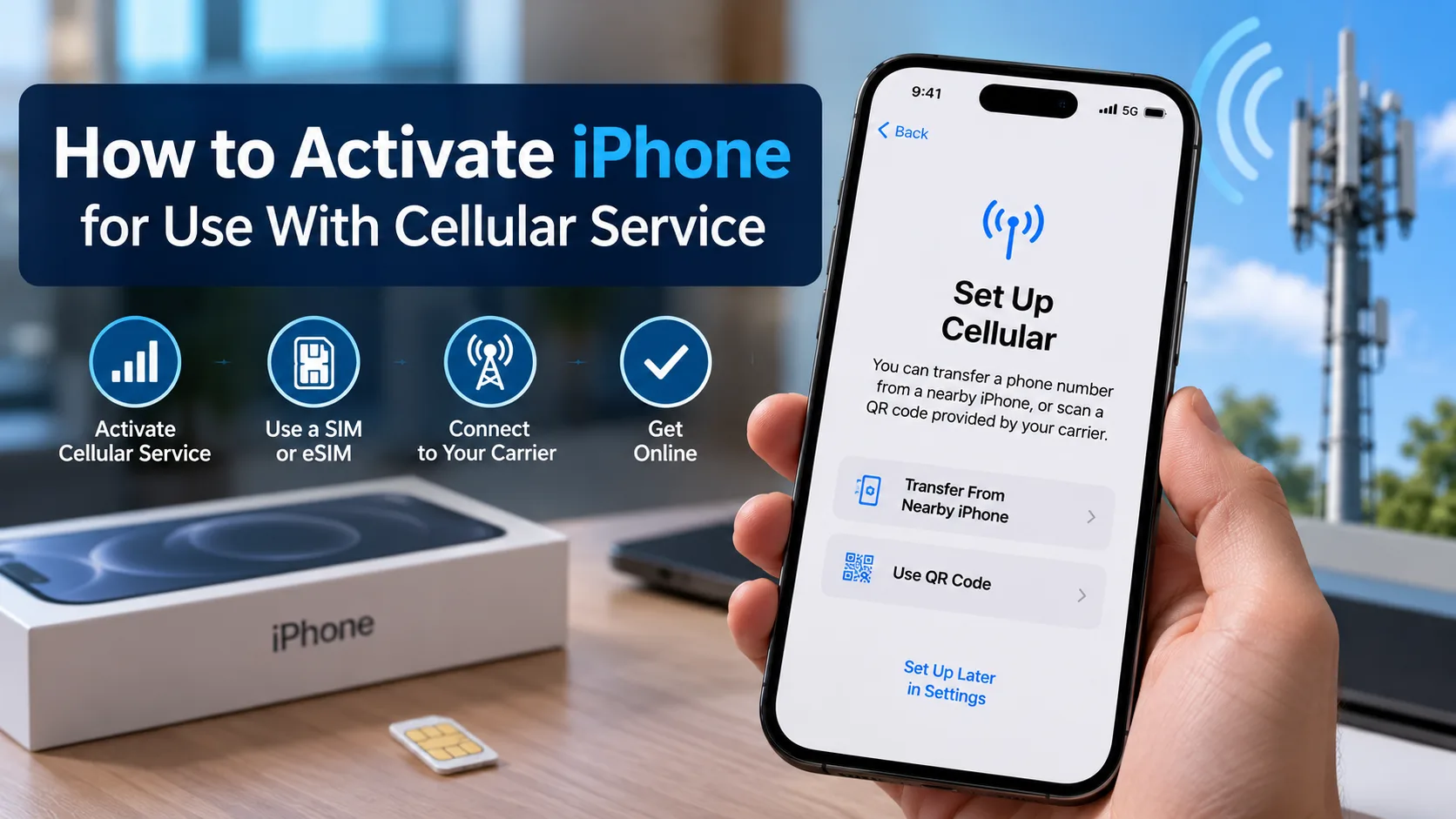
- On iPhone: Settings → Cellular (or Mobile Service) → Add eSIM → Use QR code or Transfer From Nearby iPhone if offered.
- On Android (Samsung/Pixel): Settings → Connections/Network & Internet → SIMs/Carrier → Add eSIM → Scan QR code.
Dual-SIM tip: You can keep two lines at once (e.g., personal and work, or domestic SIM + travel eSIM). Set which line handles data, calls, and iMessage/RCS in your SIM settings.
Step 3: Activate with Your Carrier
You can activate online, in the carrier app, or by calling support.
Typical flow
- Go to the carrier’s BYOD/Activate page or open their app.
- Enter your IMEI to confirm compatibility (if you didn’t already).
- Choose Keep my number (port) or Get a new number.
- If porting, enter your current account number and transfer PIN. Keep your old phone powered on until the port completes.
- For eSIM, scan the QR code when prompted. For physical SIM, just insert and follow the on-screen steps.
- Wait for the network to provision your line. This can be instant or take up to an hour. You may see “No Service” briefly—don’t worry.
After activation
- On iPhone, you may see a Carrier Settings Update prompt—tap Update.
- On Android, open Settings → System → Software Update to pull any remaining vendor updates.
Step 4: Confirm Calls, Texts, Data, and 5G
Do a quick end-to-end test so you know everything is live.
- Place a call to a friend or your voicemail.
- Send a text and a photo (MMS) to confirm messaging.
- Open a web page and run a speed test to confirm data.
- Check your status bar for LTE/5G. If you don’t see data:
- Toggle Airplane Mode on/off once.
- Restart the phone.
- Make sure Mobile Data is enabled.
- On Android: Settings → Network & Internet/Connections → Preferred network type → 5G/LTE/Auto.
- If data still fails on an MVNO, update APN:
- Android: Settings → Mobile Networks → Access Point Names → Add new APN (enter values from your carrier).
- iPhone: Settings → Cellular → Cellular Data Options → Cellular Network (this option appears only for some carriers; many push APNs automatically).
If you can call and text but MMS fails, it’s almost always an APN field (MMSC/MMS Proxy) or a plan feature not toggled yet—ask your carrier for their current APN sheet and compare line by line.
Step 5: Turn On Wi-Fi Calling (If Available)
Wi-Fi Calling keeps calls clear in weak-signal buildings and helps with 911 address accuracy.
- iPhone: Settings → Cellular → Wi-Fi Calling → On. Enter your E911 address if asked.
- Android (Samsung/Pixel): Settings → Network & Internet/Connections → Wi-Fi Calling → On. If you don’t see it, open the Phone app → Settings → Calls → Wi-Fi Calling.
How to test it
- Turn Airplane Mode on, then re-enable Wi-Fi.
- Place a call. If it connects, Wi-Fi Calling is working.
Common Hiccups & Fast Fixes (Keep This Handy)
“SIM Not Provisioned” / “No Service”: Wait 10–15 minutes after activation; toggle Airplane Mode; reboot. If it persists, the line may not be fully provisioned—contact the carrier to “refresh” the line.
eSIM fails to download: Make sure you’re on Wi-Fi, scan the QR again in a well-lit area, or ask the carrier to reissue a fresh QR. Some carriers require their app instead of a QR—follow their prompt.
Port-in stuck: Double-check the account number and transfer PIN from your old carrier. If the name or ZIP doesn’t match, ports can stall. Keep both phones powered until the cut-over finishes.
No 5G: Confirm your plan includes 5G and the phone’s 5G bands match your carrier. Try a different area; some towers are LTE-only.
MMS/Group chat broken: Re-enter the APN values exactly (watch for typos in MMSC and MMS Proxy/Port). On iPhone, MMS also relies on carrier toggles—sometimes it starts working after the Carrier Settings Update.
iMessage/FaceTime not activating: Toggle off/on in Settings, make sure the phone number shows under “Send & Receive,” and wait up to 24 hours. Ensure you have SMS capability (some data-only plans block activation).
RCS (Android) not working: In Messages settings, toggle Chat features off/on. Make sure the default SMS app is Google Messages (or your carrier’s supported app).
Wi-Fi Calling missing: Not all carriers/MVNOs support it on every device variant. Ask your carrier if your exact model is enabled for Wi-Fi Calling.
“SIM Not Supported” / Activation Lock screen: That message usually means the device is carrier-locked or tied to another Apple/Google account. For a phone sold as unlocked, contact the seller immediately with order proof.
Pro Tips for a Smooth First Week
- Leave VoLTE/HD Voice and 5G set to Auto unless your carrier advises otherwise.
- If battery seems high on day one, let it settle through a couple of full charge cycles—background restores and indexing can take a day.
- Keep a photo of your IMEI and EID. It speeds up any future eSIM moves or support chats.
- Going abroad soon? Add a travel eSIM before you fly so you land with data. You can keep your home line active for calls/texts while using the travel eSIM for data.
Troubleshooting—When Unlocked Doesn’t “Just Work”
IMEI Passed, But No 5G?
Your plan may not include 5G, or your phone may be missing a local band your carrier uses. Check your plan, update the phone, then try another area. If you’re on a small MVNO, ask support which 5G bands they rely on in your ZIP code.
Wi-Fi Calling Missing
Some devices need carrier-specific firmware toggles to expose Wi-Fi calling. If you bought an international variant, certain features may be limited. Ask your carrier which software build is required.
Activation Required” Pop-Up
If the phone boots with a carrier splash screen or keeps asking for activation with a specific brand, you may have purchased a carrier-locked or prepaid device. If the product page promised “Unlocked,” contact the seller for a fix or return—screenshots of the listing help.
Buying Tips to Maximize Value at Walmart
Time Your Purchase
Walmart runs seasonal deal events that often include unlocked phones on sale. The unlocked “deals” pages are worth checking around major shopping holidays and carrier promo weeks.
Compare With Last-Year Models
Flagship phones from the previous year can be excellent buys—very close to current performance with big savings. Many get 4–7 years of updates now, so you’re not “outdated” at all. Tech outlets have highlighted deep 2025 discounts on popular midrange models, which is a good sign for value across the board.
Verify Marketplace Sellers
If it’s not shipped and sold by Walmart, read seller ratings and return policies carefully. Make sure “Unlocked” appears on the product page and in the seller’s bullets.
FAQs
Does Walmart still sell unlocked phones?
Yes. Walmart sells a wide range of unlocked phones online and in many stores. Look for listings that clearly say “Carrier: Unlocked” or “SIM-free.” If a page lists a specific carrier (like AT&T, Verizon, T-Mobile, or Walmart Family Mobile), that model is not unlocked.
Are Walmart phones unlocked to any carrier?
Only the ones labeled “Unlocked.” Those are not tied to a single network, but you still need to check compatibility. Before buying, run the phone’s IMEI on your carrier’s BYOD (Bring Your Own Device) checker to confirm support for LTE/5G, VoLTE, Wi-Fi Calling, and other features.
What’s the best unlocked phone to buy?
Pick by needs and budget, not just brand. Power users and creators should choose a current flagship for top cameras and long updates. Most people get the best value from upper-midrange models that offer smooth performance, solid battery life, and years of security updates. Budget buyers should target recent models with at least 4–6GB RAM and 128GB storage (or microSD), plus confirmed carrier compatibility.
Is it a good idea to buy an unlocked phone?
For many shoppers, yes. You get the freedom to switch plans, use local SIMs or eSIMs when traveling, avoid carrier bloat, and enjoy better resale value. The trade-off is paying more upfront and doing a quick compatibility check yourself.
Can I just put my SIM card in an unlocked phone?
Usually, yes. Insert your SIM (or add an eSIM), then follow your carrier’s activation steps. If calls, texts, or data don’t work, update APN settings (common with MVNOs), turn on VoLTE/Wi-Fi Calling, or ask your carrier to refresh provisioning. An IMEI check before purchase prevents most issues.
What are the disadvantages of an unlocked phone?
You pay full price upfront, you won’t get carrier bill-credit subsidies, and some niche features may vary by model or network (specific 5G bands, visual voicemail on certain MVNOs, or Wi-Fi Calling on imported variants). Support is split: device help usually comes from the manufacturer, while plan issues go to your carrier.