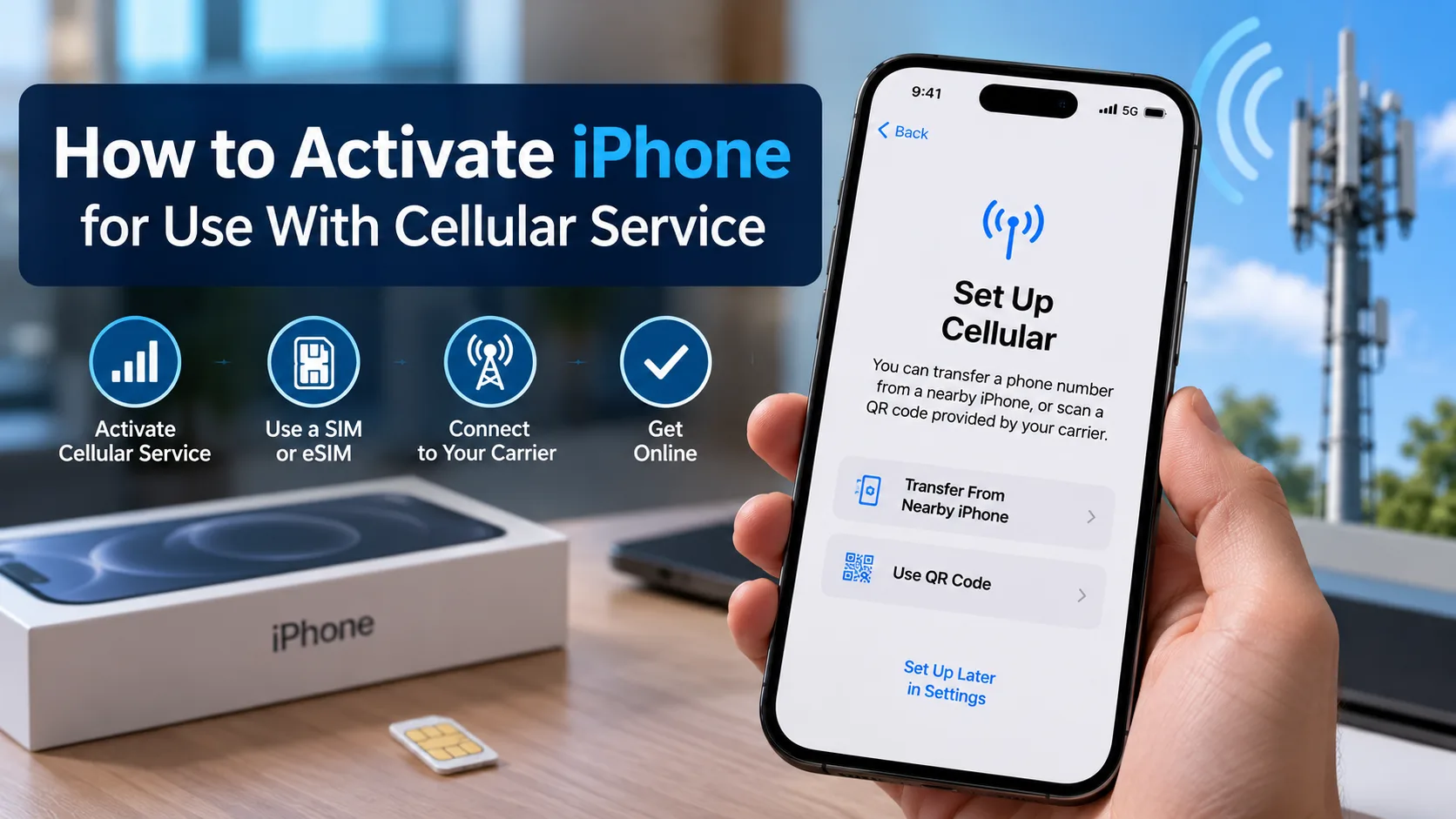


Unlocking a tablet lets you use any compatible SIM or eSIM, at home or while you travel. If your iPad, Samsung Galaxy Tab, Lenovo, or another LTE/5G tablet is carrier-locked, you’re tied to one network.
After you unlock it, you can pop in a local SIM on a trip, switch to a cheaper plan, or keep the device longer without changing hardware. This guide explains how carrier locks work, how to check your lock status, and the safest ways to unlock a tablet—step by step.
We’ll keep the language simple and the steps practical so you can follow along with confidence.
Key Takeaways
- The reliable way to unlock a carrier-locked tablet is to contact the original carrier and meet its requirements (paid off, no fraud/blacklist). Policies differ by carrier and by device (iPad vs. Android).
- iPad unlocks are server-side Only the original carrier can remove an iPad’s lock via Apple’s servers. After approval, connect to Wi-Fi or a computer and confirm in Settings > General > About that Carrier Lock shows “No SIM restrictions.”
- Android tablets use code or OTA Samsung/Lenovo/other Android tablets are unlocked by the carrier either with an unlock code (entered after inserting a new SIM) or an over-the-air method (e.g., Settings > Connections > Network Unlock > Permanent Unlock on some T-Mobile models). Eligibility checks still apply.
- Screen lock ≠ carrier lock Forgetting your PIN/password is a separate issue. A factory reset can clear a screen lock (it erases all data), but it won’t remove a carrier lock—you still need the carrier to unlock the device.
Carrier Lock vs. Other Locks (Know the Difference First)
Before you start, it helps to name the different “locks” you may see:
Carrier/Network lock.
This is the one that blocks other carriers’ SIMs or eSIMs. The tablet will say things like “SIM Not Supported,” “Network Locked,” or “Contact Carrier.” Unlocking removes this restriction.
SIM PIN lock.
A security PIN set on the SIM itself. If you move that SIM into another device, it asks for a PIN. This is not the same as a carrier lock. You can turn a SIM PIN on or off in settings if you know the PIN.
Account/Management lock (MDM) on iPad or Android Enterprise.
Company-managed devices may be tied to a school or work profile. That’s different from a carrier lock and needs removal by the IT admin.
Activation locks (Apple ID/Google FRP).
Apple’s Activation Lock and Android’s Factory Reset Protection require the owner’s account to sign in after a reset. Carriers can’t remove these. You must use the right Apple ID or Google account.
Blacklisted/Blocked IMEI.
If a device is reported lost, stolen, or involved in fraud, it can be blocked from cellular networks. No carrier will unlock a blacklisted device for use on their network.
How to Check if Your Tablet Is Carrier-Locked
On iPad (Wi-Fi + Cellular models):
Go to Settings > General > About. Look for Network Provider Lock (or “Carrier Lock”). If you see “No SIM Restrictions,” your iPad is unlocked. If you see a carrier name, it’s probably locked. You can also insert a SIM from another carrier and see if it connects.
On Samsung, Lenovo, and other Android tablets:
Open Settings > About tablet > Status (wording varies). Check SIM status or Network details. The most reliable test is to insert a different carrier’s SIM. If you get service, you’re unlocked. If you see “Network Locked,” it’s still locked.
Pro tip: If the tablet has no dialer, you won’t use *#06# to grab the IMEI. Instead, find the IMEI/IMEID in Settings > About tablet or on the box/slot tray.
📖 Also Read: Can You Unlock a Free Government Phone? Lifeline & ACP Explained
What You Need Before You Unlock
- Your IMEI or IMEID. You’ll give this to the carrier to process the request.
- An account in good standing. Most carriers require that installment plans are paid off and the device is not flagged for loss, theft, or fraud.
- Proof of purchase (sometimes). Handy if you bought the tablet second-hand.
- Stable Wi-Fi and updated software. On iPad and newer Android tablets, the unlock often completes after a software/“carrier settings” update.
If you bought the tablet used and don’t know the original carrier, look for carrier splash screens on boot, check preloaded apps, or try SIMs from multiple networks to narrow it down.
The Safest Way: Ask the Original Carrier
The cleanest, most reliable unlock is through the carrier that locked the tablet in the first place. The exact rules vary, but the flow is similar:
- Confirm eligibility. Paid in full, no fraud flags, and within policy.
- Submit an unlock request. You’ll share your IMEI/IMEID and contact info.
- Wait for approval and system update. On iPad, the carrier updates Apple’s activation servers. On Android, the carrier sends an unlock to the device, or you use the built-in “Network Unlock” function.
- Insert a different SIM or add an eSIM to test. If service works, you’re done.
iPad (Wi-Fi + Cellular)
There is no “unlock code” for iPad. The carrier flips a status on Apple’s servers. After approval, connect to Wi-Fi, restart, and you should be unlocked. To add a plan, go to Settings > Cellular/Mobile Data > Add eSIM (if supported) or insert a physical nano-SIM on models that still have a SIM tray.
Samsung Galaxy Tab (Tab A, S series, etc.)
Many carrier models include a Network Unlock option in Settings (paths vary; on some, it’s under Connections > Mobile networks or shown as “Network Unlock”). For T-Mobile/Metro branded models, older devices used a Device Unlock app; newer builds integrate unlock into Settings. If the option isn’t there, contact the carrier to push the unlock.
Lenovo LTE/5G Tablets
Lenovo sells both carrier-locked and factory-unlocked models. If yours is carrier-branded, you’ll request the unlock from that carrier. If it’s a factory-unlocked “TB-” model, it should already accept any compatible SIM. Always check band support to make sure your new carrier’s frequencies are covered.
Other Brands (Microsoft Surface, TCL, Amazon, etc.)
The process is the same: identify the original carrier, request an unlock, and apply it over Wi-Fi. Some models (like Surface Pro with LTE) lean on eSIM, so once unlocked you can scan a new carrier’s QR code in Cellular settings.
📖 Also Read: Phone Unlock Tips That Actually Work (even for “no volume” keywords)
Step-by-Step: Unlocking a Carrier-Locked Tablet
Below is a clear, human-written walkthrough you can follow for iPad, Samsung Galaxy Tab, Lenovo, Surface, and other LTE/5G tablets. It keeps the language simple and the steps practical. No fluff—just what to do and why it matters.
Step 1: Back up and update
Before you touch anything, protect your data and get your software ready. On iPad, back up with iCloud or to a Mac/PC, then go to Settings > General > Software Update and install any updates. On Android tablets (Samsung, Lenovo, etc.), back up to your Google account or use the maker’s tool (like Samsung Smart Switch), then update under Settings > System > Software update (wording varies). Keep your battery above 50% and connect to Wi-Fi. Updates reduce random errors when the unlock is applied.
Step 2: Gather details
Unlock requests move faster when you have the right info in front of you. The big one is the IMEI/IMEID—you’ll find it in Settings > About or on the box/SIM tray. If your tablet supports two lines (e.g., eSIM + physical SIM), note IMEI2 as well. Jot down the model number, your account number, and any account PIN/passcode your carrier asks for. If the device was purchased second-hand, keep any proof of purchase just in case support asks for it.
Step 3: Check your status
You want to confirm two things: that your tablet is actually locked, and that it’s eligible to be unlocked.
On iPad, open Settings > General > About and look for Network Provider Lock. If it says “No SIM restrictions,” you’re already unlocked. If not, you’re locked to a carrier. On Android, the simplest test is to insert a SIM from another carrier and see if it connects. If you see “Network Locked” or “SIM Not Supported,” it’s locked.
Eligibility is about your account. Most carriers require the device to be paid off, not reported lost/stolen, and free of fraud flags. If you bought the tablet used, ask the seller to confirm it’s in good standing. Also check that you’re dealing with a cellular model—Wi-Fi-only tablets have no modem and don’t need (or support) carrier unlocking. Finally, remember that MDM (school/work management) and Activation Locks (Apple ID/Google FRP) are different from carrier locks; the carrier can’t remove those.
Step 4: Request the unlock
Now contact the original carrier (the one the tablet is locked to). Tell them you want an official carrier unlock and provide your IMEI/IMEID, your account details, and a callback email or number. Many carriers have a web form or chat that takes just a few minutes. Ask for a ticket number so you can track progress. If you don’t have an account with that carrier (for example, you bought the tablet used), you can still request an unlock as long as the device is eligible. Be polite but direct: “Please process an official factory unlock for this IMEI.”
A quick brand note: iPad unlocks don’t use a code—the carrier flips a flag on Apple’s activation servers. Samsung/Android unlocks may arrive over the air or via a built-in Network Unlock option in Settings on carrier models. Avoid shady “USB” or “bypass” tools; they often target activation locks, not network locks, and don’t stick.
Step 5: Apply the unlock
Once the carrier approves it, you need to let the tablet “see” the change.
On iPad, connect to Wi-Fi for a minute or two, then restart. Insert a different carrier’s SIM (if you have one) or go straight to Settings > Cellular/Mobile Data > Add eSIM to load a new plan. You may get a Carrier Settings Update prompt—tap Update.
On Samsung/Android, look for Network Unlock in Settings (paths differ by model; sometimes under Connections > Mobile networks). Run it on Wi-Fi. If there’s no menu, insert a non-original SIM and follow any prompts. Some older devices use an unlock code; if so, the carrier will give it to you.
Step 6: Test with a new SIM/eSIM
Now confirm it works on another network. If you have a physical SIM from a different carrier, insert it and wait a minute. If you’re using eSIM, on iPad go to Settings > Cellular > Add eSIM and scan the QR code from your new carrier or travel eSIM provider. On Android, open Settings > Network & Internet > SIMs (or similar) and choose Download a SIM or Add eSIM.
Check that you have signal bars and that mobile data loads a webpage. If your tablet supports calls and texts on the network you chose, test those too. Many tablets are data-only, so don’t worry if calling isn’t supported. The key is that the device attaches to the network and data flows.
Step 7: Finish setup
If data is flaky or missing, finish with these quick clean-ups.
Start by accepting any carrier settings prompts and restart once. If you still get “No Service” or “SIM not provisioned,” try Airplane Mode on/off and another restart. Next, set or reset your APN. Your new carrier will give you APN values (names, usernames, and fields must match exactly). On iPad, go to Settings > Cellular Data > Cellular Data Network. On Android, go to Settings > Mobile networks > Access Point Names (paths vary). Add the APN, save it, then select it.
If issues remain, do a network settings reset. On iPad, it’s Settings > General > Transfer or Reset > Reset > Reset Network Settings. On Android, it’s usually Settings > System > Reset options > Reset Wi-Fi, mobile & Bluetooth. After the reset, re-add Wi-Fi and try data again.
Finally, check a few toggles: make sure VoLTE is on if your carrier requires it; set Preferred network type (e.g., 5G/LTE/Auto) to match your plan; and confirm your line is provisioned on the carrier side (sometimes they must attach your tablet’s IMEI to a tablet/data plan). If the device still won’t connect, verify that your tablet supports the right bands for the new network—unlocking removes the lock, but it can’t add missing hardware bands.
📖 Also Read: Unlock Your Phone & Prepare for International Travel
eSIM vs. Physical SIM on Tablets
Many newer iPads and some Windows/Android tablets support eSIM. An unlock applies to both SIM types. After unlocking, you can store multiple eSIM profiles and switch plans inside settings without swapping plastic cards. If your tablet has both eSIM and a tray, you can keep a home carrier on eSIM and use a travel SIM in the tray—handy for international trips.
After You Unlock: Fixing “No Service” or Data Issues
If the tablet shows bars but no data, or says “SIM not provisioned,” try these simple fixes:
- Restart after inserting the new SIM or adding eSIM.
- Accept carrier settings updates when prompted.
- Reset network settings: on iPad, Settings > General > Transfer or Reset > Reset > Reset Network Settings. On Android, Settings > System > Reset options > Reset Wi-Fi, mobile & Bluetooth (paths vary).
- APN check: ask the new carrier for APN details. Enter them exactly as given.
- Band support: confirm your tablet supports the new carrier’s LTE/5G bands. If the hardware lacks the right bands, you may only get 4G/LTE or fall back to slower speeds.
- Provisioning: some carriers need to add the tablet’s IMEI to your line. Call support and ask them to “provision a data-only tablet line” for your IMEI.
When Third-Party Unlock Services Make Sense (and When They Don’t)
If you can’t reach the original carrier—for example, you bought a used tablet overseas—an IMEI-based third-party service may be able to process an official unlock through carrier systems. Results depend on eligibility and carrier databases. Good services are transparent about refunds if the unlock fails.
Avoid risky methods that claim to “USB unlock” modern iPads or “bypass iCloud/FRP.” Those target activation/security locks, not carrier locks, and often don’t stick. Many also violate terms or the law. For iPad in particular, there is no legitimate local code to enter; the status must change on Apple’s servers.
Legal, Warranty, and Policy Notes (Simple but Important)
- Unlocking is legal in many countries, and carriers often must unlock eligible devices when conditions are met.
- Warranty: an official unlock does not void your hardware warranty.
- Blacklisted devices won’t work on most networks even if unlocked.
- Policy timing varies: some carriers auto-unlock after a waiting period; others require you to ask. If timing matters (you’re traveling soon), request the unlock early.
If You Can’t Unlock Right Now: Smart Alternatives
You still have options even if your tablet must stay on its original carrier for a while:
Trade or sell the locked tablet and buy a factory-unlocked model with the bands you need.
Use it as Wi-Fi only. Pair it with your phone’s hotspot or a pocket hotspot.
Run a travel eSIM on your phone and share data to the tablet.
Mini-Guides by Brand and Scenario
AT&T-branded tablet
Confirm it’s paid off and not flagged. Submit your IMEI through the carrier’s unlock portal or support chat. After approval, connect to Wi-Fi, restart, and test a different SIM/eSIM.
T-Mobile/Metro-branded Galaxy Tab
Open Settings and look for Network Unlock. If present, follow on-screen steps on Wi-Fi. If not present or it errors, contact support to push the unlock to your IMEI, then try again.
Verizon-branded tablet
Many models auto-unlock after the carrier’s holding window. If yours didn’t, contact support with your IMEI to complete the process. Then insert a SIM from your new carrier and accept any updates.
iPad bought from Apple
Most Apple Store iPads are sold unlocked. If yours says otherwise, it was likely activated on a carrier plan at purchase. Contact that carrier to clear the lock on Apple’s servers.
Lenovo Tab M10/M11 LTE or similar
Check if the model was sold carrier-free. If it’s factory unlocked, you can add any compatible SIM. If carrier-branded, request the unlock from that carrier and verify band support for your new network.
Common Questions (Quick Answers)
Does unlocking my tablet make it work on every carrier?
It removes the lock, but hardware still matters. If your tablet lacks the right bands or VoLTE profile, service may be limited or data-only.
How long does a carrier unlock take?
Anywhere from minutes to a few business days, depending on eligibility checks and how the carrier processes requests.
Can I unlock a blacklisted tablet?
Even if you could, networks usually won’t allow it. Clear any blacklist issues first.
Do Wi-Fi-only tablets need unlocking?
No. They have no cellular radio, so there’s no carrier lock to remove.
Is eSIM locked too?
Yes. A carrier lock applies to both physical SIM and eSIM. Once unlocked, you can add eSIM plans freely.
Will a factory reset help?
A reset doesn’t remove a carrier lock. It can help after an unlock to refresh settings, but only perform it after you back up and only if support suggests it.
Final Checklist (Do This Before You Switch)
- Confirm Network/Carrier Lock: No SIM restrictions (or test a different SIM).
- Update to the latest software and accept carrier settings prompts.
- Add or reset APN for data and confirm your plan is provisioned.
- Verify your tablet’s band support matches your new network.
FAQs
What is the 8-digit Samsung network unlock code?
It’s the NCK (Network Control Key) some older Samsung models request when you put in a SIM from another carrier. Many newer Samsungs now use a 16-digit NCK instead. The code is unique to your phone’s IMEI—there isn’t a “one code fits all.” If the wrong code was entered too many times, the phone may ask for an MCK (defreeze/unfreeze) code first to reset the counter. Get the right code from the original carrier (best/official) or a reputable IMEI-based service if the carrier can’t help.
What is the master unlock code for a Samsung?
There’s no universal master code that unlocks every Samsung. People often mean the MCK (Master/defreeze) code, which only clears the “too many attempts” lock so you can enter the correct NCK. The MCK is also unique to your IMEI and usually only the carrier (or Samsung via the carrier) can provide it. You’ll still need the valid NCK to finish the unlock.
Can carrier-locked Samsung phones/tablets be unlocked?
Yes—if they’re eligible (paid off, not reported lost/stolen, and in good standing). The cleanest way is through the original carrier:
Many carrier Samsung models have a built-in Network Unlock function (or the old Device Unlock app on T-Mobile/Metro variants) that contacts the carrier server over Wi-Fi.
Other carriers issue an NCK and you enter it when prompted after inserting a different SIM.
Timing and rules vary by carrier and plan type, but if you meet policy requirements, they will process it.
4) What is the secret code for Samsung Network Unlock for free?
There isn’t a secret “free” code that unlocks every Samsung. Codes like *#06# only show your IMEI, and *#7465625# may show lock status on some older models—they don’t unlock the phone. A real network unlock comes from the carrier’s approval (often free if you’re eligible) or a paid IMEI service. Be cautious with sites promising instant “free” universal codes—those are almost always scams.
5) What is the carrier SIM unlock code?
This phrase gets used two ways:
Network unlock (NCK): Unlocks the device so it can accept other carriers’ SIMs/eSIMs. You get this from the original carrier or a reputable IMEI service.
SIM PIN/PUK: Unlocks the SIM card itself after too many wrong PIN attempts. The PUK (often 8 digits) comes from the SIM’s carrier (check your account portal, packaging, or call support). A PUK won’t network-unlock a phone; it just revives a blocked SIM.
6) What is the Network Unlock app on Samsung?
On many T-Mobile/Metro Samsung models, the Device Unlock / Network Unlock feature is either a standalone app or built into Settings. It securely talks to the carrier server and, if your device is eligible, applies a temporary or permanent unlock—no code entry needed. Typical flow:
- Connect to Wi-Fi, insert a non-original SIM (optional but helpful).
- Open Settings > Connections > Mobile networks (path can vary) and select Network Unlock (or launch the Device Unlock app).
- Choose Permanent Unlock and follow the prompts.
If you see “Not eligible,” contact the carrier to confirm payment/eligibility and try again once they clear it.