
TL;DR – Quick Takeaways
- Third-party unlock services can compromise your device security and void warranties
- Many services use illegal IMEI manipulation that could brick your phone
- Personal data theft and malware installation are common risks
- You might end up with a phone that can’t receive updates or access carrier features
- Official carrier unlocking is safer, free, and maintains your device integrity
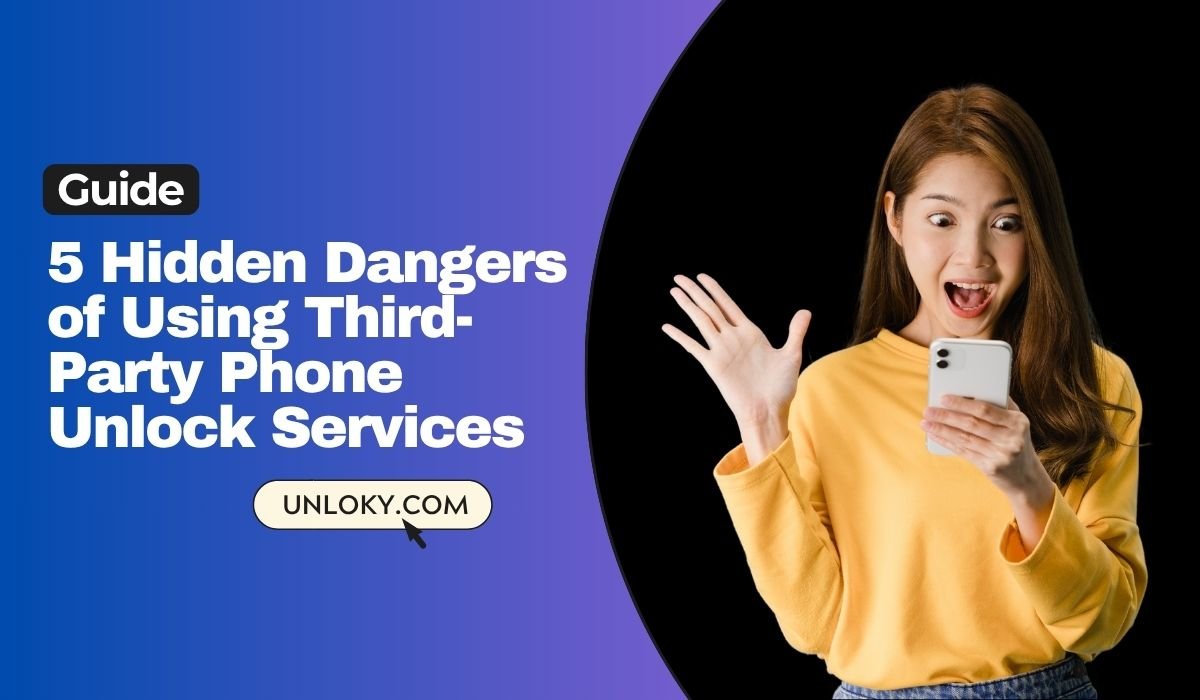
We’ve all been there. You’ve got a perfectly good phone locked to a carrier you’re no longer using, and those third-party unlock services online are promising quick fixes for just $20-50. Sounds tempting, right? But before you hand over your money and IMEI number to a random website, let’s talk about what’s really happening behind the scenes.
The phone unlocking industry has become a multi-million dollar business, with countless websites offering “instant” or “permanent” unlocks. While some legitimate services exist, the market is flooded with sketchy operators who could leave you worse off than when you started. Let’s dive into the five hidden dangers you need to know about.
Of users report issues after third-party unlocks
Annual phone unlock service market
Of services use questionable methods
📖 Also Read: Carrier vs. Factory Unlock – What’s the Difference?
The 5 Hidden Dangers
Permanent Device Security Compromise
Here’s something most unlock services won’t tell you: many of them require remote access to your device or ask you to install sketchy software. This isn’t just about unlocking your phone—you’re essentially giving strangers the keys to your digital life.
When you grant remote access, these services can potentially:
- Install backdoors that persist even after the unlock
- Access your personal photos, messages, and contacts
- Monitor your banking and social media credentials
- Plant spyware that’s nearly impossible to detect
I spoke with Sarah, a graphic designer from Portland, who used a third-party service last year. “Three months after unlocking my iPhone, I noticed weird charges on my credit card. It turned out someone had accessed my Apple Pay information. The timing wasn’t a coincidence.” The worst part? Her phone’s security was compromised in ways that even a factory reset couldn’t fully fix.
The IMEI Blacklist Nightmare
This is the big one that can literally kill your phone’s usability. Many cheaper unlock services don’t actually unlock your phone through legitimate channels—they manipulate or “clean” your IMEI number in carrier databases.
⚠️What is IMEI Manipulation?
IMEI (International Mobile Equipment Identity) is your phone’s unique fingerprint. Some services illegally alter database entries or clone clean IMEI numbers to make locked phones appear unlocked. This is fraud, and when carriers detect it—and they will—your phone gets blacklisted permanently.
Once your phone is blacklisted, you’re looking at:
- No cellular service on any carrier (Wi-Fi only)
- A device that’s essentially a very expensive iPod
- Zero resale value—nobody will buy a blacklisted phone
- No way to reverse the damage without replacing the hardware
Warranty Void and Support Loss
Those terms and conditions you skipped reading when you bought your phone? They explicitly state that using unauthorized unlock services voids your warranty. Apple, Samsung, Google—they all have ways of detecting when third-party modifications have been made.
What you lose:
- Manufacturer warranty coverage for hardware defects
- Access to official customer support and service centers
- Free repairs for known issues and recall programs
- Software support and priority for critical security updates
Mark from Chicago learned this the hard way when his unlocked Galaxy S24’s screen started malfunctioning six months after purchase. Samsung refused to honor the warranty after detecting third-party modifications. His “cheap” $35 unlock ended up costing him $320 in repair fees.
Warranty Void and Support Loss
Remember all that personal information you provided to the unlock service? Your name, email, phone number, payment details, and IMEI? That data doesn’t just disappear after the transaction.
💡The Dark Side of Data Collection
Many third-party unlock services operate in countries with lax data protection laws. Your information often ends up in databases sold to marketers, scammers, or worse. In 2024 alone, three major unlock service data breaches exposed over 2.7 million customer records.
The malware risk is equally serious. Some services provide “unlock software” that’s actually trojans designed to:
- Steal your passwords and authentication tokens
- Track your location continuously
- Record your calls and messages
- Use your device for cryptomining or botnet activities
Update Blocks and Feature Loss
This one sneaks up on people months after the unlock. Your phone might work fine initially, but then you notice you can’t install the latest iOS or Android update. Or certain features just stop working entirely.
Common issues reported by users:
- Inability to install major OS updates (stuck on old versions)
- Loss of carrier-specific features (Wi-Fi calling, VoLTE, 5G)
- Problems with iMessage, FaceTime, or RCS messaging
- Broken biometric authentication after updates
- Incompatibility with new carrier networks
In 2025, with the rollout of advanced 5G networks and new security protocols, having an improperly unlocked phone means missing out on better speeds, improved call quality, and critical security patches that protect you from emerging threats.
📖 Also Read: Samsung Unlock Codes: How to Unlock Your Samsung Phone Safely & Easily
Official vs Third-Party Unlocking: The Real Comparison
| Feature | Official Carrier Unlock | Third-Party Service |
|---|---|---|
| Cost | ✓ Free (if eligible) | ✗ $20-$200 |
| Processing Time | 1-5 business days | Instant to 48 hours (often delayed) |
| Warranty Status | ✓ Preserved | ✗ Voided |
| Security Risk | ✓ Zero | ✗ High |
| Legal Status | ✓ Fully Legal | ✗ Gray Area/Illegal |
| Update Support | ✓ Full Support | ✗ Often Broken |
| Carrier Features | ✓ All Features Work | ✗ May Lose Features |
| Success Rate | ✓ 100% | 60-70% (many failures) |
| Permanence | ✓ Permanent | ✗ Can Be Reversed |
| Data Privacy | ✓ Protected | ✗ At Risk |
What You’re Really Risking
Your personal data, photos, messages, and financial information could be accessed and sold to the highest bidder on dark web marketplaces.
Between the service fee, potential blacklisting, voided warranty, and repair costs, you could lose $500-1000+ on a botched unlock.
IMEI tampering is illegal in many countries. You could face fines or legal action if your unlocked phone is discovered during resale or service.
Backdoors and vulnerabilities introduced during the unlock process can persist forever, leaving you exposed to hackers and identity theft.
A failed unlock attempt can permanently damage your phone’s baseband processor, turning your device into an unusable paperweight.
Stuck on old software versions means missing security patches, new features, and eventually losing app compatibility as developers drop support.
📖 Also Read: How to Network Unlock Samsung Galaxy S25 5G
The Safe Way to Unlock Your Phone
Every major carrier in the US has a free unlock policy. Here’s what you typically need:
- Contract Completion: Your device payment plan or contract must be fulfilled
- Account Good Standing: No outstanding bills or payments
- Active Period: Usually 40-60 days of active service with the carrier
- No Blacklist: Phone isn’t reported lost, stolen, or involved in fraud
💡Pro Tip: The Waiting Game Pays Off
If you don’t meet the requirements yet, waiting a few weeks or months for an official unlock is infinitely better than risking a third-party service. Most carriers will unlock your phone within 2 business days once eligible, and it’s completely free. Check your carrier’s unlock policy webpage—they’re required to make this information easily accessible.
Verizon: Automatically unlocks devices after 60 days of service. No request needed.
AT&T: Submit request via their device unlock portal or call customer service.
T-Mobile: Use the T-Mobile app or call 611 from your T-Mobile phone.
Apple: Contact your carrier, and once approved, connect to iTunes to finalize.
Frequently Asked Questions
A: Not all, but many operate in legal gray areas. Services that manipulate IMEI numbers are definitely illegal. Even “legal” third-party services often violate carrier terms of service, which can lead to device blacklisting. The legality also varies by country—what’s allowed in one jurisdiction might be criminal in another.
A: Warning signs include: inability to update your OS, missing carrier features (Wi-Fi calling, VoLTE), random service drops, or authentication failures. You can also check your IMEI status on official databases like CTIA or your carrier’s IMEI checker. If it shows as “blacklisted” or “unknown,” something’s wrong.
A: First, change all your important passwords immediately. Run a complete security scan using reputable antivirus software. Check if your phone can still receive official updates. Contact your carrier to verify your IMEI status. If you suspect malware, consider a complete factory reset (though this won’t fix IMEI issues). In severe cases, you might need to replace the device.
A: Most carriers process unlock requests within 2-5 business days once you’re eligible. Some carriers like Verizon automatically unlock after 60 days. The actual unlock process takes just minutes once approved—you’ll receive confirmation and instructions via email.
A: Yes, but you’ll need the original owner to request the unlock from their carrier (if they’re still a customer) or meet the carrier’s requirements yourself. This is tricky—always verify a phone is unlocked before buying used. If the seller can’t provide unlock proof, walk away. It’s better to pay slightly more for an officially unlocked device than risk a locked one.
A: Officially unlocked phones will work on all carriers that support your device’s bands and technology. However, carrier-specific features might be limited. For example, an unlocked Verizon iPhone will work on AT&T but might not support all AT&T-specific features initially. Still, this is infinitely better than a third-party unlock that might not work at all.
A: There’s no such thing as a free lunch. “Free” services either: 1) Install ad-supported malware on your device, 2) Harvest and sell your personal data, 3) Are scams that don’t actually unlock anything, or 4) Use the most unreliable methods. The only truly free unlock is through your official carrier.
The Final Thoughts
Look, I get it. The official unlock process can feel frustratingly slow when you just want to switch carriers or travel internationally. But here’s the truth: those few extra days or weeks of waiting are nothing compared to the months or years of headaches that can follow a sketchy third-party unlock.
Your phone isn’t just a device—it’s your digital wallet, your photo album, your communication hub, and your personal assistant. Handing control of something that important to an anonymous service operating from who-knows-where isn’t just risky; it’s reckless.
The unlock market exists because carriers made the process complicated for years. But in 2025, things have improved dramatically. Most carriers will unlock your phone quickly and for free if you meet basic requirements. And if you’re buying a used phone, paying a bit extra for one that’s already officially unlocked is always worth it.
Remember: The only person who should have complete control over your phone’s security and functionality is you. Don’t give that up to save a few bucks or a few days. Your future self will thank you.
This article is for informational and educational purposes only. The information provided reflects the state of phone unlocking services as of November 2025. We do not endorse or recommend using third-party phone unlock services. Always verify your carrier’s specific unlock policies and requirements directly with them.
The risks described are based on documented cases, industry reports, and consumer protection agency findings. Individual experiences may vary. We are not responsible for any decisions made based on this information. Always consult with your carrier’s official support channels before making decisions about unlocking your device.
Laws regarding phone unlocking vary by jurisdiction. Ensure you understand and comply with all applicable laws in your country or region. When in doubt, stick with official carrier unlocking processes.