
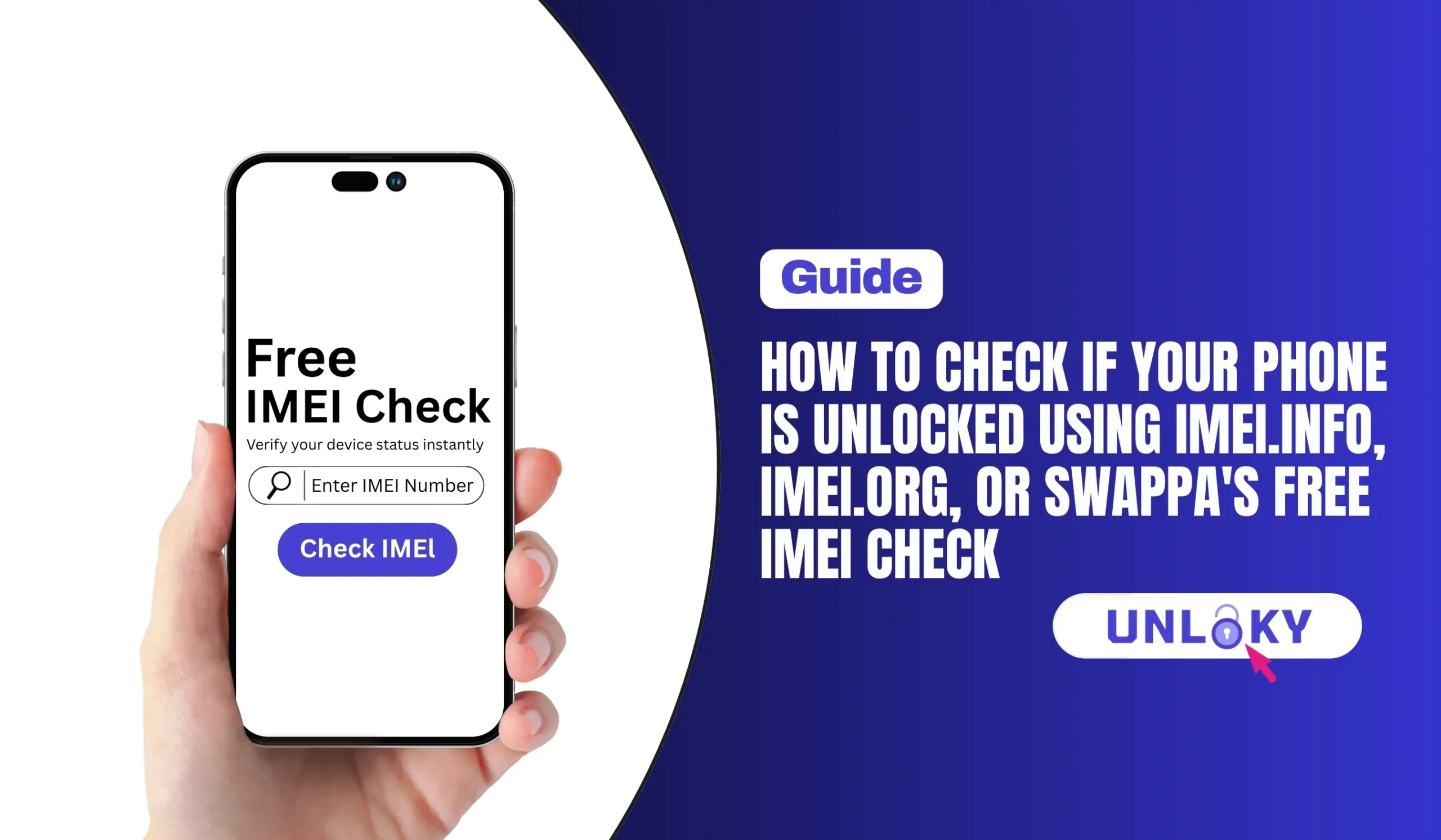
Buying a used phone or thinking about switching carriers? The first thing you should do — before handing over a single dollar — is run a free IMEI check. These three tools make it dead simple to find out if a phone is carrier-locked, blacklisted, or stolen. Here’s exactly how to use each one, and what the results actually mean.
TL;DR — Quick Answer
Yes, you can check in under 60 seconds — and it’s free
All three tools let you check your phone’s unlock status at no cost. Here’s the short version of what each one is best for:
What Is an IMEI Number — and Why Does It Matter?
The 15-digit code that knows everything about your phone
Every phone ever made has an IMEI number — International Mobile Equipment Identity. It’s a unique 15-digit identifier permanently tied to that one specific device. Think of it like a VIN number for your car, except for your phone. No two phones will ever share the same IMEI, which makes it incredibly useful for tracking, verifying, and locking or unlocking devices.
Here’s why it’s so important: when a phone gets reported stolen, the carrier adds its IMEI to a global blocklist database. When someone tries to activate that phone on any network, the carrier checks the IMEI — and if it’s on the blocklist, the phone gets rejected. This is exactly why you need to run an IMEI check before buying any used phone. The seller can swap the SIM card all they want, but they can’t change the IMEI.
Open your phone app and dial *#06# — your IMEI appears on screen immediately on almost every phone. Alternatively, check under Settings → General → About (iPhone) or Settings → About Phone → Status (Android). It’s always a 15-digit number.
Locked vs. Unlocked — What’s the Actual Difference?
Before we dive into the tools, let’s make sure we’re on the same page
A carrier-locked phone can only be used with the carrier it was originally purchased through. So if you bought an iPhone from AT&T and it’s locked, putting in a T-Mobile SIM will just get you an error message. The phone physically works — the hardware is fine — but it’s been software-restricted to one network.
An unlocked phone has no such restrictions. You can put in any SIM from any compatible carrier and it’ll work. This is what you want if you’re switching carriers, traveling internationally, or buying from the secondary market.
| Lock Type | What It Means | Who Can Fix It | How to Check |
|---|---|---|---|
| Carrier / SIM Lock | Phone only works on original carrier’s network | Your carrier (call them) | IMEI.info / IMEI.org |
| Blacklisted / Blocklisted | Reported lost or stolen — can’t be activated | Original owner + carrier | Swappa / IMEI.info |
| iCloud Activation Lock (FMI) | Find My iPhone is on — needs Apple ID to set up | Original Apple ID owner | IMEI.org |
| MDM / DEP Lock | Enrolled in corporate device management | Organization that enrolled it | IMEI.org |
| Finance Lock | Phone still has unpaid installments on carrier plan | Pay off balance or call carrier | Carrier directly |
| Fully Unlocked | Works on any compatible carrier worldwide | N/A — you’re good to go | All three tools show this |
If you’re checking an iPhone XR or newer (or most modern Android flagship), always check IMEI 1 (the primary SIM). IMEI 2 may show a clean result even if the phone is blacklisted or locked, so always use IMEI 1 for your verification check.
Tool #1: IMEI.info — The All-Rounder
Best for: device info, SIM lock, warranty, blacklist status
IMEI.info
IMEI.info is probably the most comprehensive free IMEI checker out there for general use. It uses the first six digits of your IMEI (called the TAC — Type Allocation Code) to instantly identify your device, then layers on additional checks for SIM lock, blacklist status, carrier info, and warranty dates. The basic lookup is completely free, and it shows you far more device detail than most other tools. Paid add-ons go deeper into carrier-specific data.
- Go to imei.info and locate the IMEI check field on the homepage
- Dial *#06# on your phone to get your 15-digit IMEI number
- Enter the IMEI in the search box and complete the captcha
- Hit Check — you’ll see device model, specs, and basic lock info instantly
- Click the SIM Lock or Blacklist checker tabs to run specific checks
- For paid deep reports (~$5), enter your email and get results within minutes
Sample IMEI.info Result —
Unlocked Phone
Tool #2: IMEI.org — Best for iPhones
Best for: iPhone carrier lock, iCloud FMI, MDM, and SIM lock checks
IMEI.org
IMEI.org is particularly well-known for its iPhone-specific checks. While it supports all devices, it goes very deep on Apple-specific lock types — including iCloud Activation Lock (Find My iPhone), MDM/DEP enrollment status, carrier lock, SIM lock, and blacklist status all in one place. If you’re buying a used iPhone and want to know if you’ll be able to set it up without the previous owner’s Apple ID, this is the tool to use. The basic check is free; the comprehensive report with all lock statuses goes deeper for a small fee.
- Visit imei.org and select the type of check you want — Carrier Lock, SIM Lock, or iCloud/FMI
- Enter the iPhone’s 15-digit IMEI in the check field (find it via Settings → General → About)
- Click the Check button and wait a few seconds for the server to respond
- Free results show carrier lock and basic status — look for “LOCKED” or “UNLOCKED”
- For the full report (FMI, MDM, blacklist, lost/stolen), create a free account and order the paid check
- Results arrive via email in seconds to a few minutes
Sample IMEI.org Result —
Locked iPhone
If the IMEI.org check shows iCloud Find My iPhone is still active (FMI: ON), that means the previous owner’s Apple ID is still linked to the device. Even if you factory reset the phone, it’ll ask for the original Apple ID and password during setup — making it completely unusable. Never buy a used iPhone with FMI ON unless the seller is present to remove it.
Tool #3: Swappa’s Free IMEI Check — Best for Buying Used
Best for: verifying blocklist status before purchasing any used phone
Swappa ESN / IMEI Check
Swappa is a well-trusted used phone marketplace, and their free IMEI check tool is one of the most reliable in the business. It checks your device’s IMEI against the GSMA global device registry — the same international database that carriers use — and tells you instantly whether a phone is on the allowlist (clean, ready to activate) or blocklist (reported lost or stolen). Swappa has processed over 10 million IMEI checks and it’s completely free for up to 10 checks per day. Unlike IMEI.info or IMEI.org, it doesn’t do carrier-specific lock checks — its primary focus is blocklist/allowlist status plus pricing data for the device.
- Go to swappa.com/imei — no account required for basic checks
- Enter the phone’s IMEI number in the “IMEI or TAC” field
- Hit the search icon — results appear almost instantly
- Look for “Allowlist” (clean) or “Blocklist” (reported stolen/lost)
- Check the device model match to confirm the seller’s description is accurate
- Note: For dual-SIM phones, run the check on IMEI 1 (the primary SIM number)
Allowlisted Result
The IMEI is clean in the GSMA global registry. The phone hasn’t been reported lost or stolen and is ready for activation. Safe to buy and use on a carrier.
Blocklisted Result
The IMEI has been reported as lost or stolen. The phone won’t activate on any major carrier network. Do not buy this device — walk away immediately.
Best 3 Free IMEI Check Tools (Compared)
IMEICheck.com
IMEICheck.com is a polished, full-featured checker that goes deep on both Apple and Samsung devices. The free check covers blacklist status, SIM lock, model verification, warranty dates, and even Find My iPhone / iCloud Activation Lock status on Apple devices. For Samsung phones, it pulls Knox Guard status, finance lock info, and factory origin data. Premium checks go further with carrier-specific lock reports, but the free tier is surprisingly generous for everyday use.
- Free iCloud & FMI check
- Blacklist & SIM lock
- Finance lock detection
- Samsung Knox Guard status
- Carrier & warranty info
- All brands supported
IMEIpro.info
IMEIpro.info focuses on two things and does them really well: international blacklist checking with roughly 99.9% accuracy across almost all countries and carriers, and shareable IMEI reports for resellers. If you’re selling a phone on eBay, Craigslist, or Facebook Marketplace, you can generate a permanent link to your phone’s clean IMEI report (with the option to hide the last digits for privacy) and paste it right into your listing. It also includes a free Find My iPhone / iCloud status check for Apple devices.
- 99.9% blacklist accuracy
- Free iCloud / FMI check
- Report lost/stolen devices
- Shareable report links
- Hide IMEI digits option
- Global carrier coverage
IMEI24.com
IMEI24.com keeps things clean and lightweight — no clutter, no account required. Enter your IMEI and you’ll get the device model, hardware specs, warranty status, purchase date confirmation, and basic blacklist information. It’s especially handy for verifying warranty coverage before buying a used phone, since it pulls data directly from manufacturer databases. The interface is simple, loads fast, and the free basic check covers the essentials that most buyers need without pushing you toward a paid upgrade.
- Free warranty check
- Device specs & model ID
- No registration needed
- Purchase date verification
- Blacklist status
- Lightweight & ad-free
How to Find Your IMEI Number on Any Phone
Three ways that work on almost every device
Open your phone app, go to the dialpad, and type *#06#. The IMEI appears on screen immediately — no need to press Call. Works on virtually every Android and iPhone model worldwide.
Open the Settings app → tap General → tap About → scroll down to find IMEI. Newer iPhones (XR and later) show two IMEIs — Primary SIM and Digital SIM (eSIM). Use IMEI 1 (Primary) for checks.
Open Settings → tap About Phone → tap Status or Phone Identity → find the IMEI field. On Samsung, it’s Settings → About Phone → Status Information. On Pixel, it’s Settings → About Phone → scroll down.
The IMEI is usually printed on a sticker on the original retail box. For older iPhones, it’s also etched on the back of the phone or printed inside the SIM card tray slot.
Your Phone Is Locked — Here’s Who to Call
Direct carrier support numbers for unlock requests in 2026
Unlock after 60 days (postpaid) / paid off device
Request unlock online at att.com/deviceunlock or call customer care. Paid-off devices typically unlock within 24 hours.
Unlock after 40 days (postpaid) / device paid off
Use T-Mobile’s BYOD checker at t-mobile.com to verify eligibility. Call or use the app to request an unlock — usually approved instantly.
Postpaid: auto-unlocked after 60 days
Verizon automatically unlocks most devices after 60 days. If yours is still locked, call support. Prepaid requires 12 months of service.
Unlock after 6 months of active service
Cricket requires 6 months of active service before unlocking. Call or visit a Cricket store with your IMEI ready to submit the request.
Unlock after 12 months of active service
Boost requires 12 months of continuous service. Once eligible, request an unlock via the Boost app, website, or by calling support.
Unlock after 180 days of service
Metro requires 180 days (about 6 months) of continuous service. Use the Metro app or call customer care to submit your unlock request.
Yes, absolutely. Running an IMEI check is completely legal and widely recommended when buying a used phone. IMEI numbers are not considered private personal information — they’re device identifiers, not user data. Carriers, manufacturers, and third-party tools routinely check IMEIs to verify device status. The only situation where it would be inappropriate is if you were using the IMEI to track a person’s location, which is a different matter entirely and would require legal authority. Simply checking whether a phone is locked, clean, or blacklisted is perfectly fine and actually encouraged.
Yes — a locked phone still works, it’s just restricted to one carrier’s network. If you insert a SIM from the original carrier, it’ll work fine. If you want to use it with a different carrier, you’ll need to get it unlocked first. Contact your carrier and ask for an unlock — most carriers do this for free once you meet their eligibility requirements (usually a paid-off device and a period of active service). Check the carrier phone numbers listed in this article for the quickest path to unlocking. Once unlocked, insert the new SIM and restart the phone — it should connect immediately.
This is actually pretty common and it’s nothing to worry about. If your current SIM is from the carrier the phone is locked to, the phone works perfectly — it’s only locked to other carrier’s SIMs. For example, an AT&T-locked phone works flawlessly with any AT&T or Cricket SIM (Cricket uses AT&T’s network). You’d only notice the lock if you tried inserting a T-Mobile, Verizon, or foreign carrier SIM. If your IMEI check shows locked but you have no intention of switching carriers, it’s not an immediate problem — though you should note it reduces the phone’s resale value for buyers who want carrier flexibility.
Swappa is very accurate for blocklist / GSMA status checks but, like all IMEI tools, there can be a small lag. If a phone was just recently reported stolen, it might take 24–72 hours for the blocklist update to fully propagate across the GSMA database. Swappa also adds a disclaimer that “IMEI results are generated as accurately as possible with absolutely no guarantees.” For the most critical purchases, it’s worth running Swappa’s GSMA check alongside IMEI.info or contacting the carrier directly to confirm a phone’s unlock status. No single tool is infallible — using two gives you much better confidence.
These are completely different things and it’s important not to confuse them. A locked phone is restricted to one carrier’s network, but it’s a fully legitimate, usable device — just limited. You can unlock it through your carrier. A blacklisted phone has been reported as lost or stolen and has been added to a blocklist database. A blacklisted phone physically cannot be activated on any participating carrier’s network — even if you unlock it. Blacklisting is a permanent action tied to the IMEI. You might unlock a carrier-locked phone in an afternoon; getting a blacklisted phone removed from the blocklist is extremely difficult (you’d need the original owner and original carrier involved) and sometimes impossible.
All three tools work for Android and iPhone. IMEI.info actually shows excellent device specs for Android phones — Samsung Galaxy, Google Pixel, OnePlus, Motorola, and more. Swappa checks the GSMA database for all cellular devices regardless of brand. IMEI.org focuses more on iPhones for its deeper lock checks (FMI, MDM), but basic carrier lock and blacklist checks work for Android too. For Android-specific checks like Samsung Knox status or FRP (Factory Reset Protection) lock status, you’ll need either IMEI.info’s paid checks or to contact the carrier and manufacturer directly.
Paid reports on IMEI.info and IMEI.org typically run between $2–$8 per check depending on the depth of report. For a used phone purchase — especially an iPhone — the paid report is absolutely worth it. A comprehensive IMEI.org report for an iPhone will show you carrier lock status, iCloud FMI on/off, MDM enrollment, lost/stolen status, and blacklist status all at once. If you’re about to pay $400–$800 for a used phone, spending $5 to verify its full status is a no-brainer. The free checks are a great starting point, but for high-value purchases, a paid comprehensive report gives you much more complete protection.