
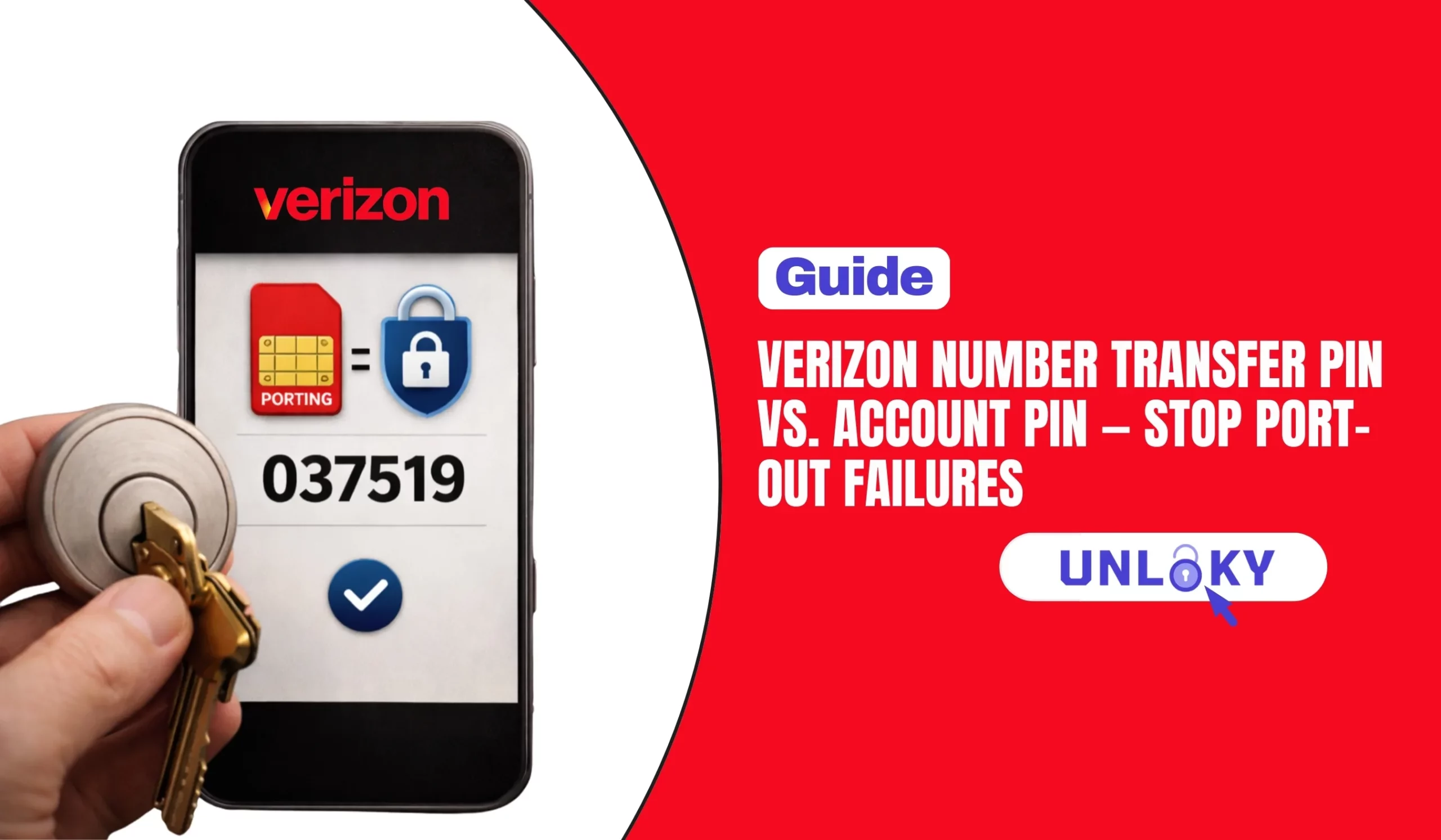
They sound alike, but mixing them up is the #1 reason carrier switches get stuck. Here’s the difference, where to find each one, and the common mistakes that block your port-out.
TL;DR — Quick Answer
Your Account PIN (4–6 digits) is the security code you set up when you opened your Verizon account — it verifies your identity when calling customer service or making account changes. Your Number Transfer PIN (6 digits) is a one-time code Verizon generates specifically to authorize porting your number to a new carrier. They are not interchangeable.
What Is a Verizon Number Transfer PIN?
If you’re planning to leave Verizon and take your phone number with you, you’re going to run into something called a Number Transfer PIN (also called a port-out PIN). It’s basically a temporary, one-time-use security code that tells Verizon, “Yes, I’m authorizing this number to move to another carrier.”
Verizon introduced this system to fight unauthorized port-outs — a type of fraud where someone hijacks your phone number without your permission. Before these PINs existed, port-out scams were a real problem. Now, without this specific code, no carrier can pull your number from Verizon.
Here’s what makes it different from what most people think of as “their PIN”: the Number Transfer PIN isn’t something you set up yourself. Verizon generates it fresh each time you request one, and it only stays valid for 7 days. After that, it expires and you need to generate a new one.
Number Transfer PIN vs Account PIN — Side-by-Side
This is where most people get tripped up. You’ve got two completely different PINs tied to your Verizon account, and confusing one for the other is probably the most common reason port-outs fail. Let’s break them down.
Comparison at a Glance
| Feature | Number Transfer PIN | Account PIN |
|---|---|---|
| Purpose | Authorizes porting your number to a new carrier | Verifies your identity on Verizon account |
| Digits | 6 digits | 4–6 digits |
| Created By | Generated by Verizon’s system on request | Set by you during account setup |
| Expires? | Yes — 7 days | No — persists until changed |
| Reusable? | One-time use, regenerated each request | Yes, used repeatedly |
| Who Needs It? | Your new carrier (to complete port-out) | You (for customer service & account access) |
| Where to Get | Dial #PORT, My Verizon App, or website | Account settings or call Verizon |
| Scope | Account-level (covers all lines) | Account-level identity verification |
| Max Generations | 5 per line per day | Can reset anytime |
When your new carrier asks for your “PIN” or “transfer PIN,” they’re asking for the Number Transfer PIN — not your Account PIN. Giving them the Account PIN will cause an instant rejection.
3 Ways to Get Your Verizon Number Transfer PIN
Good news — generating a Number Transfer PIN is pretty straightforward. You just need to be the Account Owner or Account Manager on a standard monthly account. Here are your three options:
Open your phone’s dialer and call #PORT. Verizon’s system verifies you’re calling from the phone tied to that number, then sends you a text with a link. Tap the link and it opens My Verizon where you can hit “Generate PIN.” That’s it. Fastest method by far.
Open the app → tap Account at the bottom → tap Edit Profile & Settings → scroll down to Number Transfer PIN → tap Generate PIN. You’ll see your 6-digit transfer PIN and account number on screen. Screenshot it for safekeeping.
Log in at verizon.com → navigate to My Profile → find Number Transfer PIN → click Generate PIN. Verizon will verify your identity by sending an authentication code to one of your account numbers. Once verified, your PIN and account number are displayed.
Don’t generate your transfer PIN until you’re actually ready to give it to your new carrier. It expires in 7 days, and you can only generate it 5 times per line per day. If you’ve already given a PIN to your new carrier, don’t generate a new one — that can interfere with the ongoing port-out process.
5 Common Mistakes That Block Your Port-Out
Port-out failures happen more often than you’d think, and most of the time it’s something totally preventable. Here are the biggest culprits:
This is the #1 mistake. Your new carrier asks for a PIN and you give them the 4-digit code you use for customer service calls. Wrong PIN, instant rejection.
Verizon’s Number Lock feature blocks all port-out requests. If it’s on, your transfer will get denied before it even starts — and you might not even realize it’s enabled.
You generated the PIN last week, got busy, and now it’s been more than 7 days. The PIN is dead. Your new carrier tries it and it fails.
Some people call Verizon to cancel their service thinking they need to do it before switching. Big mistake. If the line is disconnected, there’s no active number to port.
Your port is in progress, but you panic and generate a new PIN “just in case.” This invalidates the old one and breaks the pending request.
Verizon Number Lock — What You Need to Know
Verizon offers a free feature called Number Lock that prevents anyone — including you — from porting your number to another carrier while it’s enabled. It’s a solid security measure against port-out fraud, but it becomes a wall if you forget to disable it before switching.
All port-out requests are automatically blocked. You won’t be able to generate a Number Transfer PIN either. Your number stays locked to Verizon.
Port-out requests process normally. Allow at least 15 minutes after disabling before generating a Transfer PIN or initiating the switch.
My Verizon App → Account → Edit Profile & Settings → Security → Number Lock → toggle Off. Or visit the Security Settings page on verizon.com.
Only Account Owners and Account Managers have permission to enable or disable Number Lock. Standard users on the account cannot change it.
They’re separate features. Number Lock blocks port-outs. SIM Protection blocks SIM card swaps on your device. If you’re switching carriers, check that both are turned off to avoid issues.
Prepaid vs Postpaid vs Business — What’s Different?
The process for getting your Transfer PIN isn’t exactly the same across all Verizon account types. Here’s what you need to know depending on your situation:
By Account Type
| Detail | Postpaid | Prepaid | Business |
|---|---|---|---|
| PIN Needed | 6-digit Number Transfer PIN | 4-digit Account PIN | Account number + Billing PIN |
| How to Get | #PORT, App, or Website | Account Settings | My Business portal or call 800-922-0204 |
| Expiration | 7 days | Doesn’t expire | 7 days (for NTP) |
| Per Line? | Account-level (covers all lines) | Per account | Per line (unique NTP each) |
| Bulk Ports (10+) | Call 800-922-0204 | N/A | Call 800-922-0204 |
One thing that catches prepaid customers off guard: unlike postpaid accounts, prepaid Verizon accounts typically use the standard 4-digit Account PIN for porting — not a separately generated Transfer PIN. So in this one case, your Account PIN actually is what your new carrier needs.
No, they’re completely different. Your Account PIN is a permanent 4–6 digit code you created yourself for identity verification. The Number Transfer PIN is a temporary 6-digit code generated by Verizon specifically for authorizing a port-out. You need the Transfer PIN to switch carriers, not the Account PIN (exception: prepaid accounts).
A Number Transfer PIN is valid for exactly 7 days from the moment it’s generated. After that, it expires and you’ll need to generate a new one. That’s why it’s best to create it right before you give it to your new carrier.
The port-out request will be rejected by Verizon’s system. This usually means your new carrier will tell you the information doesn’t match and ask you to try again. The most common cause is giving your Account PIN instead of the Number Transfer PIN.
Yes, an unpaid balance doesn’t technically block the port-out. However, you’ll still be responsible for paying any remaining device payments, early termination fees, or final bill charges. Verizon will send you a final bill after the transfer completes.
Mobile-to-mobile ports typically complete within 4 to 24 hours. In most cases, it’s faster — sometimes just a couple of hours. Landline ports can take longer, anywhere from 2 to 10 business days. During the transfer, your phone stays active on Verizon’s network until the switch is finalized.
Verizon doesn’t charge a specific fee for porting your number out. However, if you’re still under contract, you could face an early termination fee. And if you’re making payments on a device, the remaining balance becomes due. Those costs come from your agreement with Verizon, not from the porting process itself.
Yes. While dialing #PORT requires the actual phone, you can also generate the Transfer PIN through the My Verizon website on any computer or device. Just log in as the Account Owner or Manager. If that’s not working, contact Verizon customer service at 800-922-0204 or visit a Verizon store for help.
Number Lock prevents your phone number from being ported to another carrier. SIM Protection prevents your SIM card from being moved to a different device. They’re separate security layers. If you’re switching carriers, you should disable both to ensure a smooth transfer.
Don’t generate your transfer PIN until you’re actually ready to give it to your new carrier. It expires in 7 days, and you can only generate it 5 times per line per day. If you’ve already given a PIN to your new carrier, don’t generate a new one — that can interfere with the ongoing port-out process.
The information in this article is based on publicly available Verizon support documentation and community resources as of February 2025. Carrier policies, processes, and features can change at any time. Always confirm details directly with Verizon or your new carrier before initiating a number transfer. This content is for informational purposes only and does not constitute professional telecom advice.