
TL;DR – Quick Answer
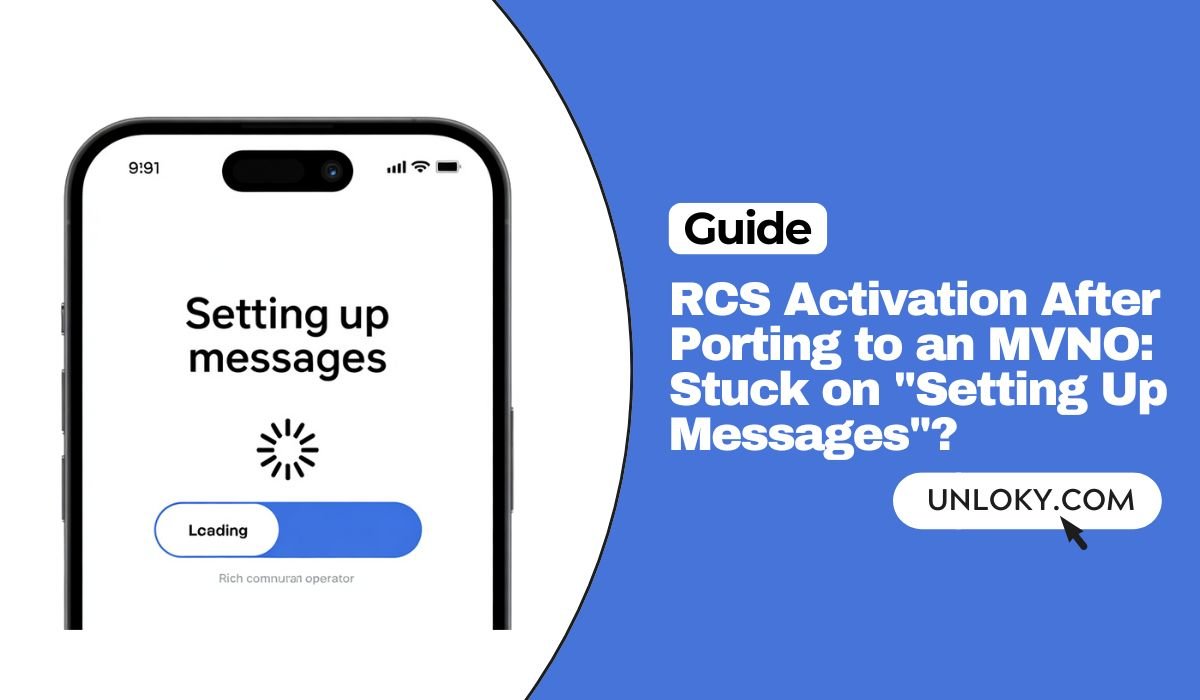
If your RCS is stuck on “Setting up” or “Waiting for activation” after porting to an MVNO, your number is likely still registered with your old carrier’s RCS system. The fastest fix is using Google’s deregistration portal at messages.google.com/disable-chat to unlink your number from the previous service. After deregistering, restart your phone, clear your messaging app’s cache, and wait 24-72 hours for RCS to reactivate. However, be aware that some MVNOs don’t support RCS at all, especially on iPhone, so check carrier compatibility first!
Understanding the Problem
So you just ported your number to a new MVNO (Mobile Virtual Network Operator) like Mint Mobile, Google Fi, Visible, or Cricket Wireless, and now your messaging app is stuck on that dreaded “Setting up…” status. Or maybe you’re seeing “Waiting for activation” on your iPhone with iOS 18. You’re not alone—this is one of the most frustrating issues people face when switching carriers in 2025.
Here’s what’s actually happening behind the scenes: When you had RCS enabled on your previous carrier, your phone number got registered with that carrier’s RCS infrastructure. Even though you’ve ported your number to a new carrier, the old RCS system doesn’t automatically know you’ve left. It’s like moving apartments but the mail keeps going to your old address because you forgot to file a change of address form.
Rich Communication Services (RCS) is the modern upgrade to traditional SMS texting. Think of it as what text messaging should have been all along. With RCS, you get features like:
Apple finally added RCS support to iPhones with iOS 18 in September 2024, ending years of the “green bubble vs blue bubble” divide. However, the rollout hasn’t been smooth, especially for MVNO customers.
Why MVNOs Have More RCS Issues
MVNOs are carriers that don’t own their own network infrastructure—they lease it from major carriers like T-Mobile, Verizon, or AT&T. While this business model keeps costs down for consumers, it creates complications for RCS activation.
The problem is that RCS requires specific carrier configurations and infrastructure. When a major carrier like Verizon enables RCS, they’re setting it up for their own systems. MVNOs that use Verizon’s network don’t automatically get access to those RCS servers. Each MVNO needs to either build their own RCS infrastructure or negotiate access to the parent carrier’s system.
Not all MVNOs support RCS, period. Some will never show the RCS option in your settings no matter what you do. This is especially true for iPhone users—even with iOS 18, many MVNOs simply don’t have RCS enabled for their customers yet. Before spending hours troubleshooting, verify that your specific MVNO actually supports RCS on your device type.
Why MVNOs Have More RCS Issues
| MVNO Carrier | Android RCS Support | iPhone RCS Support (iOS 18+/26+) | Parent Network |
|---|---|---|---|
| Google Fi | ✅ Full support via Google Messages | ✅ Supported (as of iOS 18.4/26+) | T-Mobile/US Cellular |
| Mint Mobile | ✅ Supported via Google Messages | ✅ Supported (rolling out 2025) | T-Mobile |
| Visible (Verizon) | ✅ Supported | ⚠️ Limited/Rolling out | Verizon |
| Cricket Wireless | ✅ Supported | ⚠️ Limited availability | AT&T |
| Metro by T-Mobile | ✅ Full support | ✅ Supported | T-Mobile |
| Boost Mobile | ⚠️ Partial support | ❌ Not yet available | AT&T/T-Mobile |
| US Mobile | ✅ Supported | ✅ Supported (T-Mobile SIMs) | Verizon/T-Mobile |
| Tello | ✅ Supported | ⚠️ Rolling out | T-Mobile |
| Ultra Mobile | ✅ Supported | ✅ Supported (iOS 18.4+/26+) | T-Mobile |
| Straight Talk | ⚠️ Depends on SIM type | ❌ Limited | Various |
| Total Wireless | ⚠️ Partial support | ❌ Not available | Verizon |
| Virgin Mobile | ✅ Supported | ⚠️ Limited | T-Mobile |
Note: Support status can vary by plan type and SIM card. T-Mobile MVNOs generally have better RCS support than Verizon or AT&T MVNOs as of early 2025.
The Root Causes of “Setting Up” Status
When your RCS gets stuck, it’s usually because of one of these issues:
Your phone number is still registered in your old carrier’s RCS database. This is the most common cause and happens when you didn’t disable RCS before porting your number.
Your new carrier simply doesn’t have RCS infrastructure set up yet. No amount of troubleshooting will fix this—you’ll need to wait for your carrier to enable support.
Your phone hasn’t downloaded the correct carrier configuration file. This is especially common on iPhones, which require carrier-specific profiles to enable RCS.
Your messaging app has corrupted data from the previous setup preventing fresh registration.
Solutions That Actually Work
Solution 1: Use Google’s Deregistration Portal (Most Effective)
This is the nuclear option that works for most people. Google provides a web portal specifically designed to unlink your phone number from RCS when you no longer have access to your old device or it’s not working properly.
- Visit the deregistration portal: Go to messages google disable chat in any web browser
- Enter your phone number: Type in the phone number that’s stuck in RCS limbo
- Request verification code: Click “Send Code” and you’ll receive a 6-digit code via SMS
- Complete deregistration: Enter the verification code and click “Verify”
- Wait for confirmation: You should see a message saying “Chat Features Have Been Turned Off”
- Restart and wait: Turn off your phone completely, wait 30 seconds, turn it back on, and give it 24-72 hours for the changes to propagate through the system
Don’t try to re-enable RCS immediately after deregistering. The system needs time to update across all the carrier networks. Wait at least 24 hours, but ideally 3 days, before attempting to reactivate RCS on your new carrier.
Solution 2: Clear Messaging App Data (Android)
If you’re using an Android device with Google Messages, clearing the app data can force a fresh RCS registration attempt.
- Open Settings on your Android device
- Go to Apps (might be called “Applications” or “App Manager”)
- Find “Messages” in the app list
- Tap Storage (or “Storage & cache”)
- Tap “Clear Data” and then “Clear Cache”
- Also clear data for “Carrier Services” if you see it in your app list
- Restart your phone
- Open Messages and sign back in with your Google account
- Go to Settings > RCS chats and turn on RCS
Your text conversations will still be intact after clearing data, but you’ll need to sign back into your Google account in the Messages app.
Solution 3: Reset Network Settings (iPhone)
For iPhone users on iOS 18, resetting network settings can help force the carrier profile to reload with proper RCS configurations.
- Open Settings on your iPhone
- Go to General > Transfer or Reset iPhone
- Tap Reset
- Select “Reset Network Settings”
- Enter your passcode when prompted
- Confirm the reset
- After restart, go to Settings > General > About and wait for any carrier updates
- Check Settings > Apps > Messages to see if RCS is now available
This will erase all saved Wi-Fi networks, Bluetooth pairings, VPN configurations, and cellular settings. You’ll need to reconnect to your Wi-Fi network after the reset. It won’t affect your personal data or apps.
Solution 4: The “Wait It Out” Method
Sometimes the least satisfying solution is the right one. RCS registration can genuinely take anywhere from a few hours to a week to fully process, especially after porting numbers between carriers.
If you’ve deregistered from your old carrier, cleared app data, and confirmed your MVNO supports RCS, give it time. The typical timeline is:
During this waiting period, turn off the RCS toggle in your settings and leave it off. Don’t keep toggling it on and off—this can actually make Google’s system temporarily block your number from RCS as an anti-spam measure.
Solution 5: Force a SIM Card Refresh
For some users, removing and reinserting the SIM card (or deleting and re-downloading the eSIM profile) triggers the carrier to push updated settings.
- Physical SIM: Turn off your phone, remove the SIM card, wait 30 seconds, reinsert it, and power on
- eSIM: Go to Settings > Cellular/Mobile, tap your plan, tap “Remove Cellular Plan,” then contact your carrier to reinstall the eSIM
- After reinsertion: Check Settings > General > About (iPhone) or Settings > About Phone (Android) for carrier updates
Android vs iPhone: Key Differences
| Aspect | Android (Google Messages) | iPhone (iOS 18+) |
|---|---|---|
| RCS Availability | Available since 2019, works on most MVNOs | New as of September 2024, MVNO support limited |
| Where to Enable | Google Messages app > Settings > RCS chats | Settings > Apps > Messages > RCS Messaging |
| Stuck Status Message | “Setting up… trying to verify phone number” | “Waiting for activation” |
| Deregistration Method | messages.google.com/disable-chat portal | Turn off RCS toggle, then use same portal |
| Typical Fix Success Rate | High – Google controls the infrastructure | Lower – depends on carrier configuration |
| Alternative if RCS Fails | Falls back to SMS/MMS automatically | Falls back to SMS/MMS (green bubbles to Android) |
What NOT to Do
People get frustrated and try all sorts of things that actually make the problem worse. Here’s what to avoid:
Don’t Toggle RCS On and Off Repeatedly
Turning RCS on and off multiple times in a short period can trigger Google’s anti-spam systems to temporarily block your number. If this happens, you might be locked out of RCS for several weeks.
Don’t Factory Reset Your Phone Immediately
A factory reset is a nuclear option that’s rarely necessary. Try every other solution first, and only consider a factory reset if you’ve waited 7+ days and nothing else has worked.
Don’t Assume Your Carrier Support Knows the Fix
Unfortunately, many MVNO customer service representatives aren’t trained on RCS issues. They might tell you “it’s an Apple problem” or “it’s a Google problem” when it’s actually a carrier configuration issue. Use the solutions in this guide rather than spending hours on customer service calls.
Don’t Use Third-Party Messaging Apps as a Workaround
While apps like WhatsApp or Signal are great, switching to them doesn’t solve your RCS problem. Plus, you want RCS working for people who don’t have those apps installed.
When All Else Fails: Alternatives
If you’ve tried everything and RCS still won’t activate after a week or two, you have some options:
Accept Standard SMS/MMS
Not ideal, but SMS still works for basic communication. You’ll lose features like typing indicators and high-quality media, but you can still send and receive messages.
Use Third-Party Messaging Apps
Apps like WhatsApp, Signal, Telegram, or Facebook Messenger offer all the features RCS provides, plus they work regardless of carrier. The downside is getting everyone on the same platform.
Switch MVNOs
If RCS is crucial for you, consider switching to an MVNO with better RCS support. Google Fi, Mint Mobile (for iPhone), and Metro by T-Mobile generally have the most reliable RCS activation. Check the comparison table earlier in this article.
Move to a Major Carrierch MVNOs
The nuclear option. T-Mobile, Verizon, and AT&T all have comprehensive RCS support for both Android and iPhone. Yes, it costs more, but if seamless RCS is worth the premium, it’s the most reliable solution.
Final Thoughts
RCS activation problems after porting to an MVNO are incredibly frustrating, but they’re usually solvable with patience and the right approach. The key is understanding that RCS requires cooperation between multiple systems—your device, your messaging app, your carrier’s infrastructure, and sometimes Google’s Jibe platform. When you change carriers, especially to an MVNO, any weak link in that chain can cause the “Setting up” status to get stuck.
Start with the Google deregistration portal—it’s the single most effective solution that works regardless of whether you have your old phone. Give the system time to update (at least 24-72 hours), and avoid the temptation to constantly toggle settings on and off. If you’ve confirmed your MVNO supports RCS and followed all the steps, it should eventually activate.
And remember, while RCS is a nice upgrade to texting, it’s not the end of the world if it takes a week to activate or doesn’t work on your particular carrier yet. You can still communicate via SMS, and plenty of third-party apps offer similar features. As RCS continues rolling out to more MVNOs throughout 2025, especially on iPhone, the activation process should become smoother.
Frequently Asked Questions
A: Most users see RCS activate within 24-72 hours after porting to a new MVNO. However, it can take up to 7 days in some cases, especially if your previous carrier was slow to release your number from their RCS registry. If it’s been more than a week, use the Google deregistration portal and wait another 2-3 days before trying again.
A: No, your message history should remain intact when you clear data and cache in the Messages app. Your conversations are tied to your Google account. However, it’s always smart to back up important conversations before clearing data, just in case. You’ll need to sign back into your Google account after clearing data.
A: Even if an MVNO technically supports RCS, they need to have a carrier configuration profile approved by Apple for it to show up on iPhones. Many MVNOs announced RCS support for Android first, with iPhone support rolling out months later through iOS updates. Check with your carrier about when iPhone RCS support will be available, and make sure you’re running iOS 18 or later.
A: No. RCS activation isn’t controlled by APN (Access Point Name) settings—it requires specific carrier provisioning and authentication through the carrier’s servers. Changing APN settings won’t help and might actually break your mobile data. Don’t follow online guides that tell you to modify APNs for RCS activation.
A: RCS uses your mobile data connection (or Wi-Fi), so it counts against your data plan if you’re not on Wi-Fi. However, most modern phone plans include unlimited or high-cap data, and RCS uses minimal data for text messages. Photos and videos sent via RCS will use more data, similar to any app-based messaging. Standard SMS/MMS, in contrast, are typically included free with phone plans but don’t count against data.
A: Yes. If RCS isn’t active or fails, your messages automatically fall back to SMS (for text) or MMS (for photos/videos). You’ll still be able to communicate, but you’ll lose features like read receipts, typing indicators, and high-quality media sharing. The conversation will show a different send icon indicating SMS instead of RCS.
Yes. RCS only works when both people in the conversation have it enabled and active. If you have RCS enabled but you’re texting someone on an old phone without RCS support, or someone who has it turned off, the conversation falls back to SMS/MMS. On iPhone, you’ll see the green message bubble, while on Android in Google Messages, it’ll say “SMS” instead of “RCS message.”
This error typically means one of three things: (1) Your MVNO doesn’t support RCS at all, (2) Your specific plan or SIM card isn’t provisioned for RCS, or (3) There’s an issue with Carrier Services on Android. First, verify with your carrier that your plan includes RCS support. If they confirm it should work, try updating Carrier Services from the Play Store and clearing its data.
Disclaimer:
This guide provides general troubleshooting information based on commonly reported user experiences and official carrier documentation as of early 2025. RCS technology and carrier support are constantly evolving. Carrier availability, features, and activation procedures may vary by region, plan type, device model, and software version. Always verify current RCS support directly with your specific MVNO carrier before assuming compatibility.
We are not affiliated with Google, Apple, or any mobile carrier mentioned in this article. The solutions presented here worked for many users but are not guaranteed to resolve every situation. If you’re experiencing persistent issues, contact your carrier’s technical support for device-specific assistance.
Clearing app data, resetting network settings, or manipulating SIM cards may have unintended consequences. Proceed at your own risk and ensure you have backups of important data before attempting advanced troubleshooting steps.