
Your phone is unlocked. Your carrier has 5G. But you’re stuck on LTE. Sound familiar? There are exactly three reasons this happens — and most “fix” guides only cover one of them. Here’s the full picture.
TL;DR — Why Your Unlocked Phone Has No 5G
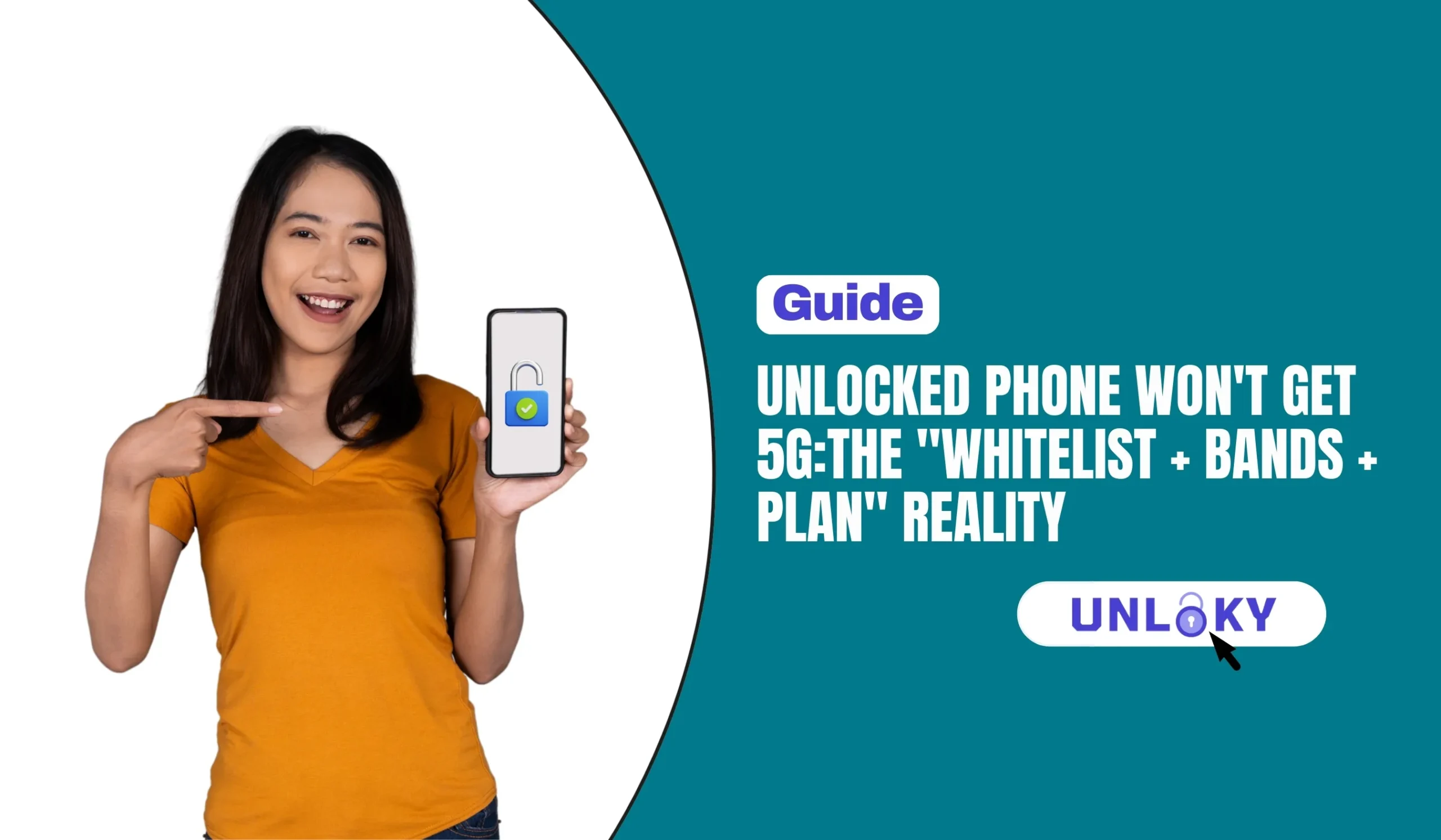
An unlocked phone not getting 5G almost always comes down to one of three things: your phone’s hardware doesn’t support your carrier’s 5G bands, your device isn’t on the carrier’s whitelist (so it’s blocked from 5G provisioning), or your plan simply doesn’t include 5G access. Unlocking only removes the SIM lock — it doesn’t add new radio bands, change carrier approvals, or upgrade your plan. You need all three pieces working together.
The Three Locks Between Your Unlocked Phone and 5G
Here’s the frustrating reality: “unlocked” only means your phone isn’t tied to a single carrier’s SIM. It does NOT mean your phone will work perfectly on every carrier. Getting 5G requires passing three separate checks — fail any one of them, and you’re stuck on LTE (or worse).
Your carrier may have flipped the unlock switch, but your iPhone hasn’t fetched the updated status yet. A restart or carrier settings update usually solves this.
Each carrier broadcasts 5G on specific frequency bands (like n41, n71, n77, n260). Your phone needs the right antennas built in. A phone made for the Asian market might support n78 (common in Europe/Asia) but completely miss n77 (AT&T/Verizon C-Band). You can’t add bands after purchase.
Not every plan includes 5G. Many prepaid plans, older grandfathered plans, and some MVNOs (like Cricket, Boost, Mint) may cap you at LTE even if your phone and the network both support 5G. Upgrading your plan usually fixes this instantly.
Lock #1: The Carrier Whitelist — The Invisible Gatekeeper
This is the one that catches most people off guard. After the 3G shutdown in 2022, all three major US carriers started requiring devices to be “certified” for their VoLTE and 5G networks. In practice, this means they maintain a whitelist — a database of approved device models identified by IMEI ranges. If your phone isn’t on it, you don’t get 5G. Sometimes you don’t even get voice calls.
AT&T maintains the most aggressive device whitelist of any US carrier. They require not just the correct model, but the exact model variant (e.g., SM-S926U1 vs SM-S926B — the same Galaxy S25 Ultra, but only one is approved). International and imported versions are frequently blocked, even if they support every AT&T band. AT&T also blocks Wi-Fi calling and sometimes VoLTE on non-whitelisted devices.
Verizon requires IMEI approval for SIM activation — you can’t even put a Verizon SIM into an unapproved phone without getting blocked at setup. However, once a SIM is active, moving it to another device sometimes works (reports vary). Verizon has gotten less strict over time, but budget imports and non-US models still commonly fail the check.
T-Mobile is significantly more relaxed. If your phone is unlocked, supports T-Mobile’s LTE/5G bands, and has VoLTE capability, it will almost always work — even without being formally “certified.” This is why T-Mobile is the go-to carrier for people who buy unlocked phones from international manufacturers, budget brands, or imports. It’s not perfect (some niche features may be missing), but 5G connectivity is rarely blocked by IMEI.
Lock #2: The 5G Band Reality — Not All 5G Is the Same
There is no single “5G” frequency. Each carrier uses different bands, and each band has different characteristics. Your phone needs the right hardware to connect to each one. Here’s what each carrier actually uses in 2025–2026.
| 5G Type | Band | T-Mobile | AT&T | Verizon | What It Does |
|---|---|---|---|---|---|
| Low-Band | n71 | ✓ Primary | — | — | Wide coverage, building penetration. T-Mobile’s backbone. |
| Low-Band | n5 | — | ✓ Primary | Limited | AT&T’s low-band 5G. Good coverage, moderate speeds. |
| Mid-Band | n41 | ✓ Key Band | — | — | T-Mobile’s fastest widespread 5G. The speed king. |
| Mid-Band | n77 (C-Band) | Some | ✓ Key Band | ✓ Key Band | AT&T and Verizon’s primary mid-band 5G. Critical for speed. |
| Mid-Band | n25 / n66 | Some | — | — | Supplemental T-Mobile 5G bands. |
| mmWave | n260 / n261 | Limited | Limited | ✓ Primary | Ultra-fast, ultra-short range. Stadiums, downtowns only. |
An imported Samsung Galaxy S25 (model SM-S936B, made for Europe) supports n78 — the dominant European 5G band — but may not support n77, the C-Band frequency used by AT&T and Verizon. Same phone name, different internal hardware. This means your “5G phone” shows an LTE icon despite being in the middle of a 5G zone. The US model (SM-S936U1) supports n77. Always check the exact model number, not just the phone name.
Must-Have 5G Bands by Carrier (2026)
| Carrier | Essential 5G Bands | Nice-to-Have | Whitelist Strictness |
|---|---|---|---|
| T-Mobile | n41, n71 | n25, n66, n77, n260/n261 | Low — most phones work |
| AT&T | n5, n77 | n260, n261 | High — strict IMEI whitelist |
| Verizon | n77, n260/n261 | n5, n2 | Medium — IMEI check at activation |
Lock #3: Your Plan Might Not Include 5G
This is the easiest problem to miss — and the easiest to fix. Even if your phone passes the whitelist and has the right bands, your actual wireless plan needs to include 5G access. Not all of them do.
T-Mobile: All current postpaid and most prepaid plans include 5G. AT&T: All Unlimited plans include 5G. Value Plus and starter plans include it too. Verizon: All myPlan and Unlimited plans include 5G (including 5G Ultra Wideband on premium tiers).
MVNOs vary widely: Cricket Wireless includes 5G. Mint Mobile includes 5G. But some smaller MVNOs running on AT&T or Verizon networks may restrict 5G access to LTE-only, especially on budget tiers. Prepaid plans: Some legacy and budget prepaid plans cap at LTE. Grandfathered plans: Very old unlimited plans may not include 5G — you’d need to migrate to a current plan. Always check your plan details or call your carrier to confirm.
Carrier-by-Carrier: What Your Unlocked Phone Needs
Most unlocked-friendly carrier
Essential 5G Bands
n41 (mid-band speed king), n71 (low-band coverage)
Essential LTE Bands
2, 4, 5, 12, 66, 71
Low Strictness — If it works, it works
- T-Mobile doesn’t aggressively whitelist. Most unlocked phones with the right bands get full 5G. Even imported and budget phones typically work. Best carrier for BYOD (Bring Your Own Device).
Strictest whitelist of any carrier
Essential 5G Bands
n5 (low-band), n77 (C-Band mid-band — the big one)
Essential LTE Bands
2, 4, 5, 12, 14, 17, 29, 30, 66
High Strictness — Exact model variant must be whitelisted
AT&T checks exact model numbers, not just phone names. The US factory unlocked version (e.g., SM-S926U1) usually works. International (SM-S926B) often doesn’t. Check AT&T’s approved device list BEFORE buying.
Moderate whitelist, strict at activation
Essential 5G Bands
n77 (C-Band), n260/n261 (mmWave for Ultra Wideband)
Essential LTE Bands
2, 4, 5, 13, 66
Medium Strictness — IMEI verified at SIM activation
Verizon checks your IMEI when you activate a SIM. If it fails, you can’t activate on Verizon at all. However, flagship unlocked phones (iPhone, Pixel, Samsung S-series) almost always pass. Run Verizon’s BYOD checker first.
How to Diagnose Your 5G Problem (Step by Step)
If your unlocked phone isn’t getting 5G, work through these checks in order. The fix usually lives in one of these four steps.
Run your IMEI at your carrier’s BYOD page: AT&T → att.com/idpassport/check · T-Mobile → t-mobile.com/resources/bring-your-own-phone · Verizon → verizon.com BYOD checker. If it says “not compatible” or “partial,” your phone isn’t whitelisted for full features. No settings change will fix this.
Look up your exact model number (Settings → About Phone → Model Number) on GSMArena.com or the manufacturer’s spec page. Compare the 5G NR bands listed against your carrier’s required bands from the table above. Missing the key band? That’s a hardware limitation — no fix possible.
Log in to your carrier account or call customer service. Ask specifically: “Does my current plan include 5G access?” If not, upgrade to a 5G-included plan. On most carriers, this is free on all current unlimited plans. Some MVNOs and prepaid plans restrict you to LTE — switching tiers is the fix.
Go to Settings → Connections → Mobile Networks → Network Mode (Android) or Settings → Cellular → Voice & Data (iPhone). Make sure 5G or 5G Auto is selected — not “LTE/4G.” Also try toggling airplane mode on/off, resetting network settings, and removing/reinserting SIM. Sometimes the phone just needs a network refresh.
Phones That Work on All Three Carriers (No Headaches)
These phones are whitelisted on AT&T, T-Mobile, and Verizon when purchased as the US factory unlocked variant. They support virtually all US 5G bands, including C-Band and mmWave on flagship models.
25+ 5G bands · All carriers ✓
20+ 5G bands · All carriers ✓
US model (U1) · All carriers ✓
US model (U1) · All carriers ✓
20+ 5G bands · All carriers ✓
All US bands · All carriers ✓
US variant · T-Mo best, others vary
US model · All carriers ✓
International Samsung variants (model ending in B, DS, or F instead of U1), Xiaomi/Redmi/Poco (most lack n77), Huawei (no Google services, missing US bands), Realme (lacks C-Band), imported OnePlus (Chinese/Indian variants miss US bands). Also older 5G phones like Galaxy S10 5G — AT&T dropped 5G support for it after 12/31/2025.
The Bottom Line
Getting 5G on an unlocked phone in the US isn’t as simple as “just pop in a SIM.” Three things must align: your phone’s IMEI must be on the carrier’s approved list, your phone’s hardware must support the carrier’s specific 5G frequency bands, and your plan must include 5G access. Miss any one of these, and you’re on LTE.
The safest path: buy a current flagship (iPhone, Galaxy S, Pixel) in the US factory unlocked version, use it on T-Mobile or a T-Mobile MVNO for maximum compatibility, and make sure you’re on a current plan. If you’re an AT&T customer, stick to phones you’ve verified on their whitelist before purchasing.
🔒 AT&T — exact model variant must be whitelisted
📡 n77 (C-Band) — used by AT&T + Verizon for mid-band 5G
✅ T-Mobile — no aggressive whitelisting, wide band support
📱 iPhone 16 or Galaxy S25 (US unlocked variant)
Three possible reasons: (1) Your phone’s IMEI isn’t on your carrier’s whitelist — the network is blocking 5G access even though your hardware supports it. (2) Your phone doesn’t support your carrier’s specific 5G bands — it may support 5G frequencies used in other countries but not the ones your US carrier uses. (3) Your plan doesn’t include 5G. Run through the four diagnostic steps above to pinpoint which lock is blocking you.
Go to att.com and use their BYOD/IMEI compatibility checker. Enter your 15-digit IMEI (found in Settings → About Phone or by dialing *#06#). If it says “compatible,” you’re on the whitelist. If not, AT&T won’t enable 5G or sometimes even VoLTE. AT&T also publishes a PDF list of all approved devices at att.com/scmsassets/support/wireless/devices-working-on-att-network.pdf — search for your exact model number.
All three are mid-band 5G frequencies, but they’re used in different regions. n77 (3.3–4.2 GHz) is the primary C-Band used by AT&T and Verizon in the US. n78 (3.3–3.8 GHz, subset of n77) is dominant in Europe and Asia. n79 (4.4–5.0 GHz) is used mainly in China and Japan. A phone with n78 but NOT n77 might technically connect to some US 5G towers, but you’ll miss a large portion of C-Band coverage. For full US 5G, you need n77 specifically.
Yes — if it’s the US factory unlocked model (model numbers ending in U1, like SM-S926U1). Samsung’s US unlocked phones are designed to work on all three major carriers and are included on AT&T’s, T-Mobile’s, and Verizon’s whitelists. They support all US 5G bands including C-Band and mmWave. The international models (ending in B, F, or DS) are a different story — they’re often missing US-specific bands and aren’t on AT&T or Verizon’s whitelist.
It varies. Cricket Wireless (AT&T network) includes 5G on many plans and follows AT&T’s whitelist. Mint Mobile (T-Mobile network) includes 5G on all plans and is very BYOD-friendly since T-Mobile doesn’t aggressively whitelist. Visible (Verizon network) includes 5G but requires Verizon-compatible devices. Boost Mobile includes 5G on its AT&T-based network. Metro by T-Mobile includes 5G. Always run the MVNO’s own IMEI checker — sometimes their approved device list differs slightly from the parent carrier’s.
If your phone hardware supports the right bands and it’s whitelisted, you can check Settings → Mobile Networks → Preferred Network Type and select “5G/LTE/3G” or “5G Auto.” On iPhone, go to Settings → Cellular → Voice & Data → 5G On or 5G Auto. If 5G doesn’t appear as an option, your carrier isn’t offering it to your device (likely a whitelist or band issue). Resetting network settings, toggling airplane mode, and updating carrier settings (iPhone: Settings → General → About) can sometimes help.
Yes — if you buy the right one. Unlocked phones save you $600–$1,200 over two years (cheaper plans, no device financing interest, freedom to switch carriers). The key is buying the US factory unlocked version of a major flagship (iPhone, Galaxy S, Pixel). These work on all carriers with full 5G. Avoid budget imports and international variants if you need reliable 5G. Also, buying unlocked means faster software updates (no carrier bloatware delays) and higher resale value.
Last updated March 2026. Carrier whitelists, 5G band deployments, and plan policies change without notice. The information in this guide reflects currently available data and may not match your exact situation. Always verify device compatibility directly with your carrier before purchasing an unlocked phone. IMEI checker results can vary. Band support varies by phone model variant and regional firmware. We are not affiliated with any carrier or phone manufacturer mentioned in this guide.